Rahul Gandhi flags 20 homes burned as Manipur violence persists
Synopsis
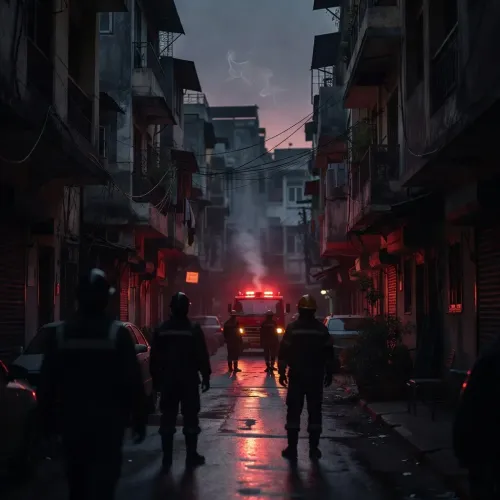
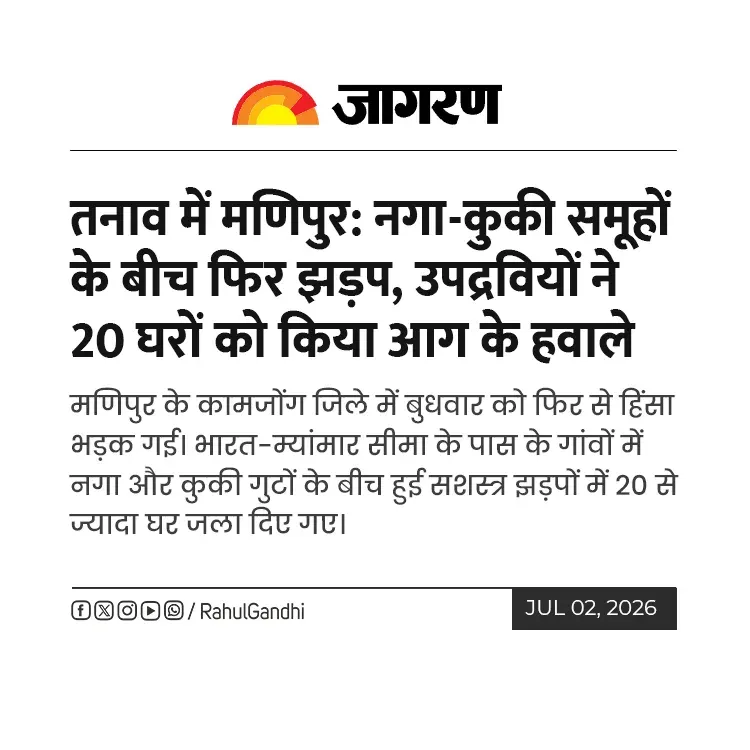
Congress leader Rahul Gandhi on 2 July 2026 condemned the burning of 20 homes in Manipur, saying the state has been engulfed in ethnic violence for years and that the conflict has deepened despite two governments and the imposition of President's rule.
Key Takeaways
Rahul Gandhi posted on 2 July 2026 condemning fresh violence in Manipur in which 20 homes were reported burned.
Gandhi stated that thousands have lost their lives and countless families have been displaced since the conflict began.
He noted that the violence has persisted through two governments and the imposition of President's rule under Article 356.
Ethnic clashes between Meitei and Kuki-Zo communities in Manipur first erupted in May 2023 following a High Court order on Scheduled Tribe status.
The opposition is expected to raise the issue in the upcoming monsoon session of Parliament .
Congress leader Rahul Gandhi on Thursday, 2 July 2026, condemned the continuing ethnic violence in Manipur, stating that 20 more homes had been reduced to ash in fresh clashes, and calling the state's suffering 'unimaginable' despite multiple changes in administration and the imposition of President's rule.
Posting in Hindi, Gandhi wrote: 'मणिपुर सालों से जल रहा है, और आज फिर नफ़रत और हिंसा की आग में 20 घर राख हो गए' — 'Manipur has been burning for years, and today once again 20 homes have been turned to ash in the fire of hatred and violence.' He added that thousands had lost their lives and countless families had been uprooted.
Context
Ethnic violence in Manipur erupted in May 2023 after a High Court directive on Scheduled Tribe status for the Meitei community triggered widespread clashes with Kuki-Zo communities in the hill districts. The conflict has since resulted in large-scale loss of life, displacement of tens of thousands of residents, and destruction of homes and places of worship across the state.
The violence persisted through multiple phases of central and state-level intervention. N. Biren Singh, the BJP Chief Minister whose tenure coincided with the initial years of the conflict, faced sustained criticism over the state government's inability to restore peace. The Centre subsequently imposed President's rule under Article 356 of the Constitution, placing the state under direct central administration.
Policy Backdrop
President's rule is a constitutional provision invoked when an elected state government is deemed to have failed to govern in accordance with constitutional provisions. Its imposition in Manipur was presented as a measure to restore order after years of ethnic strife that the state machinery had been unable to contain.
Gandhi's post pointedly notes that 'दो सरकारों और राष्ट्रपति शासन के बावजूद संघर्ष गहराता ही जा रहा है' — 'despite two governments and President's rule, the conflict continues to deepen.' This framing positions the violence not as a law-and-order failure of a single administration but as a systemic governance breakdown across multiple regimes, placing accountability squarely on the central government.
Stakeholders and Impact
The two primary communities at the centre of the conflict — the Meitei population concentrated in the Imphal Valley and the Kuki-Zo communities in the hill districts — have both suffered severe humanitarian losses. Homes, churches, temples, and entire villages have been burned in successive waves of violence, with relief camps housing large numbers of internally displaced persons across the state.
Gandhi's intervention signals that Manipur will remain a major political flashpoint for the opposition in Parliament. The issue has featured in previous sessions of the Lok Sabha and the Rajya Sabha, with the opposition demanding a statement from the Prime Minister and a debate on the floor of the House.
What's Next
Attention will now turn to whether the central government responds to the latest incident with a fresh statement on peace talks or a rehabilitation package for displaced families. Any announcement on lifting or extending President's rule in Manipur will be closely watched, as will references to the state's situation in the upcoming monsoon session of Parliament.
With the opposition keeping the issue alive through high-profile social media interventions and parliamentary manoeuvres, the humanitarian and political crisis in Manipur shows no sign of fading from the national agenda.
Point of View
' a formulation designed to neutralise the BJP's counter-argument that the Congress-era administration shares blame. By invoking President's rule as evidence of failure rather than remedy, the opposition is attempting to shift the burden of accountability entirely onto the current central dispensation. Manipur has become a durable pressure point for the opposition, and sustained social media engagement keeps it on the national agenda between parliamentary sessions. The humanitarian framing — homes, families, unimaginable suffering — is also a deliberate attempt to move the discourse beyond ethnic fault lines and towards a universal accountability argument.
NationPress
2 Jul 2026
Frequently Asked Questions
Why is Manipur still experiencing violence in 2026?
Ethnic clashes between the Meitei community in the Imphal Valley and Kuki-Zo communities in the hill districts of Manipur began in May 2023 and have continued despite state and central government interventions, including the imposition of President's rule under Article 356 of the Constitution.
What did Rahul Gandhi say about Manipur on 2 July 2026?
Rahul Gandhi posted on X condemning the burning of 20 homes in fresh violence, saying Manipur has been burning for years and that thousands have lost their lives and countless families have been displaced, despite two governments and President's rule failing to end the conflict.
What is President's rule and why was it imposed in Manipur?
President's rule is a constitutional provision under Article 356 by which the central government takes direct control of a state when the elected administration is deemed to have failed. It was imposed in Manipur after the state government was unable to contain sustained ethnic violence.
Who are the communities involved in the Manipur ethnic conflict?
The primary communities are the Meitei people, who are predominantly Hindu and live in the Imphal Valley, and the Kuki-Zo communities, who are predominantly Christian and live in the hill districts. Tensions escalated after a 2023 High Court directive on Scheduled Tribe status for Meiteis.
Will Manipur be raised in Parliament?
Manipur has been a recurring subject in both the Lok Sabha and the Rajya Sabha since 2023. With the opposition continuing to highlight fresh incidents, the issue is expected to feature prominently in the upcoming monsoon session of Parliament.