Rajasthan Chief Secretary meets UNESCO on AI Ethics course for public officials
Synopsis
Rajasthan is moving beyond policy paperwork on AI — Chief Secretary V. Srinivas sat down with UNESCO in Jaipur to discuss a structured ethics-and-capacity course for state officials, aligned with the Rajasthan AI/ML Policy 2026. It is a rare instance of an Indian state pursuing a formal multilateral framework to train its bureaucracy on responsible AI use.
Key Takeaways
Rajasthan Chief Secretary V.
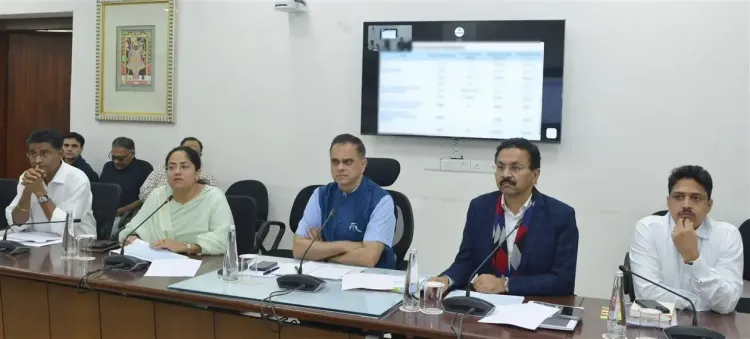
Srinivas met a UNESCO delegation on 13 November 2026 in Jaipur to discuss an AI Ethics course for state officials.
The UNESCO -designed course will focus on ethical, transparent and accountable use of AI in governance and public administration.
The initiative is aligned with the Rajasthan AI/ML Policy 2026 , which promotes AI adoption across government sectors.
The collaboration is expected to give officials access to globally recognised expertise and AI-based governance frameworks.
Implementation details, including the rollout timeline and number of officials to be trained, are yet to be formally announced.
Rajasthan Chief Secretary V. Srinivas on 13 November 2026 held a high-level meeting with a UNESCO delegation in Jaipur to discuss the rollout of a globally recognised course on the Ethics of Artificial Intelligence, designed to equip state government officials with the knowledge, skills and competencies required for the responsible and effective use of AI in governance and public administration.
What the UNESCO Course Covers
The proposed course, developed by UNESCO, is aimed at building institutional capacity among public officials to adopt AI and emerging technologies in ways that are ethical, transparent, accountable and inclusive. It will familiarise participants with the practical applications of AI in government functioning, including its potential to improve administrative processes, enhance decision-making and strengthen public service delivery.
Crucially, the curriculum is designed to ensure that technological advancement in governance remains aligned with ethical principles and public interest — not just operational efficiency. Emphasis will be placed on responsible AI practices and governance standards as guardrails for adoption.
Alignment with Rajasthan AI/ML Policy 2026
The initiative is directly aligned with the Rajasthan AI/ML Policy 2026, which envisions the broad adoption of Artificial Intelligence and Machine Learning across sectors including government administration. The collaboration with UNESCO is intended to give Rajasthan's public officials access to internationally recognised expertise and learning frameworks, enabling them to apply AI-based solutions more effectively in their respective domains.
Notably, this makes Rajasthan one of the early Indian states to pursue a structured, multilateral capacity-building programme on AI ethics specifically for its bureaucratic cadre — a step beyond ad hoc digital skilling initiatives seen elsewhere.
Expected Impact on Governance
Officials and observers expect the initiative to strengthen the institutional capacity of the Rajasthan state government, promoting informed and responsible use of emerging technologies while facilitating the integration of AI into day-to-day governance processes. The programme is also expected to make public administration more efficient, responsive and citizen-centric.
This comes amid a broader national push to integrate AI into government functioning, with the Centre's own frameworks encouraging states to develop tailored AI strategies. Rajasthan's engagement with UNESCO adds a multilateral dimension rarely seen at the state level.
What Comes Next
The specifics of a rollout timeline, the number of officials to be trained and the modalities of course delivery are yet to be formally announced. The meeting between Chief Secretary V. Srinivas and the UNESCO delegation is understood to be an early-stage consultative step, with implementation details to follow. Stakeholders will be watching whether the initiative translates into a structured, time-bound training programme or remains a framework-level collaboration.
Point of View
But the proof will be in execution. India's digital governance push has repeatedly produced policy documents and MoUs with little follow-through on structured, outcome-linked training. The key question is whether this meeting leads to a mandatory, time-bound programme with measurable competency benchmarks — or becomes another line in an annual report. Bringing UNESCO's global framework to a state-level context is genuinely novel; ensuring it sticks requires political will and budgetary commitment that a single consultative meeting cannot guarantee.
NationPress
14 Nov 2026
Frequently Asked Questions
What was the UNESCO-Rajasthan meeting about?
Rajasthan Chief Secretary V. Srinivas met a UNESCO delegation on 13 November 2026 to discuss implementing a globally recognised course on the Ethics of Artificial Intelligence for state government officials. The meeting focused on building capacity for the ethical and responsible use of AI in governance and public administration.
What will the UNESCO AI Ethics course cover?
The course, designed by UNESCO, will cover the practical applications of AI in government, responsible AI practices, ethical governance standards, and the opportunities and challenges of AI in public administration. It aims to make officials capable of applying AI-based solutions in an accountable and citizen-centric manner.
How does this initiative connect to the Rajasthan AI/ML Policy 2026?
The UNESCO collaboration is directly aligned with the Rajasthan AI/ML Policy 2026, which envisages promoting AI and Machine Learning adoption across various sectors including government administration. The course is intended to operationalise the policy's goals through structured capacity building.
Who will benefit from the AI Ethics training programme?
The primary beneficiaries are Rajasthan state government officials across departments. The course aims to equip public servants with the knowledge and skills to adopt AI tools in administrative processes, decision-making and public service delivery in an ethical and responsible manner.
When will the AI Ethics course for Rajasthan officials be launched?
A formal rollout timeline has not yet been announced. The 13 November meeting between Chief Secretary V. Srinivas and the UNESCO delegation is understood to be a consultative step, with implementation modalities and scheduling expected to be detailed in subsequent discussions.