Rajnath Singh flags India's indigenous defence surge
Synopsis
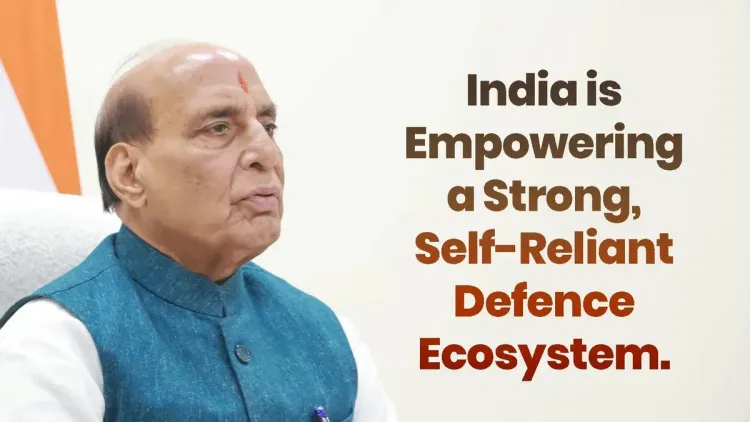
Union Defence Minister Rajnath Singh on 15 November 2026 highlighted India's growing indigenous capabilities in missiles, naval platforms, aerospace, radar and space, crediting scientists, engineers and industry partners for driving a more self-reliant defence future.
Key Takeaways
Rajnath Singh credited India's scientists, engineers and industry partners for advances in five domains: missiles, naval platforms, aerospace, radar and space.
The Atmanirbhar Bharat Abhiyan (2020) and Defence Acquisition Procedure 2020 form the policy foundation for India's indigenisation drive.
Successive Positive Indigenisation Lists from 2021 onward have banned the import of identified weapons systems and platforms.
DRDO and ISRO are central to India's domestic missile, radar, aerospace and dual-use space capabilities.
The shift from state-led to public-private partnerships has broadened and accelerated India's domestic defence production ecosystem.
Reducing import dependence is framed as a strategic autonomy objective, not merely an economic one.
From missiles to spacecraft, India's defence technology ecosystem is undergoing a generational shift — and Union Defence Minister Rajnath Singh wants the world to notice. On Sunday, 15 November 2026, the minister took to X to underscore how the country's scientists, engineers and industry partners are collectively powering a more self-reliant national security architecture.
Singh's post cited advances across five distinct domains — missile development, naval platforms, aerospace engineering, radar systems and space applications — framing them not as isolated wins but as converging proof of a coherent strategic direction. 'India's growing indigenous capabilities across missile development, naval platforms, aerospace engineering, radar systems and space applications are driving the nation towards a stronger, more self-reliant defence future,' the minister wrote.
The policy scaffolding behind the claim
The statement lands against a well-defined policy backdrop. The Atmanirbhar Bharat Abhiyan, launched in 2020, placed defence manufacturing at the heart of India's self-reliance agenda. The Defence Acquisition Procedure 2020 followed, structurally prioritising domestic design and production over import contracts. Then came successive Positive Indigenisation Lists — beginning in 2021 — that outright banned the import of identified weapons systems and platforms, forcing the armed forces and industry to source from within.
Together, these measures created both a mandate and a market for domestic defence producers. DRDO, the government's primary research and development agency, sits at the core of missile, radar and aerospace programmes. ISRO's satellite and launch capabilities increasingly overlap with defence requirements, blurring the line between civilian space ambition and strategic utility.
Scientists, engineers and the industry ecosystem
Singh's deliberate mention of scientists, engineers and industry partners signals something beyond bureaucratic credit-sharing. It reflects a structural reality: India's indigenisation push has moved from state-owned laboratories to a widening public-private partnership model. Private sector firms now participate in areas that were once the exclusive domain of government entities, accelerating development timelines and introducing competitive pressure.
The five domains named in the post — missiles, naval vessels, aerospace, radars and space — are precisely the high-complexity, high-stakes segments where import dependence had historically been most acute and most strategically uncomfortable.
What the indigenisation push means for India's strategic posture
Reducing import dependence is not merely an economic calculation. For a country that for decades ranked among the world's largest arms importers, the ability to design, build and sustain its own systems carries direct implications for strategic autonomy — the freedom to act without being constrained by a supplier nation's foreign policy preferences. Singh's framing of a 'stronger, more self-reliant defence future' maps directly onto that logic.
The next concrete milestones to watch include the next tranche of indigenisation lists, major platform induction ceremonies, and defence R&D budget allocations — each of which will test whether the momentum Singh describes is accelerating or plateauing.
India's defence transformation is no longer a promise on a policy document. It is, by the minister's own account, a process already in motion — driven by the people building it, one platform at a time.
Point of View
Showcasing indigenous capability also serves a domestic political purpose: associating the party's governance record with tangible national security progress. The harder test will come in independent assessments of indigenisation ratios and operational induction timelines — metrics that will determine whether the narrative holds.
NationPress
15 Nov 2026
Frequently Asked Questions
What is India's Atmanirbhar Bharat defence policy?
Atmanirbhar Bharat Abhiyan, launched in 2020, is a national self-reliance initiative with a dedicated defence component that prioritises indigenous design, development and production of weapons systems over imports, backed by reformed procurement procedures and Positive Indigenisation Lists.
What are India's Positive Indigenisation Lists?
Positive Indigenisation Lists, introduced from 2021 onward, are government-notified catalogues of weapons systems and platforms whose import is banned, requiring the armed forces to source them from domestic manufacturers instead.
What role does DRDO play in India's indigenous defence efforts?
DRDO is India's primary government defence research and development agency, leading programmes in missile systems, radar technology, aerospace engineering and other high-complexity domains central to the indigenisation drive.
How is ISRO involved in India's defence capabilities?
ISRO's satellite and launch technologies increasingly serve dual-use defence applications, including communications, reconnaissance and navigation, making it a key contributor to India's strategic space capability.
What did Rajnath Singh say about India's defence capabilities?
On 15 November 2026, Defence Minister Rajnath Singh stated that India's growing indigenous capabilities across missile development, naval platforms, aerospace engineering, radar systems and space applications are driving the nation toward a stronger, more self-reliant defence future.