Rajnath Singh: IITs key to cutting-edge indigenous defence tech
Synopsis
Defence Minister Rajnath Singh didn't just attend a fundraiser — he signalled a strategic shift. At IIT Kanpur's $1 billion campaign launch, he revealed that a National Military Drone Technology Hub at the institute is nearing Cabinet approval, while endorsing a new School of Defence Technology. With ₹4,155 crore already committed, academia is moving closer to the front lines of India's defence build-out.
Key Takeaways
Defence Minister Rajnath Singh addressed the launch of IIT Kanpur's Greater Than Us campaign on 14 October 2026 in New Delhi .
The campaign targets $1 billion by March 2029 ; ₹4,155 crore — nearly half — has already been committed.
A National Military Drone Technology Hub at IIT Kanpur, in collaboration with the Ministry of Defence , is reportedly nearing approval.
Singh endorsed a proposed School of Defence Technology at IIT Kanpur to deepen defence-academia collaboration.
The IIT ecosystem supports over 6,000 start-ups , 56 unicorns , and nearly 5,000 patents , according to the minister.
The government has approved a ₹1 lakh crore Research, Development and Innovation Scheme to catalyse private-sector R&D investment.
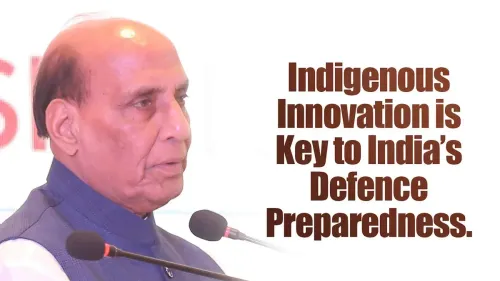
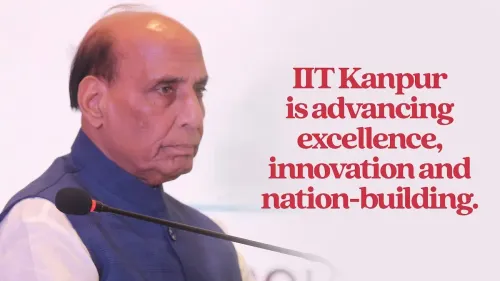
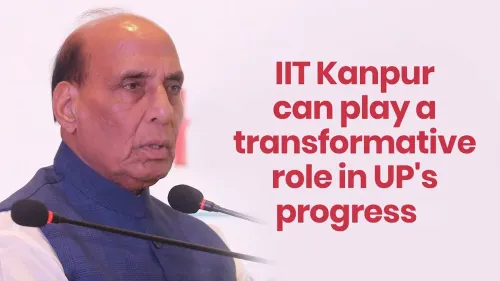
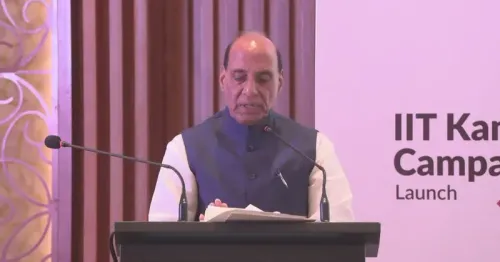
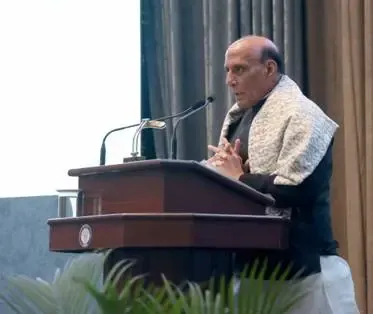
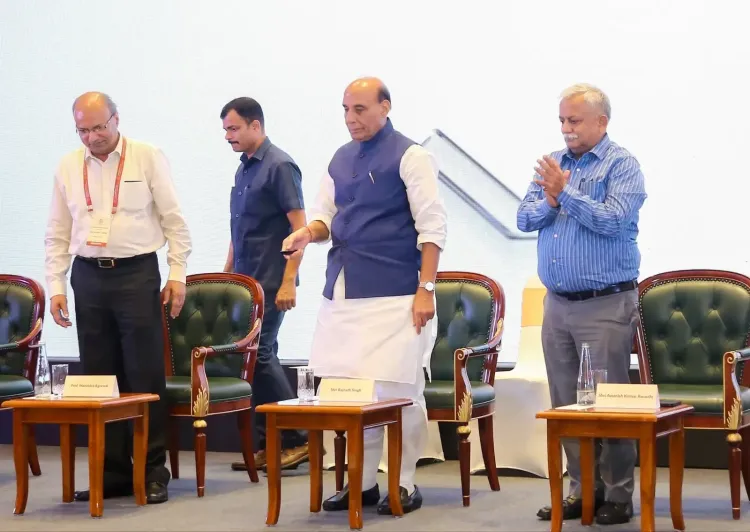
Defence Minister Rajnath Singh on Wednesday, 14 October 2026, called on India's Indian Institutes of Technology (IITs) to play a pivotal role in building the country's indigenous defence capabilities, saying that bridging academic research with the operational needs of the armed forces and industry had become a strategic imperative. He made the remarks in New Delhi at the launch of IIT Kanpur's Greater Than Us fundraising campaign, which aims to raise $1 billion by March 2029.
Campaign Already Halfway to Its Target
The Greater Than Us campaign has already secured commitments of ₹4,155 crore — nearly half the stated goal — from alumni, donors, corporate partners, and government sources. The campaign is framed as a national institution-building exercise, not merely a fundraise, with contributions channelled toward research, innovation, and infrastructure at IIT Kanpur.
Why Defence Technology Needs Academia
Singh underscored that emerging technologies — artificial intelligence, autonomous systems, unmanned platforms, advanced sensors, cybersecurity, and space-based technologies — are fundamentally reshaping military dynamics globally. 'In this environment, our ability to develop, adopt, and continuously appraise technology indigenously is of strategic importance. This requires close collaboration among the armed forces, DRDO, academic institutions, defence public sector undertakings, private industry, and startups,' the minister said.
He cited the DRDO Industry-Academia Centre of Excellence at IIT Kanpur as a working model of this inter-institutional approach. Notably, the institute's proposal to establish a School of Defence Technology also drew the minister's explicit endorsement.
National Military Drone Hub Nears Approval
Among the more consequential disclosures, Singh confirmed that a proposal to set up a National Military Drone Technology Hub at IIT Kanpur, developed in collaboration with the Ministry of Defence, has made significant progress and that its approval process is 'nearing completion.' The hub is intended to fast-track indigenisation and innovation for combat advantage — reflecting a broader push to reduce India's dependence on imported defence platforms.
Singh also highlighted the institute's C3i Cybersecurity Technology Innovation Hub and its medical school as significant contributions to cybersecurity and healthcare technology innovation respectively.
IIT Ecosystem and the Aatmanirbhar Bharat Vision
Placing the campaign within the government's larger policy narrative, Singh said the Narendra Modi-led government's Aatmanirbhar Bharat commitment sits at the core of its Viksit Bharat vision — building a nation that is not merely a consumer of knowledge and technology but an active contributor to their creation. He pointed to the IIT ecosystem's track record of supporting over 6,000 start-ups, 56 unicorns, and nearly 5,000 patents as evidence of growing institutional depth.
He also referenced the government's approved ₹1 lakh crore Research, Development and Innovation Scheme as a structural lever to catalyse private-sector investment in advanced technologies. 'While public policy can create an enabling environment, institutions must nurture talent and generate ideas, and industry must help translate innovations into practical applications and scale them up,' he said.
What Comes Next
With the drone hub approval reportedly close to finalisation and the School of Defence Technology proposal gaining ministerial backing, IIT Kanpur appears set to become a more direct node in India's defence research architecture. The coming months will test whether institutional ambition and government intent translate into funded, operational programmes — the gap where past defence-academia partnerships have often stalled.
Point of View
It would represent a rare instance of a defence-specific R&D facility embedded within a civilian university. The harder question is execution. India's defence-academia collaboration history is littered with well-announced centres that produced papers rather than platforms. The DRDO-Industry-Academia model has existed for years without producing a single deployable system at scale. Whether the School of Defence Technology and the drone hub avoid that fate depends on sustained funding, classified access protocols, and a procurement pipeline willing to absorb early-stage academic output — none of which have been detailed yet.
NationPress
14 Oct 2026
Frequently Asked Questions
What is IIT Kanpur's Greater Than Us campaign?
It is a fundraising initiative by IIT Kanpur targeting $1 billion by March 2029 to build research, innovation, and infrastructure at the institute. As of 14 October 2026, ₹4,155 crore — nearly half the goal — has already been committed by alumni, donors, corporate partners, and government sources.
What is the National Military Drone Technology Hub at IIT Kanpur?
It is a proposed facility to be set up at IIT Kanpur in collaboration with the Ministry of Defence, aimed at fast-tracking indigenisation and innovation in military drone technology for combat advantage. Defence Minister Rajnath Singh confirmed on 14 October 2026 that the approval process is nearing completion.
Why is Rajnath Singh pushing for IIT involvement in defence research?
Singh argued that emerging technologies such as AI, autonomous systems, cybersecurity, and space-based platforms are reshaping military dynamics, making indigenous development capacity strategically essential. He said close collaboration among the armed forces, DRDO, academic institutions, and industry is now a national security requirement, not an option.
What is the ₹1 lakh crore Research, Development and Innovation Scheme?
It is a government-approved scheme designed to catalyse private-sector investment in research and advanced technologies. Singh cited it as part of the enabling policy environment the Centre is building to complement institutional and industry-led innovation efforts.
What other defence and research initiatives exist at IIT Kanpur?
IIT Kanpur already hosts the DRDO Industry-Academia Centre of Excellence and the C3i Cybersecurity Technology Innovation Hub, both cited by Singh as active models of defence-academia collaboration. The institute also has a medical school focused on healthcare and medical technology innovation.