Rajnath Singh pays tribute to poet Nirala on death anniversary
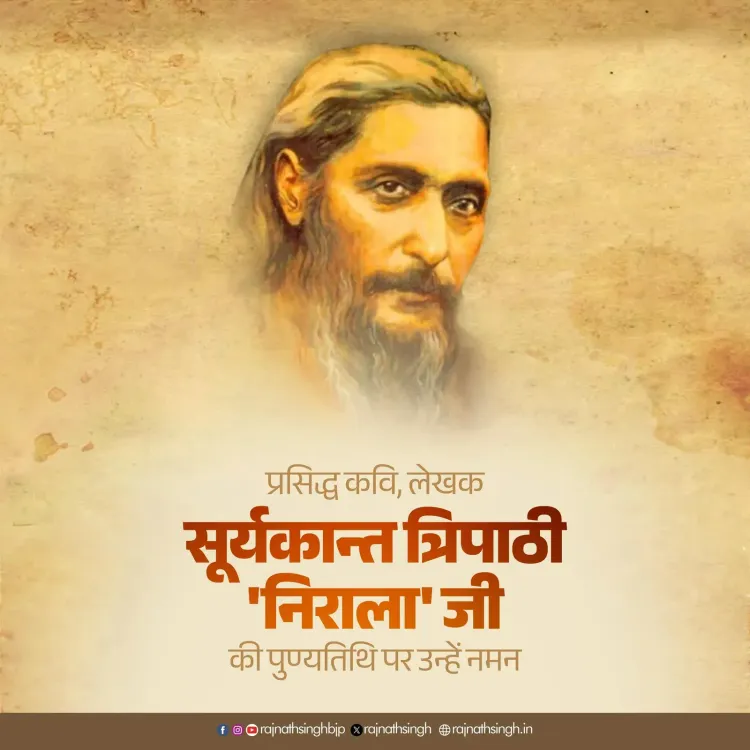
Synopsis
Union Defence Minister Rajnath Singh honoured Hindi poet Suryakant Tripathi 'Nirala' on his death anniversary, praising the Chhayavad pioneer's spirit of rebellion, humanism, and commitment to free expression that reshaped Hindi literature in the twentieth century.
Key Takeaways
Rajnath Singh posted a Hindi tribute to poet Suryakant Tripathi 'Nirala' on his death anniversary on 15 October 2026 .
Nirala ( 1896–1961 ) was a foundational figure of the Chhayavad movement and a pioneer of free verse in Hindi poetry.
Singh highlighted Nirala's 'voice of rebellion, depth of human sensitivity, and firm assertion of self-respect' as enduring inspirations.
Nirala's works, including Ram ki Shakti Puja , are celebrated for blending mythological grandeur with social critique.
Senior Indian political leaders routinely mark anniversaries of canonical literary figures as an assertion of Hindi cultural heritage.
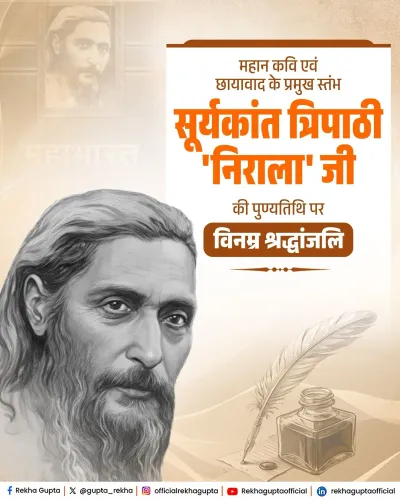
A voice of rebellion, humanism, and unyielding self-respect — Suryakant Tripathi 'Nirala' shaped the Hindi literary imagination like few others, and on his death anniversary, Union Defence Minister Rajnath Singh paused to honour that legacy on Thursday, 15 October 2026.
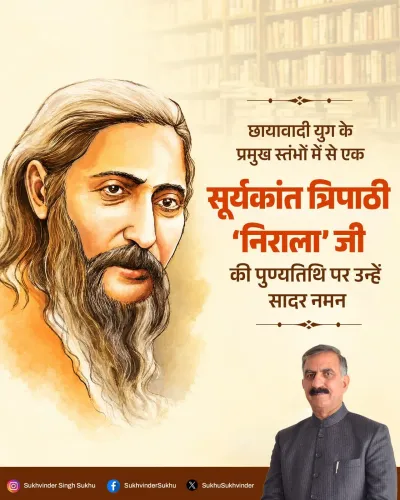
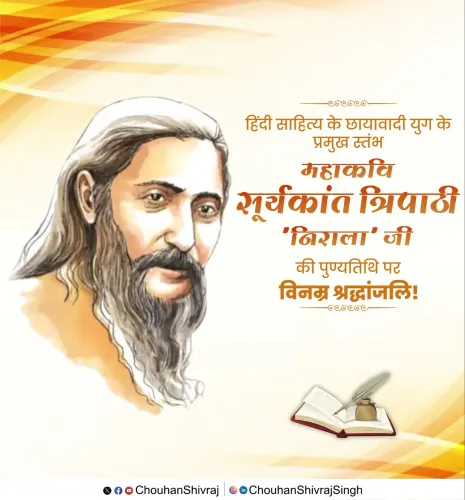
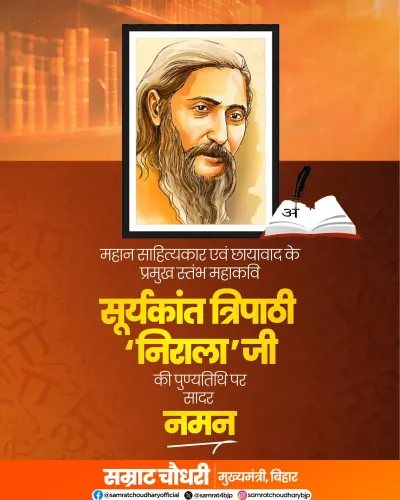
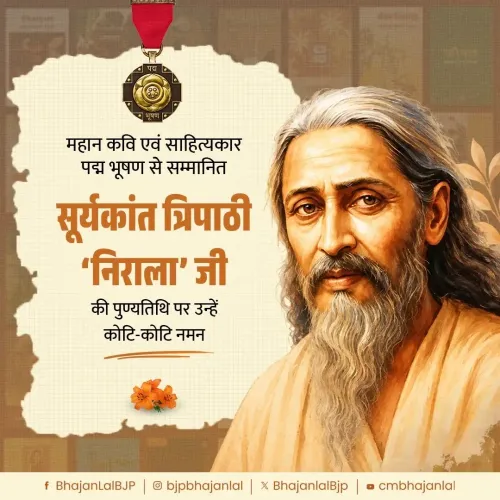
In a post in Hindi, Singh offered his respectful tribute, writing: 'हिंदी साहित्य के महान कवि एवं छायावाद के प्रमुख स्तंभ सूर्यकांत त्रिपाठी 'निराला' जी की पुण्यतिथि पर उन्हें विनम्र श्रद्धांजलि' — 'A humble tribute to Suryakant Tripathi Nirala, the great poet of Hindi literature and a principal pillar of Chhayavad, on his death anniversary.' Singh noted that Nirala gave Hindi literature 'a new direction and a distinct identity' through his vigorous writing and original thought, and that his works carry 'the voice of rebellion, the depth of human sensitivity, and a firm assertion of self-respect.'
Nirala and the Chhayavad revolution in Hindi verse
Suryakant Tripathi 'Nirala' (1896–1961) was one of the four towering figures of the Chhayavad movement — Hindi poetry's romantic, mystical, and nationalist flourishing in the early twentieth century. He broke from the rigid metrical conventions of his era, pioneering free verse in Hindi at a time when the form was barely accepted. His landmark composition Ram ki Shakti Puja remains a celebrated fusion of mythological grandeur and deeply personal anguish.
What set Nirala apart was the uncompromising social edge beneath the lyricism. He wrote against caste discrimination, poverty, and colonial subjugation — concerns that give his verses a relevance that outlasts their literary-historical moment. Singh's tribute specifically underlines how Nirala's ideas and works 'continue to inspire free thought, fearless expression, and a commitment to human dignity.'
Why political leaders mark literary anniversaries
Singh's tribute follows a long-standing pattern among senior Indian leaders of publicly honouring the death and birth anniversaries of canonical Hindi literary figures. These gestures serve as an assertion of Hindi linguistic and cultural heritage at a national level — and in Singh's case carry particular resonance given his own roots in Uttar Pradesh, the heartland of Awadhi and Khari Boli literary tradition within which Nirala worked and lived.
Nirala spent his final years in Allahabad (now Prayagraj), a city that became the crucible of the Chhayavad movement, and died in 1961 in relative poverty — a biographical detail that has long made him a symbol of the artist unbroken by circumstance.
Every October, literary institutions and universities across northern India mark his death anniversary with readings, seminars, and new scholarly editions of his work — a tradition that shows no sign of fading.
Point of View
A cultural strand central to the party's broader civilisational-identity politics. Nirala's own biography — a defiant, poverty-stricken poet who wrote against caste and colonial power — gives the tribute a layered texture: the minister invokes both literary canonisation and the poet's radical social consciousness. For a leader with deep UP roots, honouring the Allahabad-based Chhayavad pillar also carries regional resonance that resonates well beyond Delhi drawing rooms. The ritual of political tribute to literary icons remains a durable soft-power instrument in Indian public life.
NationPress
15 Oct 2026
Frequently Asked Questions
Who was Suryakant Tripathi 'Nirala'?
Suryakant Tripathi 'Nirala' (1896–1961) was a leading Hindi poet and one of the principal figures of the Chhayavad movement, known for pioneering free verse in Hindi and for works that blended lyricism with themes of social rebellion and human dignity.
When is Nirala's death anniversary?
Nirala's death anniversary falls on 15 October, the date of his passing in 1961. It is widely observed by literary institutions across India, particularly in Uttar Pradesh.
What is the Chhayavad movement in Hindi literature?
Chhayavad was a major movement in Hindi poetry in the early twentieth century characterised by romanticism, mysticism, nationalism, and a break from classical metrical rigidity. Its four main poets were Nirala, Jaishankar Prasad, Sumitranandan Pant, and Mahadevi Varma.
What did Rajnath Singh say about Nirala?
Singh said Nirala gave Hindi literature 'a new direction and a distinct identity' through his vigorous writing and original thought, and that his works — carrying the voice of rebellion, human sensitivity, and self-respect — continue to inspire free thought and fearless expression.
What are Nirala's most famous works?
'Ram ki Shakti Puja' is among his most celebrated poems, a fusion of mythological narrative and personal emotion. He also wrote the poems 'Saroj Smriti' and 'Kukurmutta', and several novels and essays that cemented his standing as one of Hindi literature's most versatile voices.