Amit Shah orders '360-Degree Security Grid' along India-Pak border in Bikaner review

Synopsis
Home Minister Amit Shah's Bikaner meeting went beyond routine security review — it mandated a 360-degree grid fusing civilians, state machinery, and central agencies, ordered demolition of all illegal structures within 15 km of the India-Pakistan border, and expanded District Magistrates' powers to target terror financing, mule accounts, and fraudulent Aadhaar cards. A sweeping operational reset for Rajasthan's frontier districts.
Key Takeaways
Home Minister Amit Shah chaired a high-level border security review in Bikaner on Tuesday, 27 May 2025 .
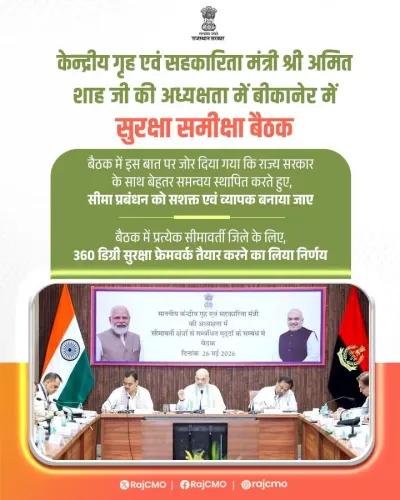
A '360-degree security grid' was ordered for every border district, integrating residents, state machinery, and central agencies.
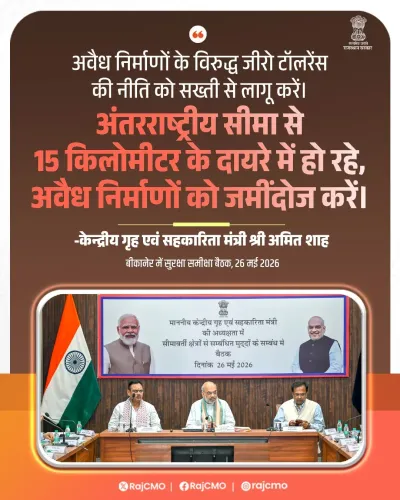
Authorities directed to demolish all unauthorised structures within a 15-km radius of the India-Pakistan International Border .
BSF, CBDT, NCB and state agencies mandated to coordinate against infiltration, narcotics trafficking, and terror financing.
District Magistrates assigned expanded powers to monitor mule accounts, shell companies, and fraudulent Aadhaar cards .
Special focus on Vibrant Villages Programme-II (VVP-II) to ensure development and governance in border villages.
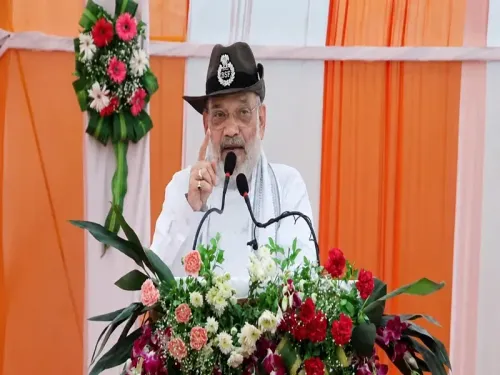
Union Home Minister Amit Shah on Tuesday, 27 May chaired a high-level security review meeting in Bikaner, Rajasthan, directing the formulation of a '360-degree security grid' for every district along the India-Pakistan International Border. The meeting, attended by senior central and state officials, signals a sharper operational focus on border management in the wake of heightened cross-border tensions.
Key Decisions from the Bikaner Meeting
The most consequential directive from the meeting was the creation of a 360-degree security grid — a framework designed to integrate local residents, state government machinery, and all central security agencies into a unified border management system. Rajasthan Chief Minister Bhajan Lal Sharma was present alongside District Magistrates and Superintendents of Police from Bikaner, Jaisalmer, Barmer, Sri Ganganagar, and Phalodi districts.
Shah also ordered strict enforcement of a zero-tolerance policy against illegal constructions, directing authorities to demolish all unauthorised structures within a 15-km radius of the International Border.
Inter-Agency Coordination Mandated
Emphasising the need for seamless coordination, Shah directed the Border Security Force (BSF), Central Board of Direct Taxes (CBDT), Narcotics Control Bureau (NCB), and state agencies to work in close concert to counter infiltration, narcotics trafficking, terror financing, and other cross-border crimes. This is not a routine administrative exercise — it represents a structural attempt to close coordination gaps that have historically allowed smuggling and infiltration networks to exploit inter-agency blind spots.
Enhanced Responsibilities for District Magistrates
Shah assigned expanded duties to District Magistrates, directing them to ensure legal and financial compliance by banks, scrutinise major business establishments and their funding sources, monitor mule accounts and shell companies, identify fraudulent Aadhaar cards, and intensify action against smuggling networks. Officials were also instructed to effectively utilise the '1930' cybercrime helpline for prompt response to cyber offences.
The Home Minister stressed robust implementation of India's three new criminal laws to strengthen law enforcement and judicial processes across border districts.
Vibrant Villages Programme-II in Focus
Special emphasis was placed on the Vibrant Villages Programme-II (VVP-II) in border regions. The initiative aims to strengthen grassroots governance, bridge infrastructure gaps, prevent economic crimes, and ensure holistic development of border villages — an acknowledgment that security alone cannot stabilise frontier communities without parallel developmental investment.
The meeting also underscored the need to achieve 100 per cent saturation of all government schemes in border areas. With the Centre doubling down on both hard security measures and soft developmental outreach, Rajasthan's border districts are set for intensified administrative and security attention in the months ahead.
Point of View
But the devil is in execution: past coordination mandates between BSF, state police, and revenue agencies have often dissolved into turf friction. The expansion of District Magistrates' financial surveillance powers is notable; it reflects a growing Centre-level recognition that cross-border crime is as much a financial network problem as a physical one. Whether the 15-km demolition order will be enforced uniformly — or selectively — will be the real test of political will.
NationPress
10 Oct 2026
Frequently Asked Questions
What is the '360-degree security grid' ordered by Amit Shah?
It is a comprehensive border management framework directed by Home Minister Amit Shah during a security review in Bikaner on 27 May 2025. The grid mandates coordinated participation of local residents, state government machinery, and all central security agencies to create a unified and effective border management system for every district along the India-Pakistan International Border.
Why was the security review meeting held in Bikaner?
The meeting was held in Bikaner to assess and strengthen security arrangements along the India-Pakistan International Border in Rajasthan. It covered five border districts — Bikaner, Jaisalmer, Barmer, Sri Ganganagar, and Phalodi — and came amid heightened focus on cross-border threats including infiltration, narcotics trafficking, and terror financing.
What is the 15-km demolition order along the India-Pakistan border?
Home Minister Amit Shah directed authorities to enforce a zero-tolerance policy against illegal constructions and to demolish all unauthorised structures located within a 15-km radius of the International Border. The order is aimed at removing potential cover for cross-border criminal and infiltration activity.
What new responsibilities have been given to District Magistrates in border districts?
District Magistrates have been directed to ensure legal and financial compliance by banks, scrutinise major business establishments and their funding sources, monitor mule accounts and shell companies, identify fraudulent Aadhaar cards, and strengthen action against smuggling networks. They are also expected to utilise the '1930' cybercrime helpline for prompt response to cyber offences.
What is the Vibrant Villages Programme-II and why was it highlighted?
The Vibrant Villages Programme-II (VVP-II) is a Central government initiative aimed at strengthening grassroots governance, bridging infrastructure gaps, preventing economic crimes, and ensuring holistic development of border villages. It was highlighted at the Bikaner meeting as a complementary developmental strategy alongside hard security measures, recognising that stable border communities are a long-term security asset.