Could the SHANTI Bill Revolutionize India's Nuclear Power?
Synopsis
The introduction of the SHANTI Bill is set to transform India's nuclear energy landscape by facilitating private sector participation and aiming for a massive increase in nuclear capacity by 2047. This legislation not only modernizes regulatory frameworks but also aligns with India's ambitious climate and energy goals.
Key Takeaways
SHANTI Bill aims for 100 GW nuclear capacity by 2047.
Proposes comprehensive legislation to replace outdated laws.
Encourages private sector participation in nuclear energy.
Aligns with India's climate and energy goals.
Focus on safety and regulatory frameworks for nuclear energy.
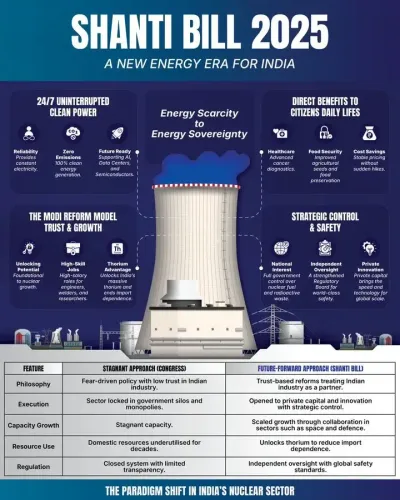
New Delhi, Dec 15 (NationPress) Union Minister of State for Science and Technology Jitendra Singh presented the Sustainable Harnessing and Advancement of Nuclear Energy for Transforming India (SHANTI) Bill, 2025, in Parliament on Monday. This initiative marks a significant move to allow private sector participation in the nuclear industry, aimed at achieving 100 gigawatt (GW) of nuclear power capacity by 2047.
The proposed legislation seeks to nullify the Atomic Energy Act, 1962, and the Civil Liability for Nuclear Damage Act, 2010, replacing them with a singular, cohesive law that meets India’s current and future energy demands.
As outlined in the Bill’s rationale, ongoing research and development have enabled India to achieve self-sufficiency in the nuclear fuel cycle and manage its nuclear power program responsibly. With this solid foundation, the government envisions a substantial increase in nuclear capacity to enhance clean energy security and provide dependable round-the-clock power for emerging requirements such as data centers and future-ready applications.
The proposed legislation aligns closely with India’s long-term energy and climate objectives, detailing a roadmap for decarbonization by 2070. To fulfill these goals, the Bill underscores the importance of more fully utilizing domestic nuclear resources and promoting active involvement from both public and private sectors, while positioning India as a key player in the global nuclear energy landscape.
At an operational level, the Bill establishes guidelines for licensing and safety authorization for designated individuals engaged in nuclear energy production or usage, along with explicit grounds for suspension or cancellation. It aims to regulate the application of nuclear and radiation technologies across sectors such as healthcare, agriculture, industry, and research, while exempting research, development, and innovation activities from licensing mandates, as per an official statement.
The Bill also proposes a modernized civil liability framework for nuclear damage, grants legal status to the Atomic Energy Regulatory Board, and fortifies safety, security, safeguards, quality assurance, and emergency preparedness mechanisms. It includes provisions for the establishment of new institutional frameworks, such as an Atomic Energy Redressal Advisory Council, Claims Commissioners, and a Nuclear Damage Claims Commission for severe nuclear damage incidents, with the Appellate Tribunal for Electricity serving as the appellate authority, the statement noted.
By introducing this Bill, the government has indicated its commitment to modernizing nuclear governance in accordance with India’s energy transition, technological advancements, and international commitments. The proposed legislation seeks to balance the growth of nuclear energy with safety, accountability, and public interest, integrating nuclear power into the broader national initiative for energy security and a sustainable, lower-carbon future, the statement concluded.
Point of View
I believe that the introduction of the SHANTI Bill represents a pivotal moment for India's energy strategy. By embracing private sector involvement and modernizing regulatory frameworks, the government is taking a bold step towards achieving energy security and sustainability. This approach not only positions India as a leader in nuclear energy but also aligns with global efforts to combat climate change. It’s crucial for the nation to balance growth with safety and public trust in this transformative journey.
NationPress
23 Sept 2026
Frequently Asked Questions
What is the SHANTI Bill?
The SHANTI Bill aims to modernize India's nuclear energy regulations, allowing private sector participation and targeting a nuclear power capacity of 100 GW by 2047.
Why is the SHANTI Bill significant?
It seeks to replace outdated laws, enhance safety measures, and promote clean energy, aligning with India's long-term climate goals.
What changes does the SHANTI Bill propose?
The bill proposes repealing older acts and establishing a comprehensive regulatory framework for nuclear energy, with a focus on safety and public involvement.
How will the SHANTI Bill impact energy security?
By increasing nuclear capacity and encouraging private investment, the bill aims to ensure reliable, round-the-clock power for India's growing energy demands.
What is the timeline for achieving the 100 GW goal?
The goal is set for 2047, coinciding with India’s centenary of independence, reflecting a commitment to sustainable energy development.