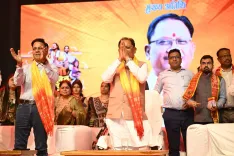
Shivraj hits back at 'Regime Change Gang' on X
Synopsis
Union Agriculture Minister Shivraj Singh Chouhan fired a sharp social-media salvo on 19 October 2026, declaring that the 'regime change gang's' plans are failing because India's youth, farmers and women trust a leadership that has raised the country's global standing.
Key Takeaways
Shivraj Singh Chouhan posted on X on 19 October 2026 targeting what he calls the 'regime change gang' — those he accuses of spreading false narratives against the government.
The post asserts that India's youth, farmers, and women form an unshakeable base of trust for the nation's current leadership.
Chouhan argues public trust is built on 'work, resolve and honest leadership' — not on rival political narratives.
The framing is consistent with a broader BJP communication strategy dating to 2014 , intensifying around election cycles and political pressure points.
No specific individual, organisation or event is named; the post implies an organised, possibly externally influenced, campaign against the government.
Opposition responses in Parliament and on social media are expected following the combative tone of the post.
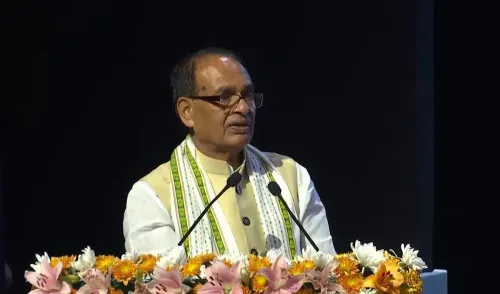
The phrase 'regime change gang' landed like a grenade on Monday morning. Union Agriculture Minister Shivraj Singh Chouhan took to X on 19 October 2026 to deliver a pointed counter-offensive against what he called organised efforts to destabilise the country's elected leadership — framing public trust in Prime Minister Narendra Modi as an unbreakable wall against such designs.
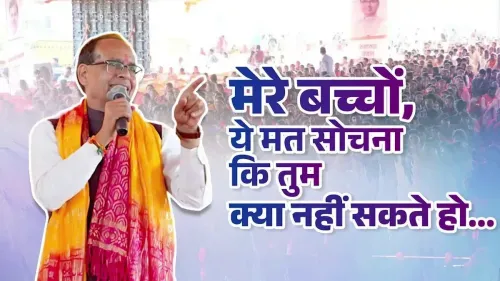
Chouhan wrote — in Hindi — 'Rijeem cheinj gaing ki daal isliye nahin gal rahi' ('The regime change gang's plans are not working') because, he argued, India's youth, farmers, sisters, daughters and mothers stand firmly behind the nation's leadership. The post is a direct rebuke aimed at those he accuses of circulating false narratives and conspiracies to weaken India.
The 'Regime Change Gang' charge
The term 'regime change gang' — increasingly deployed by senior BJP figures — is a rhetorical device that collapses domestic political opposition and alleged foreign influence operations into a single frame. Chouhan's post does not name any individual or organisation, but the language unmistakably targets critics who question the government's direction. 'Today's India is neither misled by false narratives, nor scared of conspiracies, nor does it bow before ideas that weaken the nation,' he wrote.
The messaging is calibrated around three social groups — youth, farmers, and women — that together form the BJP's core electoral coalition. Invoking them signals that the party views its social contract as intact and its base as insulated from rival messaging.
Trust built on 'work, resolve and honest leadership'
The post's sharpest line is a philosophical one: 'Janta ka vishwas kisi narrative ka mohtaaj nahin hota' — 'Public trust does not depend on any narrative.' Chouhan argues it is built instead on 'work, resolve and the honesty of leadership.' That formulation is a direct counter-punch to what BJP insiders describe as opposition attempts to construct an alternative story of government failure.
Chouhan is well-placed to make such arguments. A four-term former Chief Minister of Madhya Pradesh, he built a durable political brand around welfare schemes — particularly those targeting women through programmes like Ladli Behna — before being elevated to the Union Cabinet. His credibility on farmer welfare gives the message additional weight in rural constituencies.
A well-worn playbook, deployed with urgency
This post fits a pattern that has defined BJP communication since 2014: senior leaders use social media to pre-empt opposition narratives by anchoring the government's legitimacy in a broader civilisational confidence — 'India walking with self-belief' and 'holding its head high before the world.' The pattern intensifies around election cycles and moments of political pressure.
What is notable today is the combative specificity of the 'regime change' framing. It moves beyond standard boilerplate and implies an organised, possibly external, hand in domestic political disruption — a charge that is certain to draw responses from opposition benches and on social media in the hours ahead.
Whether that response reshapes the news cycle or confirms BJP's diagnosis that the attacks will keep 'shattering' — the minister's closing image — will be the real test of whose narrative lands.
Point of View
A frame that puts critics on the defensive. By anchoring the argument in farmers, youth and women rather than policy data, it trades the vulnerability of statistics for the durability of identity. The move fits a long-running BJP playbook of using social media surrogates to road-test language before it migrates into campaign speeches and Parliament. Watch for whether 'regime change gang' becomes a coordinated BJP hashtag — that would signal a formal communication offensive rather than a solo intervention.
NationPress
19 Oct 2026
Frequently Asked Questions
What did Shivraj Singh Chouhan say about the 'regime change gang'?
Chouhan said the 'regime change gang's' plans are failing because India's youth, farmers, and women trust the country's leadership. He argued that public trust is built on work and honest leadership, not on false narratives or conspiracies.
Who is Shivraj Singh Chouhan?
Shivraj Singh Chouhan is the Union Minister of Agriculture and Farmers Welfare and Rural Development, a senior BJP leader, and a former four-term Chief Minister of Madhya Pradesh.
What does 'regime change gang' mean in Indian politics?
The term, increasingly used by BJP leaders, refers to those the party accuses of attempting to destabilise India's elected government through false narratives, conspiracies, or alleged foreign influence — though no specific group is formally named.
Why did Shivraj Singh Chouhan post this message on X?
While the immediate trigger is unconfirmed, the post fits a recurring BJP pattern of using senior ministers' social media to counter opposition criticism and reinforce public confidence in the central leadership, especially during periods of political pressure.
What response is expected from the opposition?
Given the combative framing of the post, opposition parties are likely to respond in Parliament and on social media, either by dismissing the 'regime change' charge or by using it to highlight what they see as government overreach.