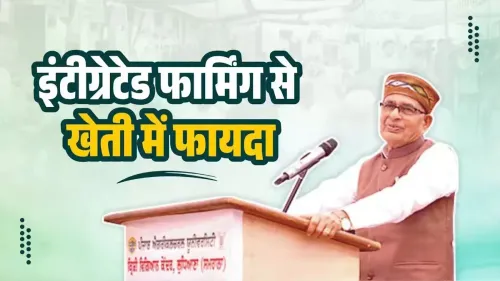
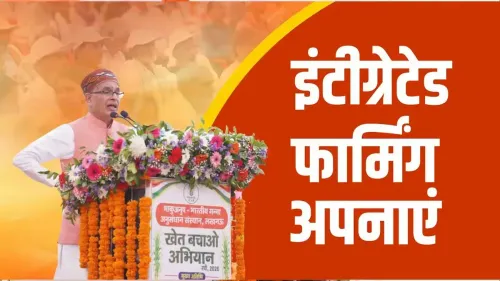
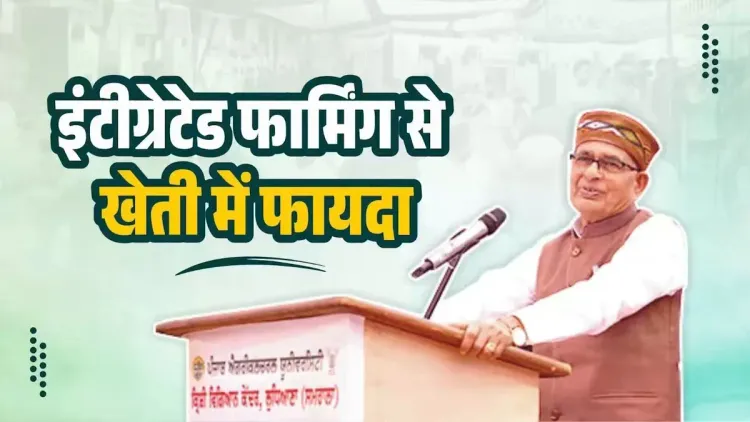
Shivraj Singh Chouhan calls for Integrated Farming to boost farm incomes
Synopsis
Union Agriculture Minister Shivraj Singh Chouhan has called for adopting the Integrated Farming Model to make farming profitable, emphasising crop-livestock diversification as a resilience tool for India's small and marginal farmers.
Key Takeaways
Shivraj Singh Chouhan posted on 17 November 2026 that India must adopt the Integrated Farming Model to make agriculture profitable.
The Integrated Farming Systems (IFS) model combines crops, livestock, poultry, fisheries and agroforestry to diversify income and reduce risk.
The National Mission for Sustainable Agriculture (2014) has promoted IFS to enhance resilience for smallholders.
Small and marginal farmers — those holding under two hectares — stand to benefit most from income diversification under IFS.
Possible policy vehicles include scaled IFS incentives in the next Union Budget or revised central mission guidelines.
Chouhan previously piloted integrated farming models during his tenure as Chief Minister of Madhya Pradesh .
India's farm economy needs a structural rethink — and Union Agriculture Minister Shivraj Singh Chouhan is making that case with fresh urgency. On Tuesday, 17 November 2026, the minister took to X to deliver a pointed message: monoculture alone cannot make farming profitable, and India's smallholders need a smarter model.
Posting in Hindi, Chouhan wrote: 'Kheti ko faaydemand banaane ke liye hamein integrated farming model apnaana hoga' — 'To make farming profitable, we will have to adopt the integrated farming model.' The statement was brief. The implication was not.
What integrated farming actually means for a small Indian farmer
The Integrated Farming Systems (IFS) model is not a new idea — but it remains unevenly adopted. The approach bundles crops, livestock, poultry, fisheries and agroforestry on the same landholding, allowing each enterprise to feed the other. Animal waste becomes fertiliser. Crop residue becomes feed. A bad monsoon that wrecks the kharif crop does not necessarily wipe out a family's entire income if poultry or fish ponds are also running.
That diversification logic matters most for India's small and marginal farmers — those holding under two hectares — who make up the overwhelming majority of the country's agricultural households. For them, a single failed crop can mean debt. A second or third income stream can mean survival, and over time, modest prosperity.
The policy lineage behind Chouhan's push
The National Mission for Sustainable Agriculture (NMSA), launched in 2014, has long promoted integrated farming systems as a tool to build climate resilience and stabilise smallholder incomes. The Indian Council of Agricultural Research (ICAR) has backed IFS models through decades of field trials. State-level pilots — including during Chouhan's own four terms as Chief Minister of Madhya Pradesh — have tested variations of the model in diverse agro-climatic zones.
What has historically lagged is scale. Incentive structures under central missions have tended to treat IFS as a supplementary intervention rather than a primary organising principle for farm planning. Chouhan's renewed emphasis as Union Minister signals a possible push to change that arithmetic — with eyes on the next Union Budget and revised guidelines under existing missions as potential vehicles.
Why the timing of this message matters
Farm income stagnation, soil health degradation and the mounting volatility of monsoon cycles have sharpened the debate around agricultural diversification. A minister of Chouhan's weight — with rural development and agriculture both in his portfolio — using his platform to frame IFS as a necessity, not an option, is a signal worth reading carefully. The word he chose was 'apnaana hoga' — 'will have to adopt.' That is not a suggestion. That is a direction of travel.
India's farming families deserve a model where one bad season does not erase a year of labour. Chouhan is betting integrated farming is that model — and the real test will be whether the next policy cycle delivers the resources to prove it.
Point of View
His framing of IFS as a necessity rather than a recommendation suggests a ministerial intent to mainstream the model in upcoming budget cycles. The statement also draws on Chouhan's own political capital from Madhya Pradesh, where he has prior credibility on farm-sector interventions. The real test will be whether rhetorical commitment translates into incentive design that reaches the smallholder at scale.
NationPress
17 Nov 2026
Frequently Asked Questions
What is the Integrated Farming Model that Shivraj Singh Chouhan is advocating?
The Integrated Farming Model, or Integrated Farming Systems (IFS), combines crops, livestock, poultry, fisheries and agroforestry on the same landholding so each enterprise supports the other, diversifying income and reducing the risk from a single crop failure.
Why is integrated farming important for Indian farmers?
Most Indian farmers are small and marginal holders with under two hectares. A single crop failure can mean debt; multiple income streams from livestock, fish or poultry provide a financial buffer and improve overall farm profitability.
What government schemes already support integrated farming in India?
The National Mission for Sustainable Agriculture (NMSA), launched in 2014, has promoted Integrated Farming Systems to enhance climate resilience and stabilise smallholder incomes, backed by decades of ICAR field research.
What did Shivraj Singh Chouhan say about integrated farming?
On 17 November 2026, Chouhan posted on X in Hindi stating: 'To make farming profitable, we will have to adopt the integrated farming model,' signalling a policy direction rather than a mere suggestion.
Could integrated farming incentives appear in India's next Union Budget?
Policy observers note that scaled IFS incentives or revised guidelines under existing central missions are possible vehicles in the next Union Budget, given the minister's renewed emphasis on the model.