Shivraj Singh Chouhan Holds Agri Talks With Afghan Minister in Delhi
Synopsis
Union Agriculture Minister Shivraj Singh Chouhan held bilateral talks with Afghan Agriculture Minister Mawlawi Ataullah Omari in New Delhi on 8 July 2026, covering seeds, irrigation, dryland farming and climate-resilient agriculture, as India sustains people-centric development ties with Afghanistan.
Key Takeaways
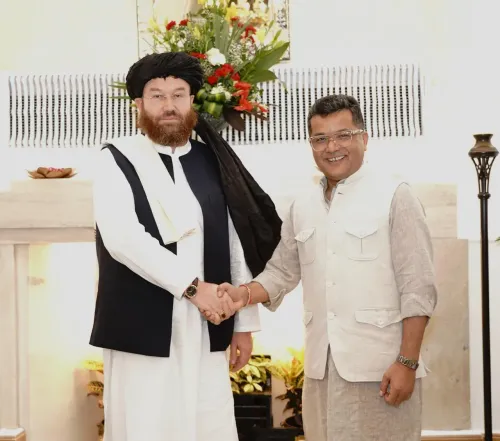
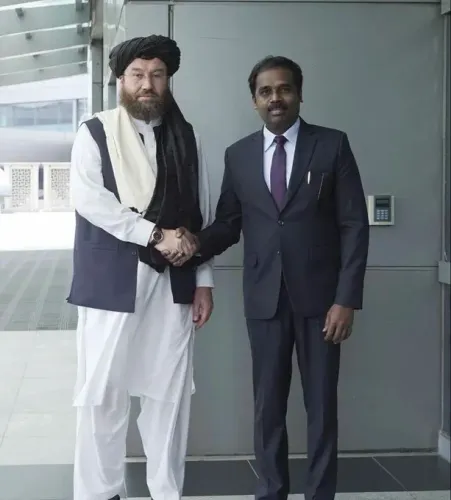
Shivraj Singh Chouhan met Afghan Agriculture Minister Mawlawi Ataullah Omari and his delegation in New Delhi on 8 July 2026 .
Discussions covered agricultural research, education, quality seeds, modern farming practices, irrigation, efficient water use and capacity building.
Both sides exchanged views on dryland agriculture and climate-resilient farming for water-scarce regions.
India's engagement with Afghanistan in agriculture dates to the early 2000s and was formalised in the 2011 India-Afghanistan Strategic Partnership Agreement .
The Ministry of External Affairs and Afghanistan's Ministry of Foreign Affairs were formally associated with the meeting, indicating diplomatic-level significance.
Follow-up implementation of joint research or training programmes and reciprocal delegation visits are expected next steps.
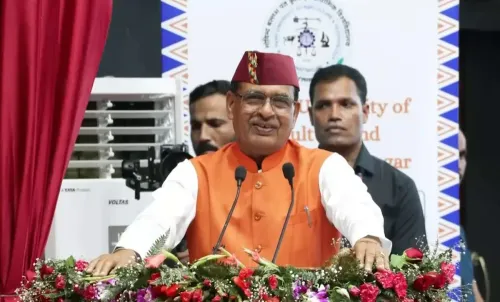
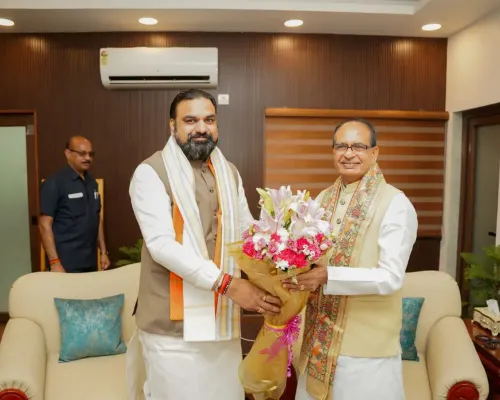
Union Agriculture Minister Shivraj Singh Chouhan met H.E. Mawlawi Ataullah Omari, Minister of Agriculture, Irrigation and Livestock of Afghanistan, and his delegation in New Delhi on Wednesday, 8 July 2026, for wide-ranging discussions on deepening bilateral cooperation in agriculture and allied sectors.
Context
The meeting, which Chouhan described as 'productive', covered a broad agenda: agricultural research, agricultural education, quality seeds, modern farming practices, irrigation, efficient water use and capacity building. The two sides also exchanged views on dryland agriculture and climate-resilient farming tailored to water-scarce regions — challenges that both countries face acutely.
Chouhan posted on X that he was 'delighted' to receive the Afghan delegation, noting that 'India and Afghanistan are united by deep civilizational ties and enduring goodwill.' He expressed confidence that, under the leadership of Prime Minister Narendra Modi, 'our agricultural partnership will deliver lasting benefits to the farmers of both countries.'
Policy Backdrop
India's agricultural engagement with Afghanistan has deep institutional roots. The 2011 India-Afghanistan Strategic Partnership Agreement explicitly included cooperation in agriculture, capacity building and rural development. Since the early 2000s, India has run training programmes and provided technical inputs — including quality seeds and agronomic guidance — for Afghan farmers and officials.
After the 2021 political transition in Afghanistan, New Delhi recalibrated its engagement toward practical, people-centric sectors such as seeds, irrigation and climate-resilient farming, rather than high-profile political overtures. The visit by Omari and his delegation signals a continuation of that approach, with both governments choosing to keep technical and developmental channels active.
Stakeholders and Impact
The most direct beneficiaries of any agreed programmes would be farmers in both countries. Afghan agriculture, heavily dependent on rain-fed and dryland systems, stands to gain from Indian expertise in drought-tolerant seed varieties and water-efficient irrigation techniques. Indian agricultural research institutions and universities could, in turn, gain access to Afghan agro-climatic data and traditional farming knowledge from a distinct ecological zone.
The Ministry of External Affairs (@MEAIndia) and Afghanistan's Ministry of Foreign Affairs (@MoFA_Afg) were both tagged in Chouhan's post, signalling that the talks carry formal diplomatic weight beyond a routine ministerial exchange. Capacity-building initiatives — training Afghan agricultural officials and researchers — form a key pillar of India's soft-power toolkit in the region.
What's Next
Follow-up steps will likely include the formalisation of joint research or training programmes and possible reciprocal visits by agricultural delegations. The involvement of both foreign ministries suggests that any agreements reached may be channelled through established diplomatic frameworks. Progress on implementing specific seed-supply, irrigation or education initiatives will be the clearest indicator of whether Wednesday's discussions translate into on-ground impact for farmers in both nations.
Point of View
Sector-specific engagement with Kabul despite the absence of formal diplomatic recognition of Afghanistan's current government. By routing the talks through the agriculture ministry rather than a high-profile political channel, New Delhi is staying consistent with its post-2021 doctrine of prioritising humanitarian and developmental ties over political legitimacy questions. For Chouhan, the meeting also reinforces his ministry's role as an instrument of foreign policy — a dimension that rarely gets attention but has real strategic value in South and Central Asia. The emphasis on dryland and climate-resilient farming suggests both sides are building an agenda with genuine long-term utility, not just ceremonial optics.
NationPress
9 Jul 2026
Frequently Asked Questions
Why did India's Agriculture Minister meet Afghanistan's Agriculture Minister in 2026?
Union Agriculture Minister Shivraj Singh Chouhan met Afghan Agriculture Minister Mawlawi Ataullah Omari in New Delhi on 8 July 2026 to hold bilateral discussions on strengthening cooperation in agricultural research, seeds, irrigation, dryland farming and capacity building for farmers in both countries.
What is India's agricultural relationship with Afghanistan?
India has maintained agricultural cooperation with Afghanistan since the early 2000s, providing training, technical inputs and quality seeds. The 2011 India-Afghanistan Strategic Partnership Agreement formally included agriculture and capacity building as pillars of bilateral cooperation.
What topics were discussed in the India-Afghanistan agriculture talks on 8 July 2026?
The discussions covered agricultural research, agricultural education, quality seeds, modern farming practices, irrigation, efficient water use, capacity building, dryland agriculture and climate-resilient farming for water-scarce regions.
How is India engaging with Afghanistan after the 2021 Taliban takeover?
India has sustained people-centric and developmental engagement with Afghanistan after the 2021 political transition, focusing on practical sectors such as seeds, irrigation and climate-resilient agriculture rather than high-profile political engagement.
What are the next steps after the Chouhan-Omari meeting?
Expected follow-up steps include formalisation of joint agricultural research or training programmes and possible reciprocal visits by delegations from both countries, with both foreign ministries involved in coordinating outcomes.