CM Siddaramaiah vows five guarantees will continue beyond 2028
Synopsis
Karnataka CM Siddaramaiah on 15 June 2026 declared the state's five guarantee schemes will continue indefinitely, rebutting BJP claims of fiscal risk and urging beneficiaries not to be misled by what he called opposition propaganda.
Key Takeaways
Siddaramaiah declared on 15 June 2026 that Karnataka's five guarantee schemes will not be stopped under any circumstances.
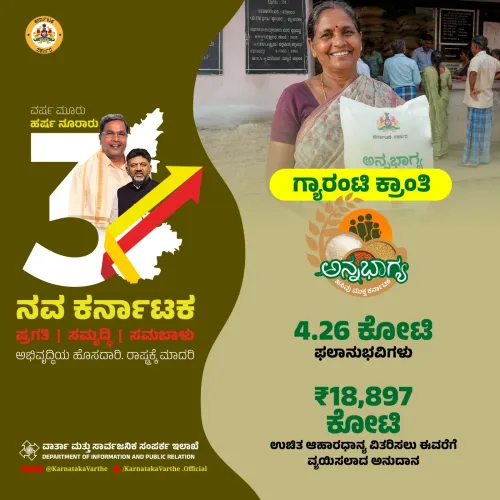
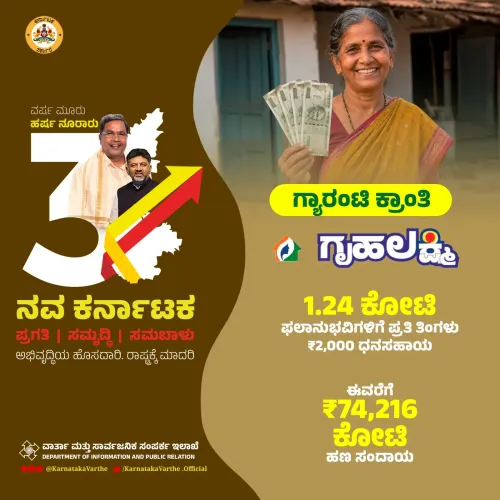
The schemes — covering women, youth, electricity, and food grains — were the Congress's core 2023 election promise and have been in phased rollout since mid-2023 .
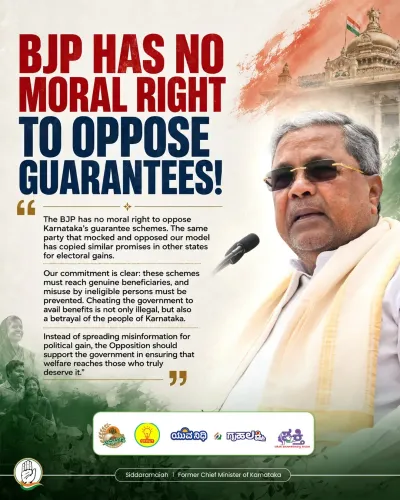
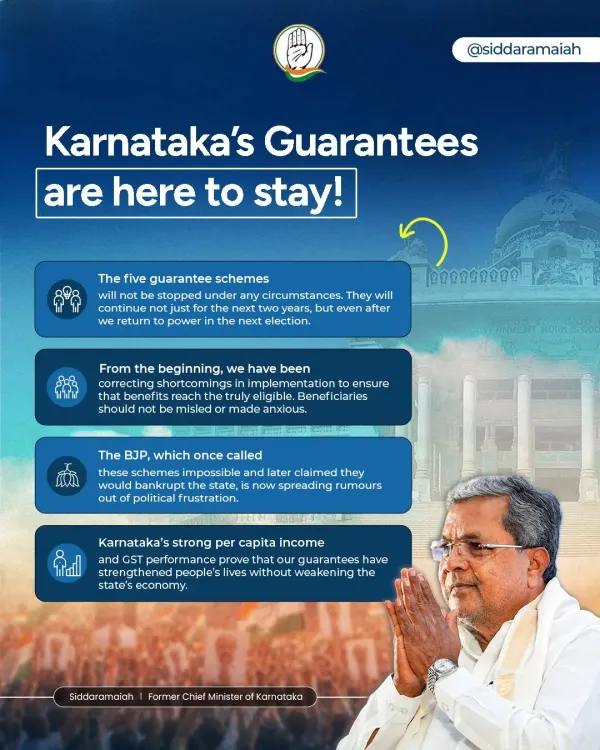
The Chief Minister said the government has been continuously correcting implementation shortcomings to ensure benefits reach 'the truly eligible.' Siddaramaiah accused the BJP of spreading 'rumours out of political frustration,' noting the party once called the schemes 'impossible' and later claimed they would 'bankrupt the state.' He cited Karnataka's per capita income and GST performance as proof the guarantees have not weakened the state economy.
Key watchpoints ahead include allocations in the 2026-27 Karnataka budget and any CAG observations on scheme expenditure.
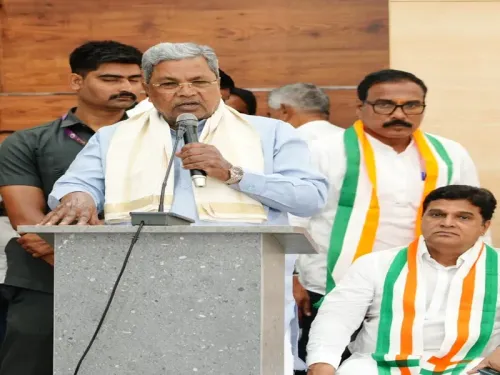
Karnataka Chief Minister Siddaramaiah on Monday, 15 June 2026, declared that the state government's five guarantee schemes will not be stopped under any circumstances and will continue even after the Congress returns to power at the next assembly election. The statement, posted on X, was a direct rebuttal of what the Chief Minister called 'false propaganda' by the Bharatiya Janata Party (BJP) aimed at unsettling beneficiaries.
Context
In his post, Siddaramaiah wrote that 'the five guarantee schemes will not be stopped under any circumstances' and will persist well beyond the current government's remaining term. He urged beneficiaries — women heads of households, unemployed youth, and rural families — not to be 'misled or made anxious by the Opposition's false propaganda.' The post comes amid a sustained BJP campaign questioning the financial viability of the guarantees.
The Chief Minister also noted that the government has been 'correcting shortcomings in implementation' since the beginning to ensure benefits reach 'the truly eligible.' This acknowledgement of ongoing refinement signals that eligibility reviews and delivery audits are continuing as part of routine administration.
Policy Backdrop
The five guarantee schemes — covering women, youth, electricity access, and food grains — were the centrepiece of the Indian National Congress manifesto for the May 2023 Karnataka assembly elections. After winning a clear majority, the Congress government began a phased rollout from mid-2023, with periodic eligibility reviews built into the framework.
State-level direct-benefit welfare programmes have become a defining feature of Indian electoral politics since the mid-2010s, with models tested earlier in Telangana and Andhra Pradesh informing Karnataka's approach. The BJP-Congress contest in Karnataka has repeatedly centred on competing claims about fiscal sustainability versus the social dividend of such spending.
Siddaramaiah specifically cited Karnataka's per capita income and GST performance as evidence that the guarantees have 'strengthened people's lives without weakening the state's economy.' The research background notes that the specific post-2025 data underpinning these claims has not been independently verified, and the article does not assert those figures as established fact.
Stakeholders and Impact
The primary beneficiaries of the five guarantees are women heads of households, unemployed youth, and rural households across Karnataka. Any disruption — real or perceived — to scheme delivery would affect a substantial share of the state's population, making political signalling around continuity particularly consequential.
The BJP, which governed Karnataka from 2019 to 2023, initially called the guarantees 'impossible' and later argued they would 'bankrupt the state.' Siddaramaiah's post characterises the party's current messaging as 'rumours' driven by 'political frustration,' framing the opposition's critique as having shifted in tone without changing in substance.
What's Next
Attention will now turn to allocations and any eligibility revisions in the 2026-27 Karnataka budget, as well as any forthcoming observations from the Comptroller and Auditor General (CAG) on scheme expenditure. How the government manages the fiscal optics of the guarantees in the run-up to the next assembly election will be a key test of whether Siddaramaiah's assurances translate into sustained delivery on the ground.
Point of View
He seeks to neutralise anxiety among a large beneficiary base before it can harden into electoral discontent. The BJP's evolving critique, from 'impossible' to 'bankruptcy' to 'rumours,' suggests the party has struggled to find a consistent line of attack, which the Chief Minister is now exploiting. Karnataka's guarantees have become a template that Congress has sought to replicate in other states, meaning the credibility of their continuation carries national implications beyond the state's borders. How the government manages fiscal optics in the next budget cycle will determine whether this political confidence translates into durable governance capital.
NationPress
14 Sept 2026
Frequently Asked Questions
What are the five guarantee schemes in Karnataka?
The five guarantee schemes are welfare programmes launched by the Karnataka Congress government after its May 2023 election win, covering cash transfers to women heads of households, support for unemployed youth, subsidised or free electricity, and free food grains for eligible rural households.
Will Karnataka's five guarantees be stopped?
Chief Minister Siddaramaiah has categorically stated the schemes will not be stopped under any circumstances and will continue even after the next assembly election if Congress returns to power.
Why is the BJP opposing Karnataka's guarantee schemes?
The BJP, which governed Karnataka from 2019 to 2023 , has questioned the fiscal sustainability of the schemes, at various points calling them 'impossible' and warning they would 'bankrupt the state.' Siddaramaiah has dismissed these claims as politically motivated.
How is Karnataka funding its five guarantee schemes?
Siddaramaiah has pointed to Karnataka's per capita income and GST performance as evidence that the state economy remains strong despite the welfare spending, though specific post-2025 fiscal data has not been independently verified.
When is the next Karnataka assembly election?
The exact date of the next Karnataka assembly election after the 2023 polls has not been officially announced. Siddaramaiah's post indicates the Congress intends to contest and retain power, with the guarantees as a central commitment.