CM Siddaramaiah Defends Karnataka Guarantee Schemes, Hits Back at BJP
Synopsis
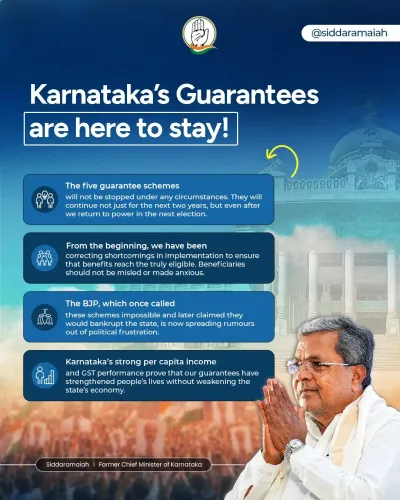
Karnataka Chief Minister Siddaramaiah on June 15, 2026, accused the BJP of lacking moral authority to oppose his government's guarantee schemes, saying the party copied similar welfare promises elsewhere while calling for strict action against misuse by ineligible beneficiaries.
Key Takeaways
CM Siddaramaiah stated on June 15, 2026 , that the BJP has 'no moral right' to oppose Karnataka's guarantee schemes.
He accused the BJP of mocking the Congress welfare model before replicating similar promises in other states for electoral gain.
The government reaffirmed its commitment to ensuring benefits reach only genuine, eligible beneficiaries.
Siddaramaiah called misuse of welfare schemes 'illegal' and 'a betrayal of the people of Karnataka.' The five guarantee schemes — covering free bus travel, cash transfers, free rice, electricity subsidy, and youth aid — were the centrepiece of the Congress 2023 Karnataka election manifesto.
The CM urged the Opposition to support welfare delivery rather than spread what he described as political misinformation.
Karnataka Chief Minister Siddaramaiah on Monday, June 15, 2026, launched a sharp defence of his government's flagship welfare guarantee schemes, accusing the Bharatiya Janata Party (BJP) of having 'no moral right' to oppose programmes it has itself replicated in other states for electoral advantage.
Context
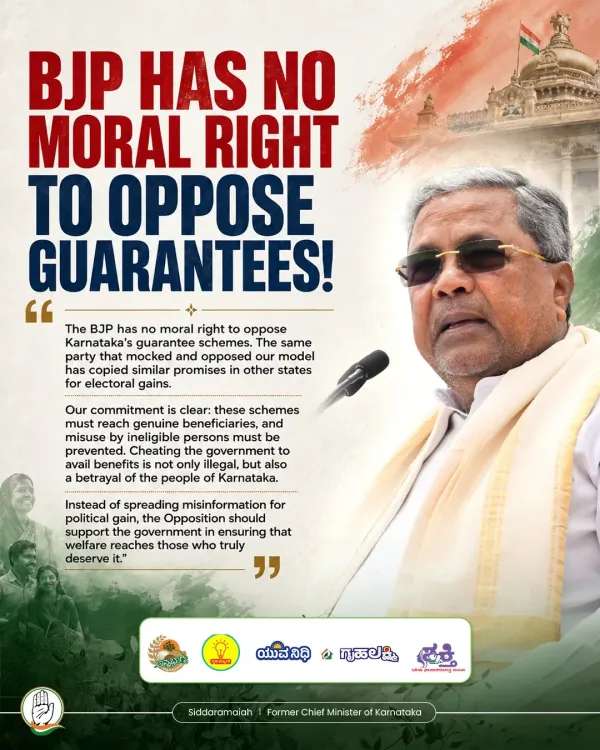
In a post on X, CM Siddaramaiah said the BJP 'mocked and opposed' the Congress model of welfare guarantees before copying similar promises elsewhere. He made clear that his government's priority remains ensuring benefits reach 'genuine beneficiaries' and that misuse by ineligible persons will not be tolerated. 'Cheating the government to avail benefits is not only illegal, but also a betrayal of the people of Karnataka,' he wrote.
The Chief Minister also called on the Opposition to set aside what he described as 'misinformation for political gain' and instead support the government in directing welfare to those who truly deserve it.
Policy Backdrop
The guarantee schemes were the central plank of the Indian National Congress manifesto for the May 2023 Karnataka assembly elections. The five guarantees cover free bus travel for women, monthly cash transfers to women heads of households, free rice, an electricity subsidy, and financial assistance for unemployed youth.
After its 2023 election victory, the Siddaramaiah government began rolling out these programmes, with budget allocations presented across the July 2023 and February 2024 legislative sessions. The schemes have drawn sustained criticism from the BJP, which held state power from 2019 to 2023, over their fiscal implications.
The broader pattern across India has seen rival parties criticise welfare spending when in opposition, only to announce comparable direct-benefit schemes when contesting other state elections — a cycle of competitive welfarism that has intensified through the 2020s.
Stakeholders and Impact
The primary beneficiaries of the guarantee schemes are women heads of households and low-income families across Karnataka. The government's stated focus on preventing misuse signals an ongoing effort to tighten beneficiary databases and verification processes.
State finances remain a key concern: large-scale direct-benefit programmes require sustained budget headroom, and any supplementary allocations in the 2026-27 Karnataka budget session will be closely watched by fiscal observers and opposition legislators alike.
For the BJP, the political challenge lies in opposing schemes that have proven popular with voters while simultaneously fielding comparable welfare promises in other states — a contradiction CM Siddaramaiah has now placed squarely in public view.
What's Next
The government is expected to intensify audits of beneficiary rolls to weed out ineligible claimants, a move that could both strengthen the schemes' credibility and generate fresh political friction. Any revision to guarantee allocations in the upcoming budget session will serve as a litmus test for the programme's fiscal sustainability.
With state-level welfare competition showing no signs of abating across India, Karnataka's model — and the political battle over its ownership — is likely to remain a reference point in the national conversation on social welfare policy.
Point of View
Pre-empting Opposition narratives about fiscal recklessness by framing the government as a responsible steward of public funds. This reflects a wider pattern in Indian politics where welfare programme ownership has become as contested as the programmes themselves. The statement signals that the Congress in Karnataka intends to keep the guarantee schemes at the centre of its political identity through the next electoral season.
NationPress
14 Sept 2026
Frequently Asked Questions
What are Karnataka's five guarantee schemes?
The five guarantee schemes promised by the Congress in its 2023 Karnataka election manifesto include free bus travel for women, monthly cash transfers to women heads of households, free rice, an electricity subsidy, and financial assistance for unemployed youth. The Siddaramaiah government began implementing them after its May 2023 election victory.
Why is CM Siddaramaiah criticising the BJP over the guarantee schemes?
CM Siddaramaiah accused the BJP of having 'no moral right' to oppose Karnataka's welfare schemes because the party, which mocked the Congress model, has since adopted similar welfare promises in other states for electoral purposes.
What action is the Karnataka government taking against misuse of welfare schemes?
The Siddaramaiah government has stated that misuse of welfare benefits by ineligible persons is illegal and amounts to a betrayal of Karnataka's people. The government is focused on tightening beneficiary verification to ensure only genuine claimants receive support.
Has the BJP introduced similar welfare schemes in other states?
According to CM Siddaramaiah, opposition parties including the BJP have introduced or promised comparable cash-transfer and subsidy schemes in other states after the success of the Congress model in Karnataka in 2023, a pattern the research also notes as part of India's broader competitive welfarism trend.
What is the fiscal outlook for Karnataka's guarantee schemes?
State-level audits of beneficiary databases and any supplementary budget revisions in the 2026-27 Karnataka budget session will be key indicators of the fiscal sustainability of the guarantee programmes.