Sitharaman at CD Deshmukh Lecture: Banks Must Serve All Indians
Synopsis
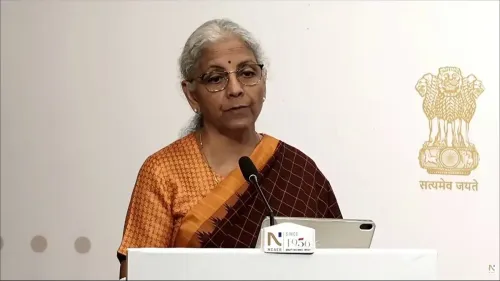
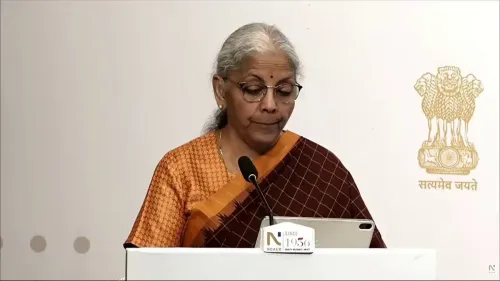
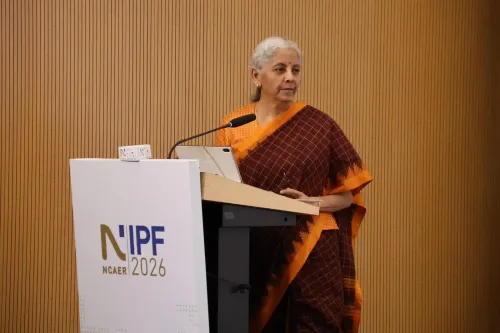
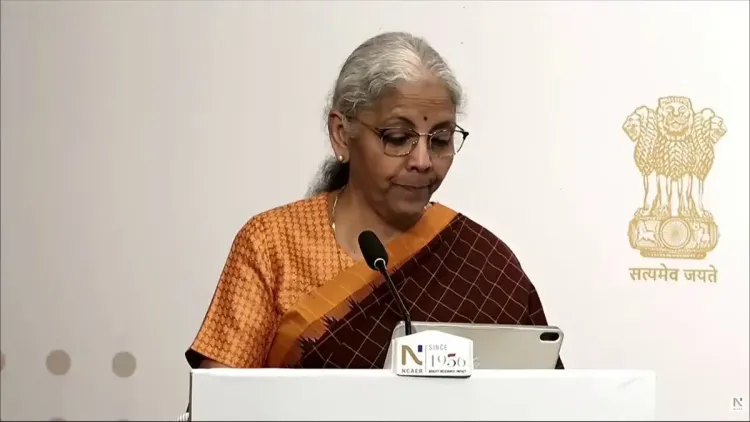
At the C.D. Deshmukh Lecture 2026 in New Delhi, Finance Minister Nirmala Sitharaman called for dismantling colonial mindsets in Indian financial institutions, championed MUDRA Yojana as proof that citizens can become entrepreneurs, and argued that banking must be an instrument of inclusion — not privilege.
Key Takeaways
Finance Minister Nirmala Sitharaman delivered the C.D.
Deshmukh Lecture 2026 in New Delhi on 6 August 2026 .
She invoked Sri Aurobindo and PM Modi 's Red Fort address to argue India must shed its colonial institutional mindset.
MUDRA Yojana , launched in April 2015 , provides collateral-free loans up to Rs 10 lakh to micro and small enterprises.
Sitharaman stated that 'our banks are for all Indians, not just a select few,' framing public sector banks as tools of inclusion.
The lecture series honours C.D.
Deshmukh , India's first Indian RBI Governor ( 1943–1949 ) and former Finance Minister.
The remarks extend the government's financial inclusion arc that began with Jan Dhan Yojana in 2014 .
A quote from Sri Aurobindo opened the argument, but the destination was squarely contemporary: Union Finance Minister Nirmala Sitharaman used the prestigious C.D. Deshmukh Lecture 2026 in New Delhi on 6 August 2026 to deliver a pointed case for institutional decolonisation, financial inclusion, and the entrepreneurial potential locked inside every Indian citizen.
Aurobindo to Modi: the ideological thread Sitharaman drew
Sitharaman opened by invoking the philosopher-statesman Sri Aurobindo — 'India lives for the world, not for herself. India has a role to play towards unity and peace for the people' — before anchoring the argument in Prime Minister Narendra Modi's Independence Day address from the Red Fort, where he called for dismantling the remnants of India's colonial mindset. The pairing was deliberate: a civilisational claim from Aurobindo, a policy directive from the Prime Minister, and a financial architecture that must now catch up with both.
'India must reject the psychology of victimhood,' Sitharaman said, framing the challenge not merely as economic but as psychological. The argument: colonial-era institutions bred a culture of gatekeeping, and that culture still shapes who gets credit, who gets opportunity, and who gets left out.
Banks as instruments of inclusion, not privilege
The Finance Minister was direct. 'Our banks are for all Indians, not just a select few,' she said, calling on financial institutions, governance structures, and public resources to 'widen the circle of opportunity' so that enterprise is 'augmented by both ability and access.' The formulation matters — ability without access is a dead end, and access without ability is charity. The goal, she argued, is both.
This framing sits inside a decade-long policy arc. The Pradhan Mantri Jan Dhan Yojana, launched in 2014, brought hundreds of millions of unbanked Indians into the formal financial system. Pradhan Mantri Mudra Yojana, launched in April 2015, went a step further — extending collateral-free loans of up to Rs 10 lakh to micro and small enterprises that had historically been invisible to formal lenders. Together, they represent the government's central bet: that credit, not charity, is the engine of social mobility.
MUDRA's legacy and the entrepreneurial citizen
Sitharaman singled out MUDRA Yojana by name — and the choice is significant. The scheme has disbursed loans to tens of millions of small borrowers, many of them women and first-generation entrepreneurs in semi-urban and rural India. 'MUDRA Yojana made our citizens into entrepreneurs,' she said, adding that India must 'recognise the entrepreneurial skill in each one of our citizens.' It is a claim that doubles as a policy philosophy: the state's job is not to create jobs but to create conditions in which citizens create their own.
The C.D. Deshmukh Lecture series carries its own symbolic weight. C.D. Deshmukh was the first Indian Governor of the Reserve Bank of India — serving from 1943 to 1949 — and later Union Finance Minister. Delivering these remarks at a lecture named after him, Sitharaman was, in effect, speaking from within the very institutional tradition she was calling on India to reclaim and redefine.
The message from New Delhi is unambiguous: India's financial architecture must stop being a filter that keeps ambition out, and start being a bridge that lets it through.
Point of View
Decolonisation) with concrete scheme-level outcomes (MUDRA, Jan Dhan) to build a coherent narrative around BJP's decade in economic governance. The 'rejection of victimhood' framing signals an intent to shift the political conversation from welfare dependency to earned enterprise. With the next Union Budget on the horizon, the emphasis on MUDRA and priority-sector credit access may preview an expansion of collateral-free lending thresholds or new MSME credit guarantees. The choice of the C.D. Deshmukh platform — deeply embedded in RBI institutional history — also signals that the Finance Ministry wants to own the legacy of Indian financial nation-building, not merely inherit it.
NationPress
6 Aug 2026
Frequently Asked Questions
What did Nirmala Sitharaman say at the CD Deshmukh Lecture 2026?
Sitharaman called for dismantling colonial mindsets in Indian financial institutions, argued that banks must serve all Indians rather than a privileged few, and cited MUDRA Yojana as evidence that ordinary citizens can be transformed into entrepreneurs when given access to credit.
What is the CD Deshmukh Lecture?
The C.D. Deshmukh Lecture is a prestigious lecture series named after C.D. Deshmukh, who served as India's first Indian Governor of the Reserve Bank of India from 1943 to 1949 and later as Union Finance Minister.
What is MUDRA Yojana and how does it help entrepreneurs?
Pradhan Mantri Mudra Yojana, launched in April 2015, provides collateral-free loans of up to Rs 10 lakh to micro and small enterprises, enabling first-generation entrepreneurs — especially women and those in rural and semi-urban areas — to access formal credit without needing assets as security.
What did PM Modi say about colonial mindset at the Red Fort?
Prime Minister Narendra Modi, in his Independence Day address from the Red Fort, called for India to completely dismantle the remnants of its colonial mindset — a theme Sitharaman echoed and extended to financial institutions at the Deshmukh Lecture.
How does MUDRA Yojana connect to India's financial inclusion drive?
MUDRA Yojana builds on the Jan Dhan Yojana (2014) foundation — while Jan Dhan opened bank accounts for unbanked Indians, MUDRA extended credit to those same citizens to fund small businesses, together forming the government's two-step strategy for financial inclusion.