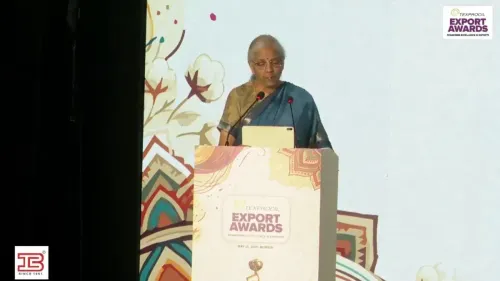
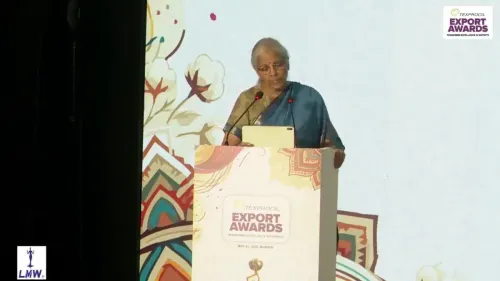
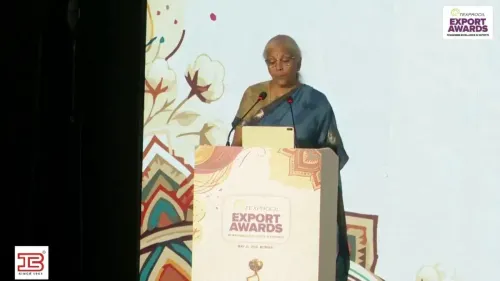
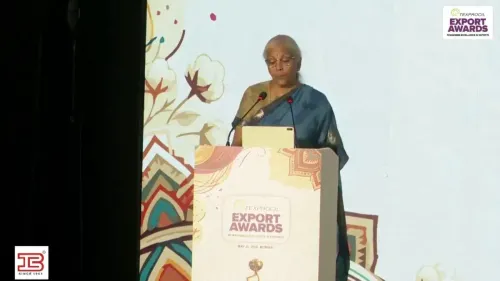
Sitharaman pitches technical textiles, GI luxury exports
Synopsis
Union Finance Minister Nirmala Sitharaman, speaking in Mumbai, called for building a domestic technical textile industry serving infrastructure, healthcare, and defence, while repositioning GI-tagged handlooms like Banarasi, Pochampally, and Chanderi as global luxury and sustainable goods — not charity purchases.
Key Takeaways
Finance Minister Nirmala Sitharaman spoke in Mumbai on May 25, 2026 on India's textiles strategy.
She called for a robust domestic technical textile industry to serve infrastructure, healthcare, and defence before exporting surplus.
She argued India's handmade textiles are a competitive advantage 'no machine can replicate' in a world tired of mass-produced goods.
GI-tagged textiles — Banarasi , Pochampally , Chanderi — should be marketed as global luxury and sustainable products, not charity purchases.
The National Technical Textiles Mission (2020) was backed by a Rs 1,480 crore outlay to build this sector.
The remarks align with the Atmanirbhar Bharat vision of domestic self-reliance and global competitiveness across both modern and heritage textiles.
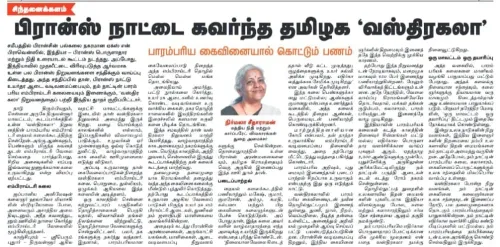
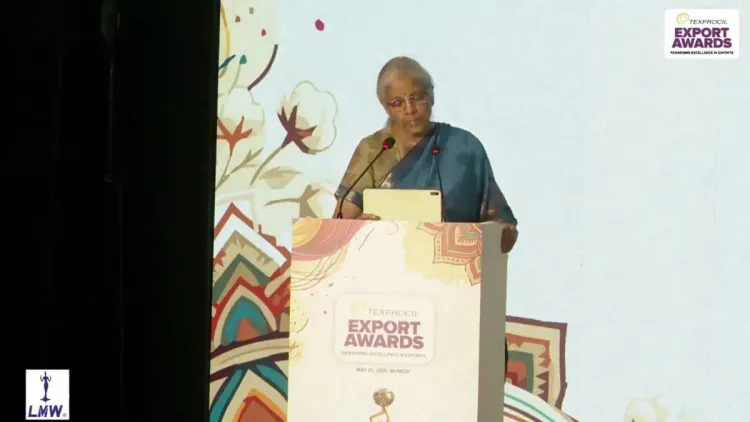
Union Finance Minister Nirmala Sitharaman, speaking in Mumbai on Monday, May 25, 2026, called for building a robust domestic technical textile industry to serve India's infrastructure, healthcare, and defence sectors — and for repositioning GI-tagged handmade textiles as global luxury and sustainable goods rather than charity purchases.
Context
Sitharaman argued that India must develop a technical textile sector capable of meeting its own massive strategic needs first, and then export its surplus to the world. She framed the handmade textile sector's uniqueness — its handcrafted, irreplicable quality — as a competitive advantage in a world 'increasingly weary of mass-produced, identical goods.'
She specifically named Banarasi, Pochampally, and Chanderi textiles as examples of GI-tagged products that should be 'positioned as global luxury and sustainable goods, not charity purchases' — a pointed reframing of how India markets its heritage weaves internationally.
Policy Backdrop
The remarks align with a dual-track textile strategy the government has pursued over recent years. The National Technical Textiles Mission, approved by the Cabinet in 2020 with an outlay of Rs 1,480 crore, was designed to position India as a global leader in high-performance technical textiles used in sectors ranging from geotextiles in infrastructure to medical textiles in healthcare and specialised fabrics in defence.
On the heritage side, India's Geographical Indications of Goods (Registration and Protection) Act, 1999 provides the legal framework for protecting traditional textile products. A Production Linked Incentive scheme for man-made fibre textiles, announced in 2021, further reinforced the push to scale domestic manufacturing and boost exports across the textiles value chain.
Banarasi silk sarees and brocades from the Varanasi region, Pochampally Ikat weaves from Telangana, and the lightweight wovens of Chanderi in Madhya Pradesh are among India's most recognised GI-tagged textile products, each with deep artisan communities dependent on their commercial viability.
Stakeholders and Impact
The minister's remarks carry direct implications for handloom artisans, whose livelihoods depend on both domestic demand and export access. A shift toward premium international positioning — luxury retail and sustainability-conscious consumers — could significantly improve price realisation for weavers compared to volume-driven, low-margin export models.
For technical textile manufacturers, the call to serve defence and healthcare needs domestically before exporting surplus echoes the Atmanirbhar Bharat framework of self-reliance. The defence and healthcare sectors represent high-specification, high-value demand that could anchor the industry's growth trajectory.
What's Next
The key test will be whether policy follow-through matches the vision Sitharaman articulated. Implementation of technical textile projects in infrastructure and defence procurement pipelines, and coordinated international marketing of GI textiles in luxury retail channels, will be the metrics to watch. As India pursues bilateral trade agreements, securing preferential access for GI-tagged textiles in premium markets — particularly in Europe and the United States — could operationalise the strategy the Finance Minister outlined in Mumbai.
Point of View
A goal that has remained aspirational for decades. Pairing this with a call to build technical textile capacity for defence and healthcare reveals a two-front strategy: strategic self-reliance on one side, premium export positioning on the other. The challenge, as always, will be bridging the gap between ministerial vision and the ground-level infrastructure, credit access, and marketing machinery that artisans and manufacturers actually need.
NationPress
9 Oct 2026
Frequently Asked Questions
What did Nirmala Sitharaman say about Indian textiles in Mumbai?
She called for building a strong domestic technical textile industry for infrastructure, healthcare, and defence, and for repositioning GI-tagged handlooms like Banarasi, Pochampally, and Chanderi as global luxury and sustainable goods rather than charity purchases.
What is the National Technical Textiles Mission?
The National Technical Textiles Mission is a government initiative approved in 2020 with an outlay of Rs 1,480 crore to promote research, development, and manufacturing in technical textiles and position India as a global leader in the sector.
What are GI-tagged textiles in India?
GI-tagged textiles are traditional Indian fabrics protected under the Geographical Indications of Goods Act, 1999. Examples include Banarasi silk sarees from Varanasi, Pochampally Ikat weaves from Telangana, and Chanderi fabrics from Madhya Pradesh.
What is India's strategy for textile exports?
India is pursuing a dual strategy: developing high-tech technical textiles for domestic strategic sectors under the Atmanirbhar Bharat framework, while positioning heritage GI-tagged handlooms as premium luxury and sustainable products in global markets.
Why does Sitharaman say GI textiles should not be charity purchases?
She argued that Indian handmade textiles have a uniqueness no machine can replicate, making them a genuine competitive advantage in global markets. Framing them as luxury goods rather than objects of charity is meant to improve price realisation and the economic standing of weavers.