Sitharaman in Madurai: Govt Is Enabler, Not Controller
Synopsis
Finance Minister Nirmala Sitharaman, addressing a gathering in Madurai on 18 July 2026, declared that the Modi government has redefined its role from controller to enabler of enterprise, citing GST, digitisation, PLI schemes and infrastructure investments, and called on businesses to tap opportunities in sunrise sectors.
Key Takeaways
Finance Minister Nirmala Sitharaman spoke in Madurai, Tamil Nadu on 18 July 2026 , urging businesses to leverage sunrise sector opportunities.
She described a shift in government philosophy: from 'controller of enterprise' to 'enabler of enterprise' under PM Narendra Modi .
Key enablers cited include GST (unified indirect tax since 1 July 2017 ), formalisation, digitisation, regulatory reforms and infrastructure investment.
Production Linked Incentive (PLI) schemes , launched from 2020 , form part of the policy architecture aimed at boosting manufacturing investment.
Businesses — particularly MSMEs and startups — were specifically called upon to utilise the emerging ecosystem and adopt technology and innovation.
The address signals the government's likely economic messaging ahead of the next Union Budget and Economic Survey .
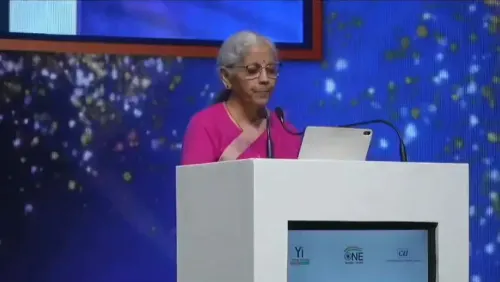
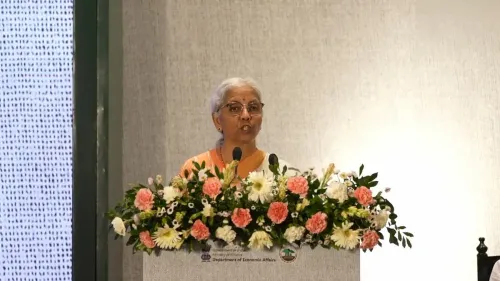
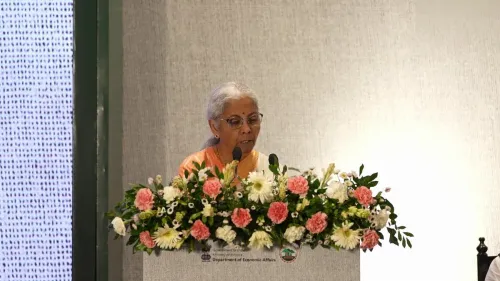
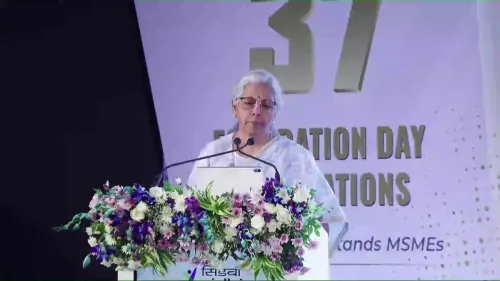
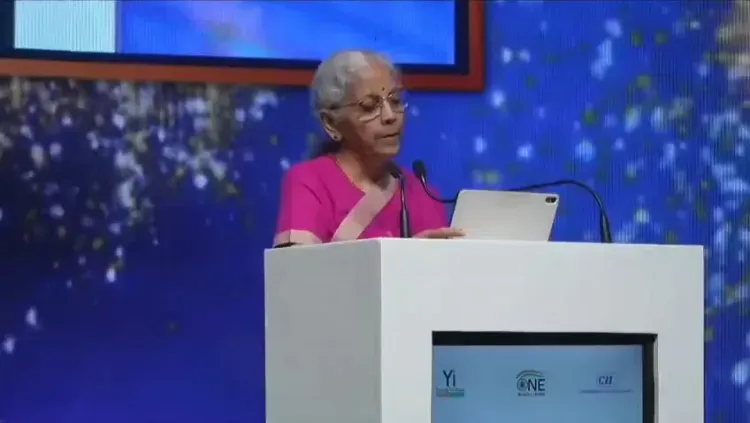
Union Finance Minister Nirmala Sitharaman addressed a gathering in Madurai, Tamil Nadu, on Saturday, 18 July 2026, asserting that the government under Prime Minister Narendra Modi has fundamentally reoriented its role — from controlling enterprise to actively enabling it. She urged businesses to seize opportunities in sunrise sectors by leveraging technology and innovation.
Context
Speaking in Madurai, Sitharaman framed the current administration's economic philosophy in direct terms: 'The role of the Government has been redefined from being a controller of enterprise to becoming an enabler of enterprise.' The statement encapsulates a decade-long policy shift that the BJP-led government has pursued since 2014, moving away from the command-and-control legacy of the pre-liberalisation era.
She cited formalisation, digitisation, regulatory reforms, GST, and investments in infrastructure and connectivity as the pillars of an ecosystem where 'businesses can start, grow and compete with confidence.' The address comes at a time when India's industrial and startup communities are navigating both domestic opportunity and global supply-chain realignment.
Policy Backdrop
The Goods and Services Tax (GST), rolled out on 1 July 2017, replaced a fragmented web of central and state indirect taxes with a unified national structure — widely regarded as the most sweeping indirect-tax reform since independence. Alongside GST, the Insolvency and Bankruptcy Code (IBC), enacted in 2016, introduced time-bound resolution of stressed assets, improving creditor confidence.
From 2020 onward, Production Linked Incentive (PLI) schemes were launched across more than a dozen manufacturing sectors, aiming to attract large-scale investment and reduce import dependence. Digitisation drives — including Aadhaar-linked identity, UPI payments infrastructure, and single-window clearance portals — have collectively pushed India up global ease-of-doing-business indices. Sitharaman's remarks in Madurai are consistent with this broader reform narrative the government has articulated repeatedly at industry forums.
Stakeholders and Impact
Businesses, MSMEs and startups are the primary audiences for Sitharaman's call to action. Madurai, a significant commercial and manufacturing hub in Tamil Nadu, hosts clusters in textiles, engineering goods, and agro-processing — sectors that stand to benefit from both PLI incentives and improved digital connectivity.
The Finance Minister's emphasis on 'sunrise sectors' signals continued government intent to channel investment into areas such as semiconductors, green energy, electric mobility, and advanced manufacturing. For smaller enterprises, the formalisation push — accelerated through GST registration and digital banking — has expanded access to formal credit, even as compliance costs have drawn mixed responses from industry bodies.
What's Next
Industry observers will watch closely for any concrete policy announcements — such as expansions of PLI schemes or further regulatory easing — in the forthcoming Union Budget and Economic Survey. Parliamentary deliberations on amendments to company law and tax administration are also on the horizon.
Sitharaman's Madurai address reinforces the government's pre-budget messaging, signalling that the 'enabler state' framing will likely anchor the administration's economic communication in the months ahead. Whether businesses in tier-two cities and smaller manufacturing clusters translate this enabling environment into tangible investment will be the real test of the policy architecture she described.
Point of View
A framing that directly contrasts with the pre-1991 License Raj. Delivering this message in Tamil Nadu, a state where the BJP has limited electoral footprint, carries political subtext: it signals an outreach to the southern business community ahead of potential budget cycles. The repeated invocation of GST and PLI as success markers suggests the government is doubling down on these as its core economic legacy. The real question is whether this 'enabler' framing translates into measurable ease-of-doing-business gains for smaller firms in tier-two cities like Madurai itself.
NationPress
18 Jul 2026
Frequently Asked Questions
What did Nirmala Sitharaman say in Madurai on 18 July 2026?
Finance Minister Nirmala Sitharaman said the Modi government has redefined the state's role from a controller of enterprise to an enabler, citing GST, digitisation, formalisation and infrastructure investments, and called on businesses to tap sunrise sector opportunities.
What are sunrise sectors in India that the government is promoting?
Sunrise sectors typically include semiconductors, green and renewable energy, electric vehicles, advanced manufacturing and digital technology — areas the government has been channelling investment into through PLI and other incentive schemes.
What is the Production Linked Incentive (PLI) scheme?
The PLI scheme, launched from 2020, offers financial incentives to manufacturers in over a dozen sectors based on incremental sales, aiming to boost domestic production and attract both domestic and foreign investment into Indian manufacturing.
How has GST changed India's business environment?
GST, implemented on 1 July 2017, replaced a complex web of central and state indirect taxes with a single unified tax structure, reducing cascading tax effects and simplifying compliance for businesses operating across multiple states.
Why did Nirmala Sitharaman speak in Madurai?
Madurai is a major commercial and industrial hub in Tamil Nadu, and the Finance Minister's address there was aimed at encouraging local businesses, MSMEs and entrepreneurs to utilise the policy ecosystem the government has built to start, grow and compete.