Sitharaman: India's 2047 goal must be settled in years, not decades
Synopsis
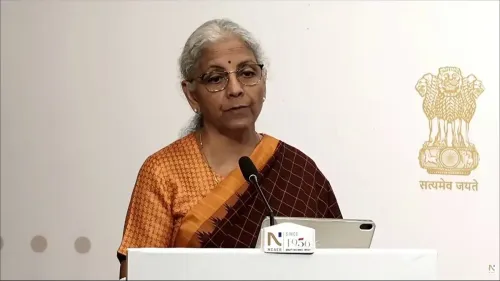
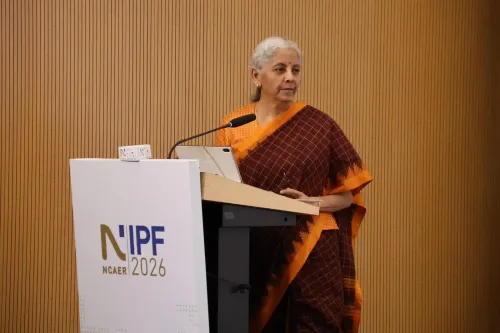
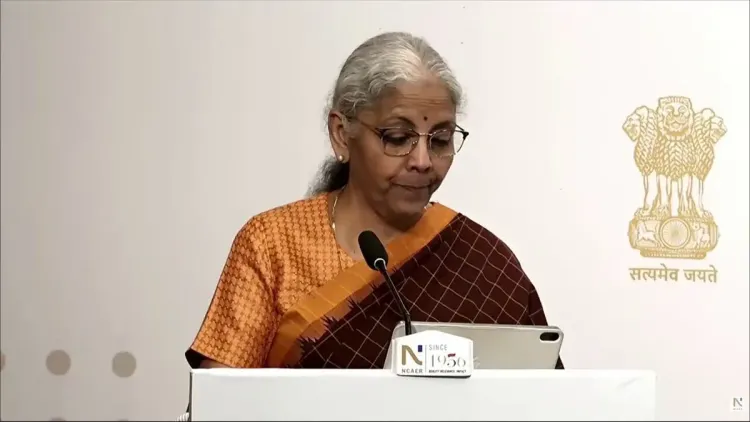
At the CD Deshmukh Lecture 2026 in New Delhi, Finance Minister Nirmala Sitharaman declared that 2047 is an 'immediate national horizon,' not a distant goal, and framed India's centenary as a civilisational milestone — with foundational choices to be made within the next few years.
Key Takeaways
Finance Minister Nirmala Sitharaman spoke at the CD Deshmukh Lecture 2026 in New Delhi on 6 August 2026 .
She called 2047 'an immediate national horizon,' stressing that critical decisions must be made 'within the next few years.' She framed India at 100 years of Independence not as a journey's end but as 'a milestone within a much larger and longer civilisational continuum.' India's stated ambition, per Sitharaman, is to 'stand among the foremost nations of the world' — not merely to improve on its current position.
The Viksit Bharat 2047 framework has been a pillar of government communication since 2022-23 , spanning Budget speeches and NITI Aayog documents.
The year 2047 is no longer a distant marker on a calendar — it is, in Union Finance Minister Nirmala Sitharaman's words, 'an immediate national horizon.' Speaking at the CD Deshmukh Lecture 2026 in New Delhi on 6 August 2026, she delivered a sharp reframe of India's centenary ambition: the foundational choices must be made now, not later.
What Sitharaman actually said — and why the framing matters
The Finance Minister drew a clear line between aspiration and urgency. 'A good deal of it must be settled within the next few years,' she said, pushing back against any reading of Viksit Bharat 2047 as a comfortable long-range target. Equally striking was her civilisational framing: India at 100 years of Independence is not, she argued, the conclusion of a journey but 'a milestone within a much larger and longer civilisational continuum.' The destination is not merely a better version of the present — it is a place 'among the foremost nations of the world.' That distinction is deliberate and consequential. Framing 2047 as a civilisational waypoint rather than a political finish line removes it from the churn of electoral cycles and embeds it in a longer arc of national purpose — one that no single government can own or exhaust.The lecture series and the legacy it invokes
C.D. Deshmukh, in whose honour the lecture series is named, was a towering figure in independent India's economic architecture — the first Indian Governor of the Reserve Bank of India and later a Union Finance Minister. Delivering a vision speech in that forum carries implicit weight: it places the speaker in a lineage of serious, structural thinking about India's economic future, not just its political present.From vision to verifiable targets
The Viksit Bharat 2047 framework has been a fixture of government communication since 2022-23, appearing across Economic Surveys, Budget speeches, and NITI Aayog documents. What has been less consistent is the translation of that vision into hard, time-bound milestones. Sitharaman's insistence that critical choices must be 'settled within the next few years' raises the stakes: the next few Union Budgets and policy documents will be read, in part, as evidence of whether that urgency is rhetorical or operational. The kicker is built into her own words. India's ambition, she said, is not to improve upon its present. It is to stand among the foremost nations of the world. The clock, she made clear, is already running.Point of View
' she implicitly raises accountability: upcoming Budgets and Economic Surveys will be benchmarked against this urgency. The civilisational framing is also politically significant — it positions 2047 as a project that transcends any single administration, building bipartisan moral pressure while keeping the BJP's reform agenda at the centre of the discourse. Whether operational specifics follow the rhetorical ambition is the central question this speech opens.
NationPress
6 Aug 2026
Frequently Asked Questions
What did Nirmala Sitharaman say at the CD Deshmukh Lecture 2026?
She declared that 2047 is 'an immediate national horizon,' not a distant goal, and argued that foundational decisions for India's centenary must be made within the next few years. She also framed India at 100 years of Independence as a civilisational milestone, not a journey's conclusion.
What is the Viksit Bharat 2047 vision?
Viksit Bharat 2047 is a long-term national development framework introduced by the Indian government in 2022-23, targeting a developed, globally prominent India by the centenary of its Independence in 2047.
Who was CD Deshmukh and why is the lecture named after him?
C.D. Deshmukh was the first Indian Governor of the Reserve Bank of India and later served as a Union Finance Minister. The CD Deshmukh Lecture series honours his legacy of serious economic and institutional thinking in independent India.
Why is 2047 significant for India?
2047 marks the 100th anniversary of India's Independence in 1947. The government has framed it as a target year for India to emerge as a developed nation and stand among the world's foremost economies.
What are the next steps after Sitharaman's 2047 speech?
Analysts and policymakers will watch upcoming Union Budgets, Economic Surveys, and NITI Aayog documents for specific, time-bound targets that translate the 2047 vision into measurable milestones.