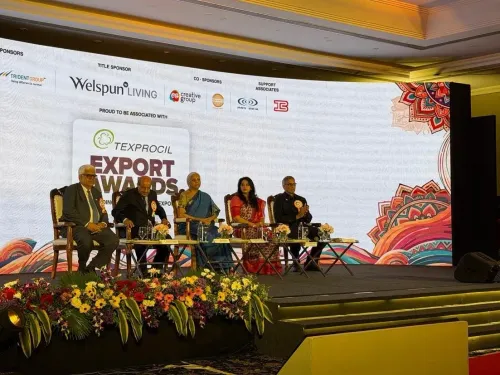
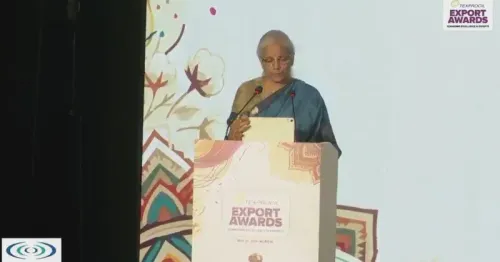
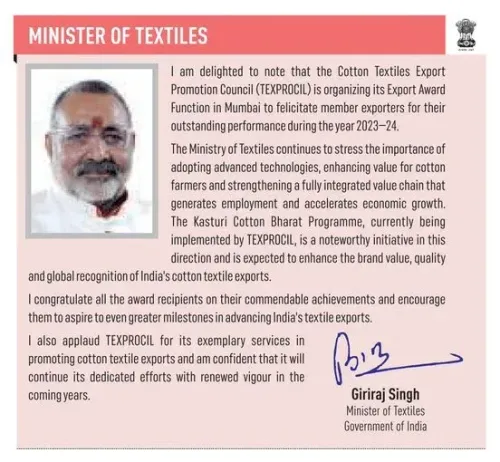
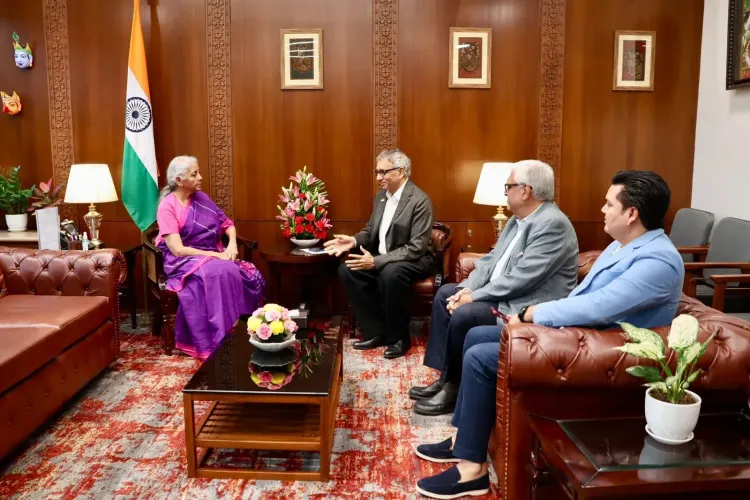
Sitharaman meets Texprocil delegation led by Ravi Sam
Synopsis
Union Finance Minister Nirmala Sitharaman met a Texprocil delegation led by Chairman Ravi Sam on 29 October 2026, in a meeting that signals the cotton textile export sector's push for policy support ahead of the next budget cycle.
Key Takeaways
Texprocil delegation, led by Chairman Ravi Sam , called on Finance Minister Nirmala Sitharaman on 29 October 2026 .
Texprocil is India's apex cotton textile export promotion body, established in the 1950s as part of post-independence trade policy.
The meeting comes within the budget cycle, a key window for sector-specific duty and incentive decisions.
Specific outcomes of the meeting have not been publicly disclosed.
Cotton textile exporters and MSMEs are the primary stakeholders watching for budget or duty-notification follow-through.
India's cotton textile exporters took their concerns straight to the top on Thursday, 29 October 2026, when a delegation from The Cotton Textiles Export Promotion Council (Texprocil) called on Union Finance Minister Nirmala Sitharaman in New Delhi. Leading the delegation was Ravi Sam, Chairman of Texprocil.
Texprocil at the Finance Minister's door
Texprocil is India's apex body for promoting cotton textile exports, with roots stretching back to the 1950s when the government established sector-specific Export Promotion Councils to plug nascent industries into global markets. Today it represents thousands of cotton textile exporters and MSMEs who depend on policy levers — duty structures, export incentives, market-access agreements — that ultimately flow through the Finance Ministry. Routine as such calls-on appear, they carry real weight. The Finance Minister's office is where decisions on export incentive schemes, customs duty remissions, and credit support for textile exporters are shaped. A delegation visit this close to the budget cycle signals that the sector has specific asks it wants on the table.What the cotton textile sector is watching
Indian cotton textile exporters have navigated a turbulent few years — shifting global demand, competition from Bangladesh and Vietnam, and debates over the Remission of Duties and Taxes on Exported Products (RoDTEP) rates. Texprocil delegations have historically used Finance Ministry meetings to flag duty anomalies on inputs, seek rationalisation of GST refund timelines, and push for enhanced support under export promotion schemes. The specific agenda of today's meeting has not been publicly disclosed, but the next Union Budget and any interim duty notifications will be the natural policy moments to watch for outcomes. When an apex council chairman walks into the Finance Ministry, the industry is not just paying a courtesy call — it is placing its bets on the next policy window.Point of View
But their frequency signals how actively the government is managing its 'Make in India' and export-push narrative. Texprocil's direct engagement with Sitharaman underlines the textile sector's strategic importance — it remains one of India's largest employment generators and a key pillar of merchandise export targets. The timing, close to the budget cycle, suggests the cotton textile lobby is positioning early to secure favourable duty and incentive structures. Whether that translates into RoDTEP rate revisions or credit scheme expansions will be the real measure of this meeting's weight.
NationPress
29 Oct 2026
Frequently Asked Questions
What is Texprocil and what does it do?
Texprocil, or The Cotton Textiles Export Promotion Council, is India's apex trade body for promoting cotton textile exports globally. Established in the 1950s, it represents exporters and MSMEs in the cotton textile sector and liaises with the government on export incentives, duty structures, and market access.
Why did Texprocil meet Finance Minister Nirmala Sitharaman?
The Texprocil delegation led by Chairman Ravi Sam called on Finance Minister Nirmala Sitharaman on 29 October 2026 to discuss sector concerns. Such meetings typically cover export incentive schemes, duty rationalisation, and support mechanisms for cotton textile exporters.
What export incentives does India offer cotton textile exporters?
Indian cotton textile exporters benefit from schemes such as RoDTEP (Remission of Duties and Taxes on Exported Products), GST refund mechanisms, and various Export Promotion Council-linked support programmes. The rates and scope of these incentives are reviewed periodically, often around the Union Budget.
What should we watch for after the Texprocil-Sitharaman meeting?
Watch for announcements in the next Union Budget or interim government notifications related to RoDTEP rates for cotton textiles, customs duty changes on inputs, and export credit support measures — these are the typical policy levers that emerge from such Finance Ministry interactions.