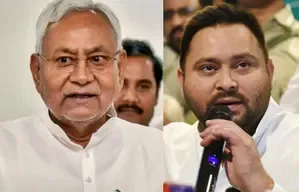
Tejashwi flags Rs 7.41 lakh VVIP toilet in Bihar's poorest district
Synopsis
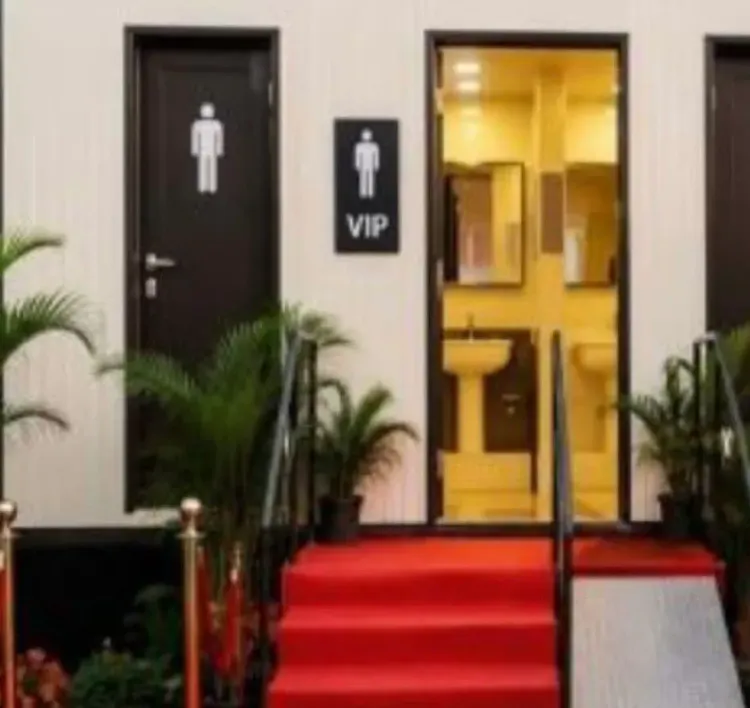
RJD's Tejashwi Yadav has cited an RTI disclosure alleging Bihar spent Rs 7.41 lakh on a temporary VVIP toilet for CM Nitish Kumar's brief Pragati Yatra stop in Araria — enough, he says, to build 37 permanent toilets for the poor under Swachh Bharat Mission.
Key Takeaways
An RTI disclosure cited by Tejashwi Yadav alleges Rs 7.41 lakh was spent on a temporary VVIP toilet during a Pragati Yatra event in Raniganj, Araria .
The facility was reportedly used for only a few seconds during CM Nitish Kumar 's one-hour programme.
Araria is among Bihar's most backward and underdeveloped districts.
Under Swachh Bharat Mission , the government provides Rs 12,000 per household toilet — meaning Rs 7.41 lakh could have funded 37 permanent toilets for poor families.
Yadav noted that even the Rs 12,000 unit cost sees an estimated 20 per cent lost to corruption before reaching beneficiaries.
The Bihar government has not publicly responded to the RTI figures cited in the post.
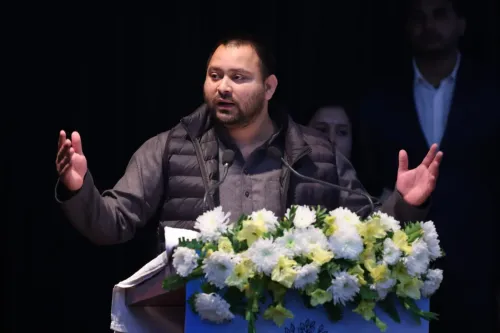
RJD leader and Leader of the Opposition in the Bihar Legislative Assembly, Tejashwi Yadav, on Wednesday, June 10, 2026, alleged that the Bihar government spent Rs 7.41 lakh on a temporary VVIP toilet used for mere seconds during Chief Minister Nitish Kumar's one-hour programme in Raniganj, Araria district — citing a disclosure obtained under the Right to Information Act.
Context
Yadav posted the allegation on X, sharing what he described as an RTI-based revelation about expenditure incurred during the Pragati Yatra, a state government outreach programme. The post states: 'RTI se khulasa hua hai' ('An RTI disclosure has revealed') that a red-carpet-fitted temporary VVIP toilet was constructed at a cost of Rs 7.41 lakh for a programme in which the Chief Minister participated for roughly one hour, with the facility itself used for only a few seconds.
The alleged expenditure took place in Raniganj, a block in Araria — a district in north-eastern Bihar that consistently ranks among the state's most backward on development and poverty indicators. Yadav described the act as a 'karname' ('feat') by the Chief Minister in the state's most deprived region.
Policy Backdrop
Under the Swachh Bharat Mission, the unit cost fixed for constructing an individual household latrine for ordinary citizens is Rs 12,000 — a figure Yadav invoked directly in his post. He noted that even this modest sum is subject to an estimated 20 per cent leakage to corruption, meaning beneficiaries effectively receive less than the full amount.
Yadav drew a pointed arithmetic contrast: at Rs 12,000 per unit, the Rs 7.41 lakh reportedly spent on the single temporary VVIP toilet could have funded the construction of 37 permanent toilets for poor households. The comparison is designed to highlight the gap between administrative privilege and welfare delivery at the grassroots level.
Stakeholders and Impact
Araria is among Bihar's most underdeveloped districts, with high rates of poverty and limited sanitation infrastructure. The allegation, if substantiated, would directly affect public trust in how state funds are allocated during official tours and outreach programmes. Rural households in the district — the intended beneficiaries of schemes like Swachh Bharat — form the core affected group.
Bihar opposition leaders, particularly from the RJD, have a pattern of using RTI-obtained government data to contrast administrative spending on VIP facilities with per-unit costs of welfare infrastructure. This forms part of the broader political contest between the RJD and the ruling JD(U)-BJP alliance over governance accountability and leakages in rural development programmes.
What's Next
The Bihar government has not issued a public response to the specific RTI figures cited in Yadav's post. Any official clarification — or additional RTI disclosures regarding similar temporary facilities constructed during other legs of the Pragati Yatra — could shape how the controversy develops. The matter may also be raised during the next session of the Bihar Legislative Assembly, where Yadav leads the opposition. Whether the ruling alliance contests the figures or offers an explanation for the expenditure will be closely watched.
Point of View
One of Bihar's most visibly underdeveloped districts, he sharpens the symbolic charge against the Nitish Kumar administration. The Swachh Bharat unit-cost comparison is particularly effective because it uses the government's own scheme as the measuring stick, making it difficult for the ruling alliance to dispute the underlying numbers without appearing to defend the expenditure. If the Bihar government does not offer a credible rebuttal, the episode risks becoming a recurring reference point in the opposition's governance narrative ahead of future electoral cycles.
NationPress
20 Sept 2026
Frequently Asked Questions
What did the Bihar RTI reveal about a VVIP toilet?
An RTI disclosure cited by RJD leader Tejashwi Yadav alleges that Bihar spent Rs 7.41 lakh to construct a temporary VVIP toilet, fitted with a red carpet, for CM Nitish Kumar's one-hour Pragati Yatra programme in Raniganj, Araria district — a facility reportedly used for only a few seconds.
Where did the VVIP toilet controversy take place in Bihar?
The alleged expenditure occurred in Raniganj block of Araria district, one of Bihar's most backward and underdeveloped districts in the north-eastern part of the state.
How many Swachh Bharat toilets could have been built with Rs 7.41 lakh?
At the government-fixed unit cost of Rs 12,000 per household toilet under the Swachh Bharat Mission, Rs 7.41 lakh could have funded the construction of 37 permanent toilets for poor families.
What is Pragati Yatra in Bihar?
Pragati Yatra is a state government outreach programme in which Chief Minister Nitish Kumar visits districts across Bihar. The VVIP toilet expenditure is alleged to have occurred during one such visit to Araria.
Has the Bihar government responded to Tejashwi Yadav's VVIP toilet allegation?
As of the time of reporting, the Bihar government has not issued a public response to the specific RTI figures cited by Tejashwi Yadav regarding the Rs 7.41 lakh temporary toilet expenditure.