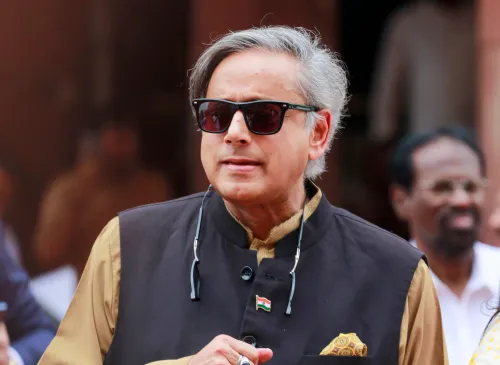
Tharoor argues against India pivoting to China amid US policy uncertainty
Synopsis
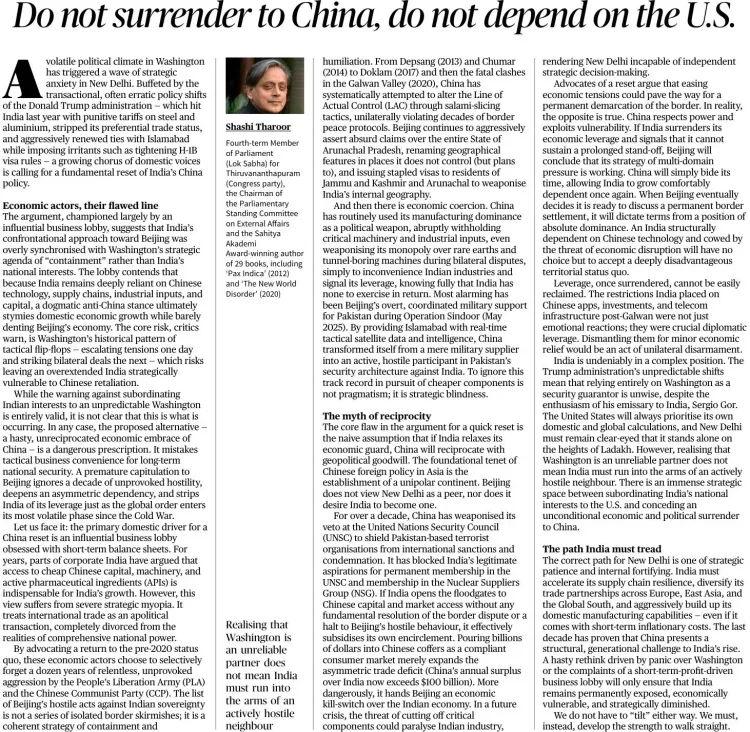
Congress MP Dr. Shashi Tharoor has publicly pushed back against the argument that India should resolve US policy unpredictability by pivoting toward China, staking out a firm multi-alignment position in a widely-read opinion piece published on 27 July 2026.
Key Takeaways
Shashi Tharoor published an article on 27 July 2026 arguing against a China pivot as a response to US policy turbulence.
Tharoor explicitly named and rejected the proposition that 'Washington's unreliability can be resolved by transforming our relationship with China.' India's multi-alignment doctrine dates to the 1991 Look East policy and has been reinforced through Quad membership and foundational defence agreements with the United States .
The June 2020 Galwan Valley clash led India to restrict Chinese investments and diversify supply chains, deepening the security rationale against a Beijing tilt.
The debate is expected to surface in parliamentary discussions during the monsoon session and at the next Quad foreign ministers' meeting.
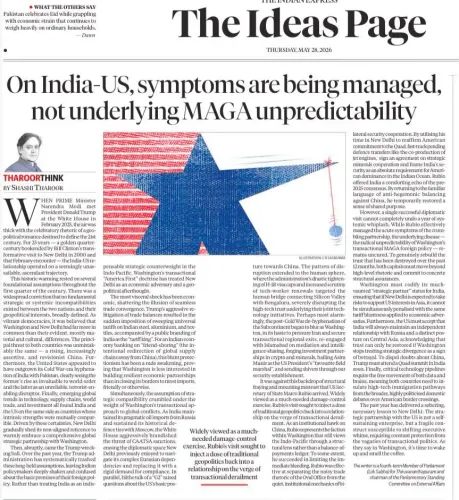
Congress MP Dr. Shashi Tharoor on Monday, 27 July 2026 published an article arguing against the proposition that India should resolve its strategic anxieties over Washington's unpredictability by fundamentally reorienting its relationship toward China. The Thiruvananthapuram MP, a former Union Minister and former UN Under-Secretary-General, laid out his reasoning in a piece carried by a leading Indian English-language daily.
Context
Tharoor's intervention comes amid a recurring debate within India's strategic community: each time United States foreign policy generates turbulence — through tariff swings, shifts in alliance commitments, or unpredictable executive decisions — voices emerge arguing that New Delhi should hedge more decisively by warming ties with Beijing. Tharoor has publicly positioned himself against that conclusion, writing, 'I argue against the case being advanced by some, that the policy turbulence generated by Washington's unreliability can be resolved by transforming our relationship with China.'
Policy Backdrop
India's multi-alignment doctrine has deep roots. The 1991 Look East policy was an early attempt to reduce over-dependence on any single power by deepening engagement with Asian economies. Decades later, the June 2020 Galwan Valley clash — which resulted in fatalities on both sides — prompted New Delhi to restrict Chinese investments, ban hundreds of Chinese applications, and actively diversify supply chains away from Beijing.
Since the early 2010s, India has simultaneously strengthened strategic ties with the United States through frameworks such as the Quad — a grouping that also includes Japan and Australia — and a series of foundational defence agreements. This dual-track approach reflects the tension between the economic pull of China's market and the security logic of US-backed deterrence, a tension that Tharoor's article directly engages.
Stakeholders and Impact
The debate has direct implications for India's defence establishment, its export-oriented industries that depend on stable supply chains, and the broader strategic community that advises the government on external affairs. A pivot toward China — even a partial one — would carry significant consequences for Quad cohesion and for the credibility of the border-management agreements painstakingly negotiated after Galwan.
Tharoor, as a senior opposition MP who sits on parliamentary committees dealing with external affairs, carries institutional weight when he enters this debate. His intervention signals that within the Congress party, there is no appetite for treating a China rapprochement as a straightforward answer to US unreliability.
What's Next
The argument is likely to reverberate in parliamentary discussions on external affairs during the ongoing monsoon session. The next Quad foreign ministers' meeting will also be a key moment to watch, as it will test whether India's multi-alignment posture holds under continued pressure from shifting Washington policy. Tharoor's public stance adds a prominent opposition voice to a conversation that the government will need to address on the floor of Parliament.
Point of View
He is shaping elite discourse ahead of what could be a contentious monsoon session discussion on external affairs. The argument also serves an internal Congress purpose: positioning the party as hawkish on China and committed to multi-alignment, not as an advocate of equidistance. Ultimately, Tharoor's piece reflects the durable consensus within India's strategic establishment that the Galwan rupture fundamentally changed the cost-benefit calculus of any China tilt, regardless of what Washington does.
NationPress
27 Jul 2026
Frequently Asked Questions
What did Shashi Tharoor say about India and China?
Tharoor argued against the proposition that India should resolve its concerns about US policy unpredictability by fundamentally transforming its relationship with China, saying he disagrees with that conclusion.
Why are some people suggesting India should pivot to China?
Some analysts argue that repeated shifts in US foreign policy — including tariff disputes and alliance uncertainty — make Washington an unreliable partner, and that India should therefore deepen ties with China as a strategic hedge.
What is India's current foreign policy stance on China and the US?
India follows a multi-alignment doctrine, maintaining strategic ties with the US through the Quad while managing China relations through diplomacy and deterrence, a posture reinforced after the 2020 Galwan Valley clash.
What was the Galwan Valley clash and why does it matter for India-China relations?
The Galwan Valley clash in June 2020 was a deadly border confrontation between Indian and Chinese troops in Ladakh. It led India to restrict Chinese investments and diversify supply chains, significantly hardening New Delhi's approach to Beijing.
What is the Quad and how does it relate to India's China policy?
The Quad is a strategic grouping of India, the United States, Japan, and Australia. India's membership reflects its alignment with a US-backed security framework in the Indo-Pacific, which would be complicated by any significant tilt toward China.