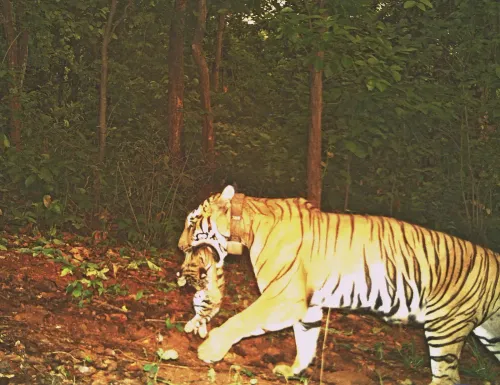
Odisha CM Office: Tigress Zeenat births 4 cubs at Similipal
Synopsis
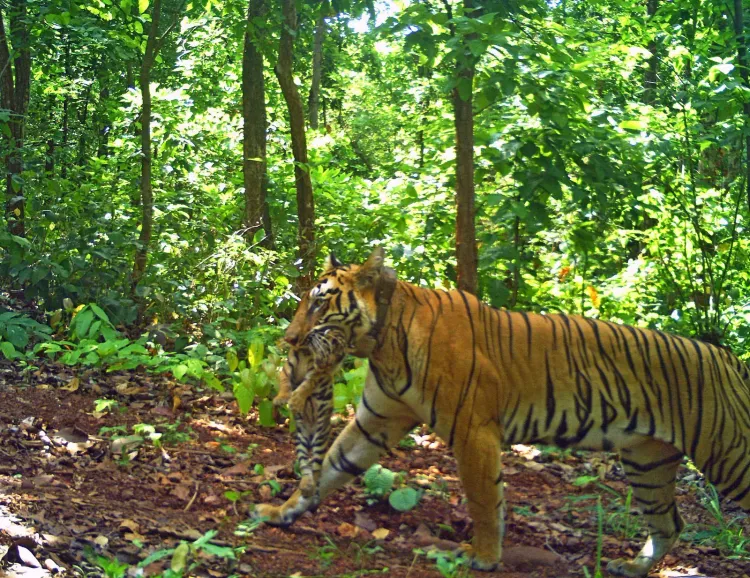
Tigress Zeenat, translocated from Maharashtra's Tadoba-Andhari Tiger Reserve to Odisha's Similipal Tiger Reserve, has given birth to four healthy cubs in the core zone — a milestone the Chief Minister's Office called a landmark success for science-led conservation and genetic diversity efforts at the UNESCO biosphere reserve.
Key Takeaways
Zeenat , a tigress translocated from Tadoba-Andhari Tiger Reserve (Maharashtra) to Similipal Tiger Reserve (Odisha), has delivered four healthy cubs in the reserve's core area.
The birth is the first confirmed offspring from the inter-reserve translocation programme at Similipal , a UNESCO biosphere reserve known for its melanistic tiger population.
The translocation was conducted under NTCA standard operating procedures designed to improve genetic diversity in isolated tiger populations.
Similipal was prioritised for genetic augmentation due to its historically small and geographically isolated tiger population.
The development is seen as validation of India's shift from passive protection to active, science-led tiger population management under Project Tiger .
Odisha's forest staff were credited by the CMO for their dedicated on-ground monitoring role throughout the process.
The Chief Minister's Office of Odisha announced on Tuesday, June 2, 2026 that Zeenat, a tigress translocated from Tadoba-Andhari Tiger Reserve in Maharashtra to Similipal Tiger Reserve, has given birth to four healthy cubs in the core area of the reserve — marking a landmark moment for the state's wildlife conservation programme.
Context
The birth was confirmed in the core zone of Similipal Tiger Reserve, a UNESCO biosphere reserve in Odisha known for hosting one of the world's only populations of melanistic, or 'black', tigers. The CMO described the development as 'a landmark success for Odisha's wildlife conservation efforts,' noting that the milestone 'strengthens Similipal's tiger population and genetic diversity.' The four cubs are the first confirmed offspring from the inter-reserve translocation programme at Similipal.
Policy Backdrop
Similipal has historically maintained a small and geographically isolated tiger population, making it a priority site for genetic augmentation under India's active population-management strategy. The translocation of Zeenat from Tadoba-Andhari Tiger Reserve — one of the highest-density tiger habitats in central India, located in Maharashtra — was carried out under standard operating procedures issued by the National Tiger Conservation Authority (NTCA) in 2013 to counter inbreeding and habitat fragmentation in isolated reserves.
Project Tiger, launched in 1973 as India's flagship centrally sponsored conservation programme, laid the institutional groundwork for such interventions. Over five decades, the programme evolved from simple anti-poaching measures to science-led population management, with inter-reserve translocations now forming a core tool in sustaining national tiger numbers across successive All-India Tiger Estimation cycles.
Stakeholders and Impact
The CMO specifically credited the 'dedicated efforts of our forest staff' for the successful outcome, acknowledging the on-ground role of Odisha's forest department in monitoring and protecting Zeenat through her gestation in the core area. Wildlife conservationists have long argued that genetic exchange between reserves is essential to prevent population collapse in smaller habitats, and the birth of four cubs provides direct, measurable evidence of that strategy bearing fruit.
Local tribal communities living in and around Similipal are longstanding stakeholders in the reserve's ecology. A growing and genetically healthier tiger population has implications for both conservation outcomes and the broader human-wildlife interface in the region, an area that wildlife managers and policymakers will continue to monitor closely.
What's Next
Attention will now turn to the survival and development of the four cubs, with the NTCA and Odisha forest department expected to track their progress as part of ongoing population monitoring. The next All-India Tiger Estimation report will be a key indicator of whether translocations into Similipal have produced a statistically significant uplift in the reserve's tiger count. Officials and conservationists will also watch for any NTCA announcements regarding further planned translocations into Similipal or other genetically vulnerable reserves across the country.
Point of View
The announcement carries political as well as ecological weight, positioning the state as a proactive conservation actor at a time when national tiger numbers and reserve health are under close scrutiny ahead of the next All-India estimation. The CMO's emphasis on 'science-led conservation' signals an intent to align state policy with the broader NTCA framework, potentially strengthening the case for further inter-reserve translocations. How the four cubs fare over the coming months will be the real test of whether Similipal can sustain a recovered, genetically diverse population long-term.
NationPress
20 Sept 2026
Frequently Asked Questions
Who is Zeenat the tigress and where did she come from?
Zeenat is a tigress who was translocated from Tadoba-Andhari Tiger Reserve in Maharashtra to Similipal Tiger Reserve in Odisha as part of a genetic augmentation programme approved by the National Tiger Conservation Authority .
How many cubs has Zeenat given birth to at Similipal?
Zeenat has given birth to four healthy cubs in the core area of Similipal Tiger Reserve , as announced by the Chief Minister's Office of Odisha on June 2, 2026 .
Why was a tigress translocated from Tadoba to Similipal?
The translocation was carried out to improve genetic diversity at Similipal , whose tiger population has historically been small and isolated, making it vulnerable to inbreeding. The NTCA issued standard operating procedures for such translocations in 2013 .
What is Similipal Tiger Reserve known for?
Similipal Tiger Reserve in Odisha is a UNESCO biosphere reserve renowned for hosting one of the world's only known populations of melanistic ('black') tigers, in addition to being a key site under India's Project Tiger programme.
What is Project Tiger and how does it relate to this development?
Project Tiger is a centrally sponsored conservation programme launched in 1973 to protect tigers and their habitats across designated reserves. The translocation of Zeenat and the resulting cubs represent the programme's evolution toward active population management to sustain India's wild tiger numbers.