TN CM Vijay urges PM Modi to block Mekedatu Dam approval, cites SC verdict
Synopsis
Tamil Nadu CM C. Joseph Vijay has formally asked PM Modi to block Mekedatu Dam approvals, calling a recent Rajya Sabha reply by the Jal Shakti ministry 'legally unsustainable.' The letter invokes the Supreme Court's Alamatti Dam precedent and the CWDT Award — escalating a decades-old inter-state water dispute into a direct Centre-state confrontation.
Key Takeaways
Joseph Vijay wrote to PM Narendra Modi on 28 July opposing Karnataka's Mekedatu Dam project.
Vijay argued the project would violate the Cauvery Water Disputes Tribunal (CWDT) Award and the Supreme Court's 2018 judgment .
The letter was triggered by a Rajya Sabha reply from the Union Minister of State for Jal Shakti , which stated the 2018 SC judgment did not require Karnataka to seek downstream states' consent.
Vijay cited the Alamatti Dam Constitution Bench ruling, which held that upstream states must obtain downstream consent before such projects.
Tamil Nadu has demanded withdrawal of the Rajya Sabha reply, a halt to all Mekedatu approvals, and a full legal and technical review before any further consideration.
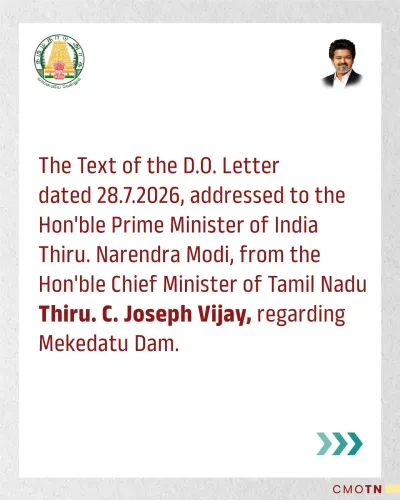
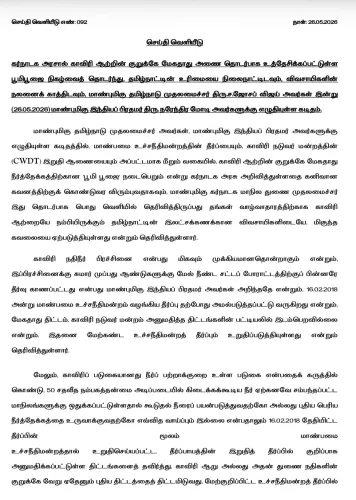
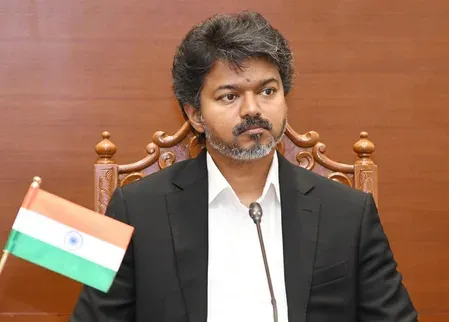
Tamil Nadu Chief Minister C. Joseph Vijay has written to Prime Minister Narendra Modi, urging the Union government to withhold all statutory and administrative approvals for Karnataka's proposed Mekedatu Dam project. In his letter dated 28 July, the Chief Minister contended that clearing the project would directly violate the Cauvery Water Disputes Tribunal (CWDT) Award and the Supreme Court's 2018 judgment on the Cauvery water-sharing dispute.
What Prompted the Letter
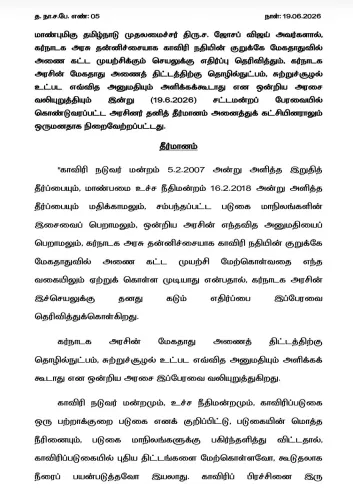
The trigger was a reply given by the Union Minister of State for Jal Shakti in the Rajya Sabha, which stated that the Supreme Court's 16 February 2018 judgment did not expressly require Karnataka to obtain the consent of lower riparian states before constructing any structure across the Cauvery River. Chief Minister Vijay described this response as 'legally unsustainable' and argued it overlooked settled judicial principles governing inter-state river disputes.
The Legal Argument
Vijay invoked the Supreme Court's Constitution Bench judgment in the Alamatti Dam case between Karnataka and Andhra Pradesh, in which the court held that the consent of downstream riparian states was essential before an upstream state could undertake such projects. He argued this principle applies squarely to the Mekedatu proposal and cannot be sidestepped.
The letter further noted that the Supreme Court, while upholding the CWDT Award in 2018, affirmed that states could regulate water within their territories only in a manner consistent with the Tribunal's directions. Vijay also cited the Tribunal's earlier insistence on coordinated water releases for Kerala's Pambar Hydro-electric Project as precedent for protecting downstream interests.
What Tamil Nadu Has Demanded
Chief Minister Vijay made three specific requests to the Prime Minister. First, that the Centre withdraw the Rajya Sabha reply. Second, that no approval be granted to the Mekedatu project unless it fully complies with the CWDT Award and the Supreme Court judgment. Third, that any future consideration of the project be preceded by a comprehensive legal and technical examination involving all affected states.
The letter also invoked provisions of the Tribunal Award that require mutual agreement and consultation before any action affecting scheduled water deliveries can be taken — a procedural safeguard Vijay argued Karnataka has not fulfilled.
Why the Cauvery Dispute Remains Sensitive
The Cauvery River is the primary water source for millions of farmers and residents across Tamil Nadu, Karnataka, Kerala, and Puducherry. The Mekedatu project, proposed by Karnataka as a balancing reservoir near Bengaluru, has long drawn opposition from Tamil Nadu, which fears it would allow Karnataka to regulate flows and reduce downstream water availability. This is not the first time Tamil Nadu has formally objected — successive state governments have raised the issue at the Centre and before the Supreme Court over several years.
With the Union government's Rajya Sabha reply now interpreted by Chennai as a shift in the Centre's legal reading, the dispute has entered a politically charged new phase ahead of the next Cauvery review cycle.
Point of View
Not the dam itself. By framing the Centre's legal reading as 'unsustainable,' Vijay is doing something more consequential than routine inter-state objection: he is putting the Union government on notice that Tamil Nadu will contest any approval in court. The Alamatti Dam precedent he cites is well-established, and if the Centre proceeds without addressing it, litigation is near-certain. What mainstream coverage misses is that this dispute is also a test of how the Modi government manages coalition optics — Karnataka is a BJP-ruled state, while Tamil Nadu is governed by the DMK, an ally of the opposition INDIA bloc. The Centre's next move will be read through that lens as much as a legal one.
NationPress
27 Oct 2026
Frequently Asked Questions
What is the Mekedatu Dam project and why is Tamil Nadu opposed to it?
The Mekedatu Dam is a balancing reservoir proposed by Karnataka on the Cauvery River near Bengaluru. Tamil Nadu opposes it on the grounds that it would allow Karnataka to regulate downstream flows, reducing water availability for Tamil Nadu farmers and residents, and that it violates the CWDT Award and the Supreme Court's 2018 Cauvery judgment.
What did the Jal Shakti ministry say in the Rajya Sabha that triggered CM Vijay's letter?
The Union Minister of State for Jal Shakti stated in the Rajya Sabha that the Supreme Court's 16 February 2018 judgment did not expressly require Karnataka to obtain the consent of lower riparian states before constructing structures on the Cauvery. Tamil Nadu CM Vijay called this reading 'legally unsustainable.'
Which Supreme Court judgments has Tamil Nadu cited in its objection?
Tamil Nadu has cited two rulings: the Supreme Court's 2018 judgment upholding the CWDT Award on Cauvery water-sharing, and the Constitution Bench judgment in the Alamatti Dam case between Karnataka and Andhra Pradesh, which held that upstream states must secure downstream consent before undertaking such projects.
What has Tamil Nadu specifically asked the Centre to do?
Tamil Nadu has asked the Centre to withdraw the Rajya Sabha reply, ensure no statutory or administrative approval is granted to the Mekedatu project unless it complies with the CWDT Award and Supreme Court judgment, and mandate a comprehensive legal and technical review before any future consideration of the project.
Why does the Cauvery water dispute matter beyond Tamil Nadu and Karnataka?
The Cauvery is the primary water source for millions of people across Tamil Nadu, Karnataka, Kerala, and Puducherry. Any upstream intervention that alters flow volumes has direct consequences for agriculture and drinking water supply in these states, making it one of India's most politically and legally contested inter-state river disputes.