UP govt plans free sanitary pads for girl students in govt schools
Synopsis
Uttar Pradesh is preparing to provide free sanitary pads to girl students in government schools — a move that also targets the deep-rooted stigma around menstruation. With a multi-department committee now coordinating on hygiene products, awareness campaigns, and disposal infrastructure, the Yogi Adityanath government is framing this as a comprehensive health and education intervention, not just a welfare handout.
Key Takeaways
The Yogi Adityanath -led Uttar Pradesh government is preparing a roadmap to supply free sanitary pads to girl students in government and government-aided schools.
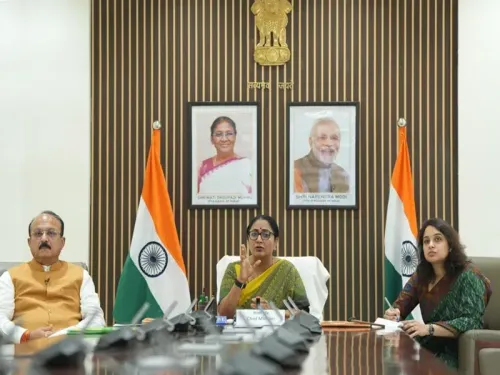
The plan was discussed at the State-Level Menstrual Health and Hygiene Committee meeting chaired by Principal Secretary V.
Hekali Zhimomi on 16 November 2026 in Lucknow .
Officials called for menstrual health education to be integrated into regular school activities, with information provided before the onset of menstruation.
Comprehensive awareness campaigns will target communities with strong cultural barriers, using community platforms, departmental channels, and digital media.
Safe and environmentally friendly disposal infrastructure for used sanitary products will be developed, with the Urban Development and Panchayati Raj departments playing a key role.
Representatives from at least 8 departments including National Health Mission, Women and Child Development, and Social Welfare participated in the deliberations.
The Yogi Adityanath-led Uttar Pradesh government is drawing up a roadmap to provide free sanitary pads to girl students enrolled in government and government-aided schools across the state, officials said on Monday, 16 November 2026. The initiative, discussed at a high-level inter-departmental meeting in Lucknow, seeks to guarantee equitable access to menstrual hygiene products while actively dismantling the social stigma and misconceptions that continue to surround menstruation in many communities.
Key Decisions From the State-Level Committee Meeting
The deliberations took place at a meeting of the State-Level Menstrual Health and Hygiene Committee, held at the Annexy Building in Lucknow. The meeting was chaired by V. Hekali Zhimomi, Principal Secretary of Medical Health and Family Welfare, and brought together representatives from the National Health Mission, Health and Family Welfare, Basic and Secondary Education, Women and Child Development, Panchayati Raj, Urban Development, and Social Welfare departments, among others.
Officials stressed that menstrual health education must become an integral part of regular school activities, with age-appropriate information reaching girls before the onset of menstruation — equipping them to understand puberty-related physical changes and adopt healthy hygiene practices from the outset.
Awareness Campaigns and Community Outreach
Beyond product access, the state government intends to roll out comprehensive awareness campaigns through community platforms, departmental channels, and digital and social media. The campaigns will specifically target communities where cultural barriers and limited awareness prevent girls from discussing menstrual health openly. Officials said the goal is to encourage frank conversations about menstruation and ensure adolescent girls have access to accurate, stigma-free guidance.
Infrastructure for Safe Disposal
The committee also highlighted the pressing need to establish proper arrangements for the safe and environmentally friendly disposal of used sanitary products. Officials discussed upgrading disposal infrastructure in both urban and rural areas, with the Urban Development and Panchayati Raj departments expected to take a lead role in building out the necessary facilities.
What Happens Next
The roadmap is currently in preparation, and no formal rollout date has been announced. Officials indicated that inter-departmental coordination will be strengthened to translate the committee's recommendations into on-ground action. The initiative, if implemented effectively, could benefit millions of adolescent girls across Uttar Pradesh, India's most populous state, where menstrual health access and awareness remain unevenly distributed.
Point of View
But the absence of a rollout date or budget figure makes it difficult to assess seriousness. Uttar Pradesh has a patchy record on girls' health schemes — good at the committee stage, inconsistent at delivery. The multi-department structure is both a strength and a risk: more stakeholders means broader reach, but also more coordination failure points. The real test will be whether the sanitary pad distribution reaches rural and semi-urban schools in districts like Bahraich, Shravasti, and Chandauli, where menstrual health awareness and infrastructure are most deficient — and where committee meetings in Lucknow rarely translate into action fast enough.
NationPress
16 Nov 2026
Frequently Asked Questions
What is the UP government's plan for free sanitary pads in schools?
The Uttar Pradesh government is preparing a roadmap to distribute free sanitary pads to girl students in government and government-aided schools across the state. The plan was discussed at the State-Level Menstrual Health and Hygiene Committee meeting in Lucknow on 16 November 2026, though a formal rollout date has not yet been announced.
Which departments are involved in Uttar Pradesh's menstrual health initiative?
At least eight departments are involved, including the National Health Mission, Health and Family Welfare, Basic and Secondary Education, Women and Child Development, Panchayati Raj, Urban Development, and Social Welfare. The coordination is being led by Principal Secretary V. Hekali Zhimomi.
How will UP address the social stigma around menstruation?
The state government plans comprehensive awareness campaigns through community platforms, departmental channels, and digital and social media to eliminate hesitation and misconceptions. Special focus will be on communities where cultural barriers prevent open discussion of menstrual health.
What provisions are being made for disposal of sanitary products in UP?
The committee discussed establishing safe and environmentally friendly disposal facilities for used sanitary products in both urban and rural areas. The Urban Development and Panchayati Raj departments are expected to lead the necessary infrastructure upgrades.
Why is this initiative significant for Uttar Pradesh?
Uttar Pradesh is India's most populous state, and menstrual health access and awareness remain unevenly distributed — particularly in rural districts. By combining free product access, school-based education, and community awareness, the initiative addresses multiple barriers that keep adolescent girls from managing menstruation safely and openly.