Uttarakhand's Disaster Model Showcased at BRICS Forum
Synopsis
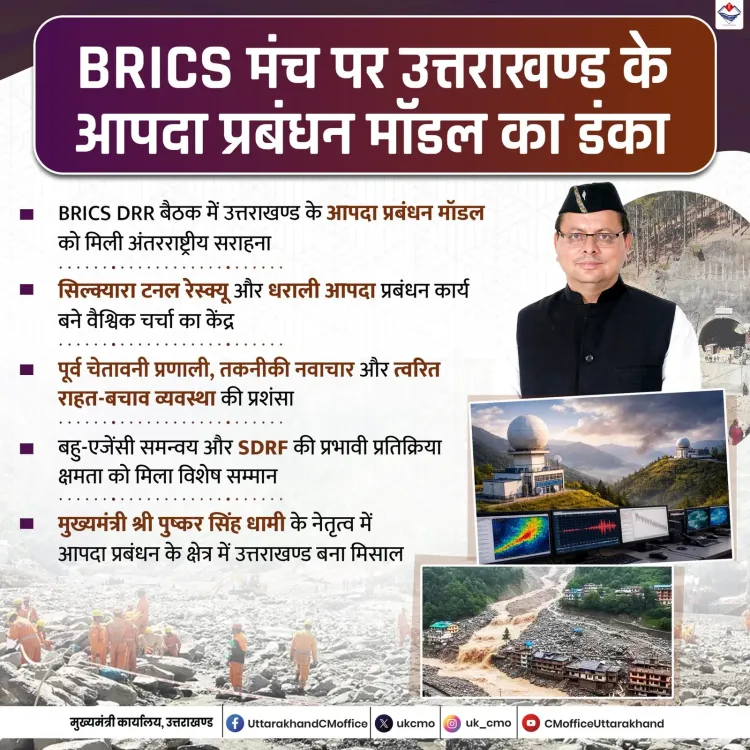
Uttarakhand's Chief Minister's Office announced on 20 June 2026 that the state's disaster management model was presented and recognised at the BRICS forum, highlighting India's push to share sub-national resilience frameworks on multilateral platforms.
Key Takeaways
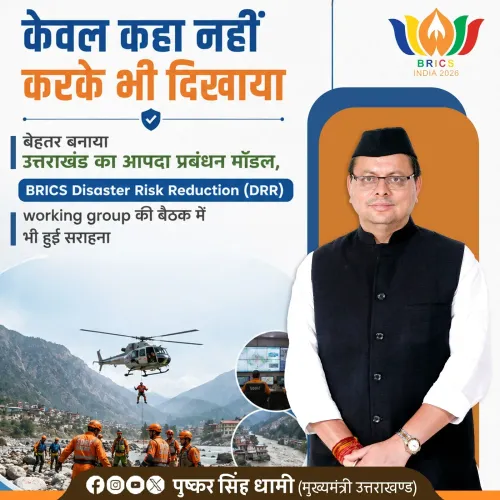
Uttarakhand's disaster management model was showcased on the BRICS platform, as announced by the Chief Minister's Office on 20 June 2026 .
The state's framework was overhauled after the devastating 2013 Kedarnath floods , introducing early-warning systems and district-level rapid response teams.
BRICS has a track record of including disaster risk reduction in its cooperative agenda alongside economic discussions.
The National Disaster Management Authority (NDMA) , established in 2005 , underpins the national policy framework within which Uttarakhand's model operates.
The presentation signals potential for South-South knowledge transfer , with other Himalayan and coastal states likely to monitor Uttarakhand's approach for replication.
The Chief Minister's Office of Uttarakhand announced on Saturday, 20 June 2026 that the state's disaster management model had been presented and recognised on the BRICS platform, marking a significant moment of international acknowledgement for the Himalayan state's preparedness framework.
Context
The official post from Uttarakhand's Chief Minister's Office declared, in Hindi, 'BRICS ke manch par Uttarakhand ke aapda prabandhan model ka danka' — loosely translated as 'Uttarakhand's disaster management model resounds on the BRICS stage.' The announcement positions the state as a contributor of practical, field-tested solutions to a multilateral forum more commonly associated with economic and geopolitical discussions.
BRICS — the grouping that includes Brazil, Russia, India, China and South Africa, along with several newer partner nations — has increasingly incorporated disaster risk reduction into its cooperative agenda alongside trade and development cooperation.
Policy Backdrop
Uttarakhand's focus on disaster preparedness is rooted in hard experience. The catastrophic 2013 Kedarnath floods, which caused widespread destruction across the state, prompted a comprehensive overhaul of the state's disaster management architecture. That overhaul introduced new early-warning systems and district-level rapid response teams coordinated through the Uttarakhand State Disaster Management Authority.
At the national level, the National Disaster Management Authority (NDMA), established in 2005, provides the policy framework within which state-level bodies like Uttarakhand's operate. The state's community-based preparedness initiatives and technology-enabled alert systems have since drawn attention as a replicable model for other ecologically fragile regions.
Stakeholders and Impact
The primary beneficiaries of Uttarakhand's disaster management model are the hill communities spread across the state's ecologically sensitive terrain — populations that face recurring threats from floods, landslides and seismic activity. Effective early-warning and rapid-response mechanisms directly reduce casualties and economic losses in these areas.
Beyond the state's borders, the BRICS presentation signals potential for South-South knowledge transfer — an approach New Delhi has championed through multilateral forums to share India's operational experience with member nations facing similar climate and terrain challenges. Other Himalayan and coastal states within India may also look to adapt elements of the Uttarakhand framework.
What's Next
The showcasing of Uttarakhand's model at the BRICS level is likely to be followed by engagement at working-group or ministerial sessions on disaster risk reduction within the grouping. Observers will watch whether any BRICS member governments or other Indian states formally initiate replication of the state's preparedness protocols.
As climate-linked disasters grow in frequency across Asia and the Global South, sub-national models that demonstrate measurable resilience outcomes are increasingly sought after in multilateral settings — placing Uttarakhand in a position to influence policy well beyond its borders.
Point of View
Which has faced severe criticism over past disaster responses, international recognition also carries domestic political weight. The development fits a wider arc in which ecologically vulnerable Indian states are transforming hard-won crisis experience into exportable governance frameworks.
NationPress
20 Jun 2026
Frequently Asked Questions
What is Uttarakhand's disaster management model?
Uttarakhand's disaster management model is a framework developed after the 2013 Kedarnath floods, featuring community-based preparedness, early-warning systems and district-level rapid response teams coordinated through the State Disaster Management Authority.
Why was Uttarakhand's model presented at BRICS?
BRICS has an ongoing track on disaster risk reduction among member states, and India has used such multilateral forums to share operational experience from ecologically fragile regions like the Himalayas.
What is BRICS and which countries are members?
BRICS is a multilateral grouping originally comprising Brazil, Russia, India, China and South Africa, later expanded with additional partner nations, that cooperates on economic, political and non-traditional security issues including disaster management.
What role does the NDMA play in Uttarakhand's disaster preparedness?
The National Disaster Management Authority, established in 2005, is India's apex policy body for disaster management and provides the national framework within which state authorities like Uttarakhand's operate.
Which other Indian states could replicate Uttarakhand's disaster model?
Other Himalayan states such as Himachal Pradesh and Sikkim, as well as coastal states prone to cyclones and flooding, are potential candidates to adapt elements of Uttarakhand's community-based preparedness and technology-enabled alert systems.