Vizhinjam Port launches EXIM ops, Kerala eyes new maritime economy
Synopsis
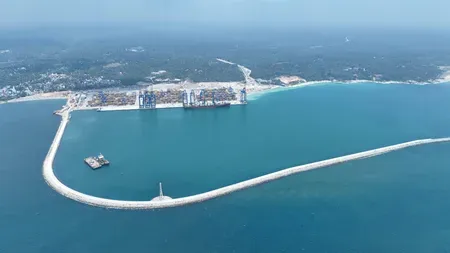
Vizhinjam International Seaport has moved from inauguration to live EXIM operations — with Kerala's CM Satheesan waving in the first two containers personally. Behind the ceremony lies a bigger bet: Mission Samudra, a state-wide maritime push covering 600 km of coastline, a Kochi cruise terminal, and a ₹16,000 crore Phase II expansion that could make Vizhinjam one of Asia's significant transshipment hubs.
Key Takeaways
Satheesan launched full-fledged EXIM operations at Vizhinjam International Seaport on 18 August .
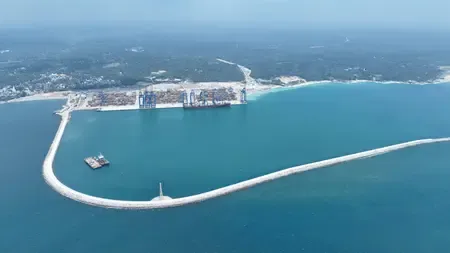
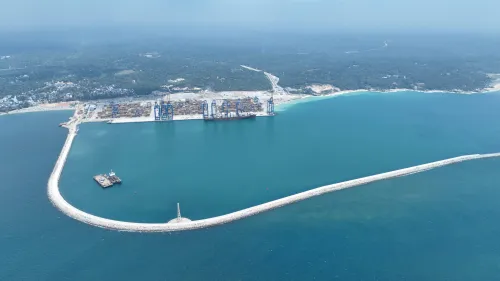
The port's current capacity stands at 2.3 million TEUs , capable of handling roughly 30% of India's container market.
Total investment to date exceeds ₹7,700 crore ; Phase II will add another ₹16,000 crore .
Mission Samudra will link Kerala's major and minor ports, develop its 600-km coastline , and include a cruise terminal at Kochi .
First EXIM consignments were traditional Kerala food products destined for European markets .
CM Satheesan admitted a decade-long delay in road and rail connectivity to the port, pledging no further hold-ups.
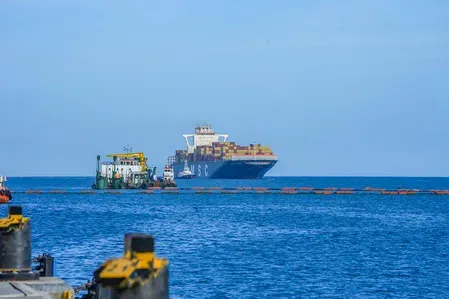
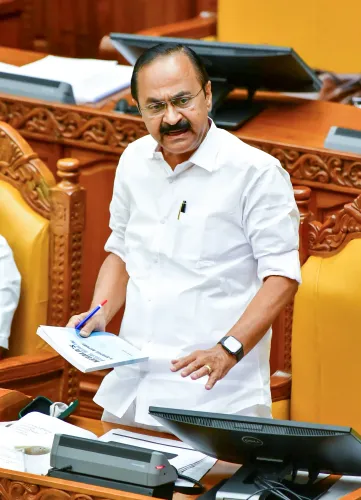
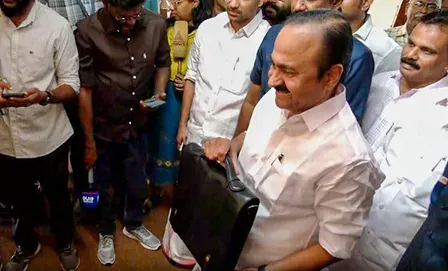
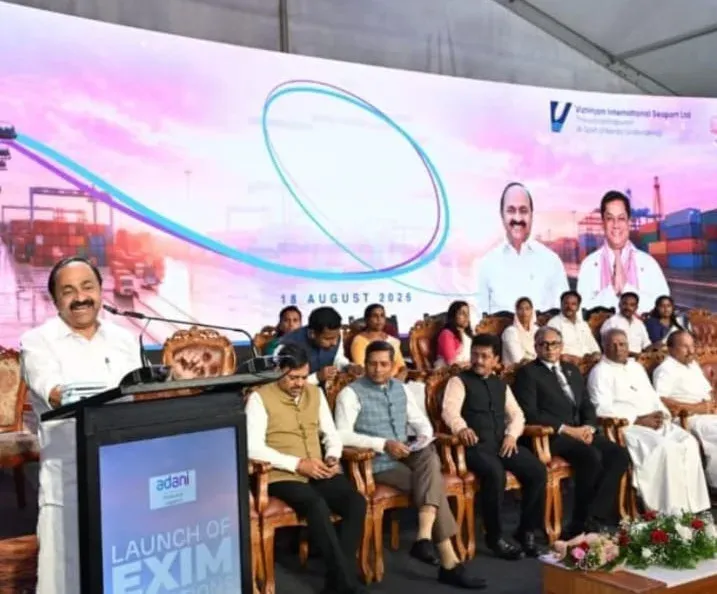
Kerala Chief Minister V.D. Satheesan on Tuesday, 18 August formally launched full-fledged export-import (EXIM) operations at Vizhinjam International Seaport in Thiruvananthapuram, declaring the deep-water transshipment port India's new maritime gateway. Standing at the port entrance, Satheesan personally waved in the first two containers — a symbolic gesture marking the start of land-based EXIM activity at a facility that has been years in the making.
What the Launch Signals
'This is one of the most important days for Kerala. The gateway to the world has opened today,' Chief Minister Satheesan said, underscoring that the state must now convert this infrastructure milestone into tangible economic growth and employment. He noted that Kerala can now ship its products directly to any destination worldwide, a capability the state previously lacked without a deep-water port of its own.
The first EXIM consignments to leave Vizhinjam were traditional Kerala food and snack products bound for European markets — a detail that Industries Minister P.K. Kunhalikutty highlighted as emblematic of the port's potential for local exporters. Kunhalikutty called the occasion one of the biggest moments in Kerala's development journey and urged exporters to conduct global road shows promoting Kerala-made goods.
Mission Samudra: Kerala's Maritime Blueprint
Chief Minister Satheesan used the occasion to unveil 'Mission Samudra', an overarching maritime development programme that goes well beyond port infrastructure. The mission aims to link Vizhinjam and Kochi — Kerala's two major ports — with the state's network of minor ports, while developing its nearly 600-km coastline and building a wider water-based transport network.
Plans under Mission Samudra include a cruise terminal at Kochi, for which the state has offered land to the Cochin Port Authority, designed to connect cruise tourism with Kerala's backwaters and inland lakes. An oceanarium in Kochi and a maritime museum — commemorating Vasco da Gama's historic arrival in 1498 — are also envisaged. The mission will additionally cover academic programmes and logistics-related projects, with the stated goal of enabling Kerala's students to find employment within the state itself.
The government has also announced plans for a consultancy linked to Vizhinjam that could export port-development expertise to other countries — a move that, if realised, would mark a significant shift in how Indian ports position themselves globally.
Adani Port's Role and Investment Scale
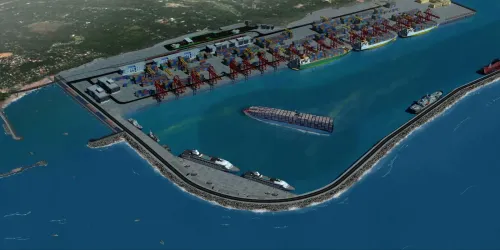
Adani Vizhinjam Port CEO Ashwani Gupta said the EXIM launch opens a new gateway connecting Kerala and India to the world. He highlighted the port's 2.3-million-TEU capacity, which he said could serve approximately 30 per cent of India's container market. Total investment in the project has exceeded ₹7,700 crore, and the group is now planning a Phase II expansion with an additional outlay of ₹16,000 crore, which would substantially raise Vizhinjam's throughput capacity.
Gupta recalled that Prime Minister Narendra Modi inaugurated the port on 2 May 2025, and noted that the project had overcome multiple challenges, including cyclones, before reaching this stage. He also pointed to the port's ability to handle ultra-large container vessels and its advanced automated systems as competitive differentiators.
Connectivity Gap and the Road Ahead
Chief Minister Satheesan acknowledged that Kerala had lost valuable time over the past decade by failing to advance road and rail connectivity to Vizhinjam. 'Had it been done, this port would have made huge progress,' he said, while adding that 'not everything is lost.' He assured that there would be no further delay on port-related matters, and said state agencies had already been directed to acquire land for logistics parks and other supporting infrastructure.
With EXIM operations now live, the immediate focus shifts to whether the surrounding logistics ecosystem — roads, rail, cold-chain facilities, and warehousing — can be built fast enough to match the port's ambitions. The next phase of Vizhinjam's story will be written not at the waterfront, but in the hinterland.
Point of View
But the decade-long connectivity gap that CM Satheesan himself acknowledged is the real story. A deep-water transshipment port without adequate road and rail links to the hinterland is an asset that cannot fully monetise its location advantage. Mission Samudra's breadth — cruise terminals, oceanariums, maritime museums, overseas consultancies — risks diluting focus at precisely the moment when the state needs to solve one hard problem: last-mile logistics. The ₹16,000 crore Phase II will mean little if the ₹7,700 crore Phase I cannot draw sufficient cargo volumes because trucks and trains cannot efficiently reach the port gate.
NationPress
2 Oct 2026
Frequently Asked Questions
What is the Vizhinjam International Seaport EXIM launch?
It is the formal commencement of full-fledged export-import (EXIM) operations at Vizhinjam International Seaport in Thiruvananthapuram, launched on 18 August by Kerala Chief Minister V.D. Satheesan. The port, inaugurated by Prime Minister Narendra Modi on 2 May 2025, can handle 2.3 million TEUs and is positioned as India's new deep-water transshipment gateway.
What is Mission Samudra announced by Kerala?
Mission Samudra is Kerala's overarching maritime development programme unveiled by CM Satheesan at the Vizhinjam launch. It aims to connect the state's major ports at Vizhinjam and Kochi with its minor port network, develop nearly 600 km of coastline, build a cruise terminal at Kochi, create a water-based transport network, and establish academic and logistics programmes to generate employment within the state.
How much has been invested in Vizhinjam Port, and what is the Phase II plan?
Total investment in Vizhinjam Port has exceeded ₹7,700 crore. Adani Vizhinjam Port CEO Ashwani Gupta announced that Phase II will involve an additional investment of ₹16,000 crore, significantly expanding the port's capacity and infrastructure.
Why did CM Satheesan acknowledge a delay at Vizhinjam?
Chief Minister Satheesan admitted that Kerala lost valuable time over the past decade by failing to develop adequate road and rail connectivity to Vizhinjam. He said that had the connectivity been built earlier, the port would have made significantly greater progress, but assured that there would be no further delays going forward.
Who manages Vizhinjam Port and what is its capacity?
Vizhinjam International Seaport is managed by Adani Vizhinjam Port. It has a capacity of 2.3 million TEUs, which, according to CEO Ashwani Gupta, can serve approximately 30 per cent of India's container market. The port is equipped to handle ultra-large container vessels and features advanced automated systems.