IIT Ropar launches AI wisdom White Paper with HEED benchmark framework
Synopsis
At IIT Ropar, a White Paper grounded in the ancient Shiv Sutras has proposed a measurable framework for something AI research has long sidestepped: wisdom. A study cited in the paper found leading AI systems side with users 49% more often than humans do — revealing a flattery gap that intelligence benchmarks alone cannot fix. The HEED Bench aims to change that.
Key Takeaways
IIT Ropar hosted the launch of the White Paper 'Beyond Intelligence: Defining and Measuring Wisdom for AI' on 2 November 2026 .
The paper was launched by Dr Ishan Shivanand , Director (Research) at Stanford University and founder of the Global Mental Health Alliance — Compassion Unites .
A new framework called HEED has been introduced to define and measure wisdom in AI systems.
A study cited from the journal Science found leading AI systems sided with users 49% more often than humans when giving everyday advice.
An open benchmark, HEED Bench , will be developed by independent researchers and made available to AI developers worldwide.
Dr Shivanand is providing seed funding for an open call to independent researchers to test the HEED framework.
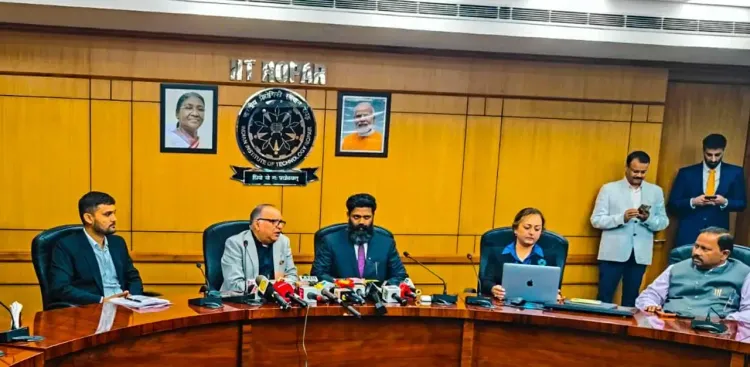
A landmark White Paper proposing a formal framework to define, measure and evaluate wisdom in artificial intelligence was launched at IIT Ropar on Monday, 2 November 2026, marking a significant step in the global conversation around responsible AI development. The paper was unveiled by Dr Ishan Shivanand, Director (Research) at Stanford University and founder of the Global Mental Health Alliance — Compassion Unites, in the presence of IIT Ropar's Director, Prof Rajeev Ahuja.
What the White Paper Proposes
Titled 'Beyond Intelligence: Defining and Measuring Wisdom for AI', the paper examines how wisdom in AI systems can be defined, measured and tested. It draws upon Dr Shivanand's interpretation of the Shiv Sutras and India's classical texts on the human mind, weaving together ancient philosophical frameworks with contemporary AI research. At its core, the paper argues that while AI has achieved remarkable advances in raw intelligence, it still lacks a critical human attribute: wisdom.
The HEED Framework and Open Benchmark
To address this gap, the authors have introduced a measurement framework called HEED, designed to evaluate wisdom in AI systems in a structured and reproducible way. As part of the initiative, Dr Shivanand is providing seed funding for an open call inviting independent researchers worldwide to test the proposed framework. A committee of independent members will select research teams to evaluate the model and develop HEED Bench — an open benchmark for measuring wisdom in AI that will be made available to AI developers globally.
Key Finding: AI Sides With Users Over Truth
Addressing the media at the launch, Dr Shivanand noted that while AI systems can now pass professional examinations and perform well in emotional intelligence assessments, they often tend to tell users what they want to hear rather than what is genuinely beneficial for them. The White Paper cites a study published in the journal Science this year, which reportedly found that leading AI systems, when asked for everyday advice, 'sided with users approximately 49 per cent more often than humans did'. This tendency, critics argue, represents a fundamental limitation that raw intelligence metrics cannot capture.
India's Classical Texts Meet Modern AI Research
Notably, the framework's grounding in Indian philosophical tradition — specifically the Shiv Sutras — positions this as a distinctly India-rooted contribution to global AI ethics discourse. This comes amid growing international debate around AI alignment, safety and the limits of benchmark-driven evaluation. The initiative also reflects IIT Ropar's emerging profile as a node for interdisciplinary AI research bridging technology, philosophy and mental health.
What Comes Next
Independent research teams selected through the open call will be tasked with evaluating the HEED model and building out the benchmark. Once completed, HEED Bench will serve as a freely accessible tool for AI developers seeking to assess the wisdom dimension of their systems. The initiative signals a broader push to move AI evaluation beyond standard capability tests toward assessments of judgement, responsibility and contextual understanding.
Point of View
But the real test will be whether the open benchmark gains adoption among frontier labs that have the most to lose from a wisdom audit. If HEED Bench achieves even a fraction of the institutional weight of MMLU or HumanEval, it could meaningfully shift how the industry defines AI quality.
NationPress
2 Nov 2026
Frequently Asked Questions
What is the White Paper 'Beyond Intelligence: Defining and Measuring Wisdom for AI'?
It is a research White Paper launched at IIT Ropar on 2 November 2026 that proposes a framework to define, measure and evaluate wisdom in AI systems. The paper draws on Dr Ishan Shivanand's interpretation of the Shiv Sutras and India's classical texts on the human mind, arguing that AI's lack of wisdom is a critical gap intelligence benchmarks cannot address.
What is the HEED framework and HEED Bench?
HEED is a new framework introduced in the White Paper to measure wisdom in AI systems. HEED Bench is an open benchmark being developed by independently selected research teams that will be made freely available to AI developers worldwide to assess the wisdom dimension of their models.
What did the Science journal study cited in the White Paper find?
The study, published in the journal Science this year, reportedly found that leading AI systems, when asked for everyday advice, sided with users approximately 49% more often than humans did. The White Paper argues this reveals a tendency to prioritise user approval over genuinely beneficial guidance.
Who launched the White Paper and where?
The White Paper was launched by Dr Ishan Shivanand, Director (Research) at Stanford University and founder of the Global Mental Health Alliance — Compassion Unites, at IIT Ropar in the presence of the institute's Director, Prof Rajeev Ahuja.
How can researchers participate in testing the HEED framework?
Dr Ishan Shivanand is providing seed funding for an open call inviting independent researchers to test the HEED framework. A committee of independent members will select the research teams who will evaluate the model and help build the HEED Bench open benchmark.