How Does AIIMS Research Day Promote Innovation, AI, and National Health Initiatives?
Synopsis
The AIIMS Research Day 2026 event highlighted the critical role of innovation and AI in shaping national health priorities. With significant engagement from various stakeholders, the day served as a platform for celebrating research excellence and fostering interdisciplinary collaboration. This initiative underscores AIIMS's commitment to advancing impactful healthcare solutions.
Key Takeaways
AIIMS Research Day promotes interdisciplinary collaboration.
Focus on artificial intelligence in healthcare.
Over 1,000 funded biomedical research projects.
Significant investment in innovation and translational research.
Top-ranked researchers at AIIMS.
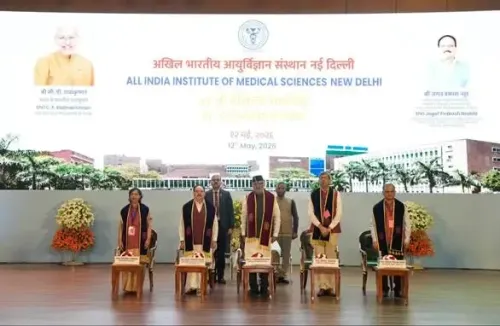
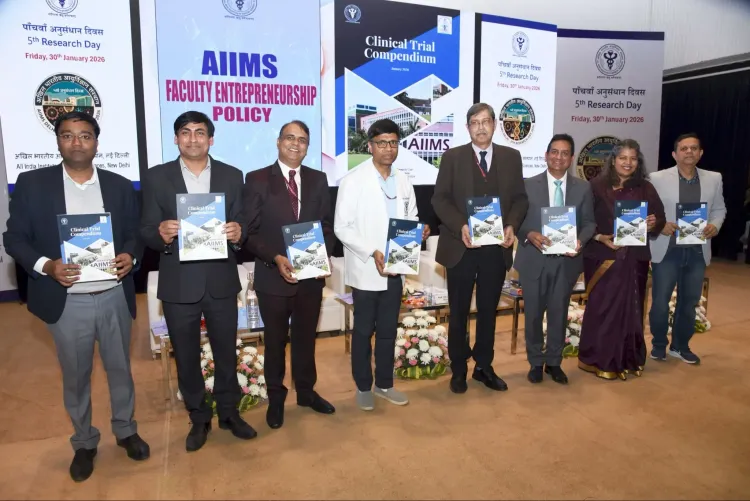
New Delhi, Jan 30 (NationPress) The All India Institute of Medical Sciences, Delhi, celebrated AIIMS Research Day 2026 on Friday, highlighting advancements in innovation, artificial intelligence (AI), and vital national health initiatives.
The scientific agenda, hosted at the Jawaharlal Auditorium, united faculty, researchers, clinicians, and students from various fields to reaffirm their dedication to innovation, translational science, and health research pertinent to the nation.
“AIIMS Research Day serves as a pivotal institutional platform to acknowledge research excellence, inspire young scholars, and align our scientific endeavors with national health priorities. As India’s leading public medical institution, AIIMS is committed to nurturing innovation, enhancing translational research, and building a supportive ecosystem for impactful, patient-centered science,” stated Prof. M. Srinivas, Director of AIIMS, New Delhi.
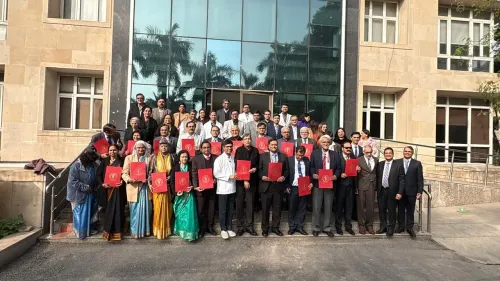
The event celebrated research excellence, promoted interdisciplinary dialogue, and reinforced the institution's role in progressing evidence-based healthcare, innovation, and policy-relevant research in India.
Professor Nikhil Tandon, Dean (Research), shared that AIIMS Delhi currently leads one of the nation’s most vibrant public-sector research environments, with over 1,000 funded biomedical research projects backed by investments exceeding Rs 300 crore.
Additionally, fifty-seven scientists from AIIMS New Delhi are ranked among the globe's top two percent of researchers.
He noted that AIIMS has broadened its focus on research translation, with its innovation and incubation program receiving over 140 innovation applications, supporting 30 startups, and facilitating more than Rs 25 crore in external funding.
Moreover, Dr. Shivkumar Kalyanaraman, CEO of the Anusandhan National Research Foundation, discussed AI's role in science and engineering, emphasizing the transformative potential of emerging technologies.
“Integrating AI within science and engineering presents unmatched opportunities to fast-track research, enhance problem-solving, and tackle complex societal issues. Institutions like AIIMS are crucial in turning these technological advancements into solutions that significantly benefit public health and national development,” remarked Dr. Kalyanaraman.
The day-long event also included presentations by undergraduate and postgraduate medical students, residents, doctoral scholars, and nursing students, showcasing strong research engagement throughout the academic and professional journey.
The sessions were enriched by discussions addressing emerging research challenges, national health priorities, and the prospects of interdisciplinary collaboration.
Point of View
It is paramount to recognize the significance of AIIMS Research Day in promoting innovation and addressing national health priorities. The commitment demonstrated by AIIMS in fostering research and collaboration among various disciplines is commendable. This event not only reflects India's commitment to advancing healthcare but also serves as an inspiration for future generations of researchers.
NationPress
19 Sept 2026
Frequently Asked Questions
What is AIIMS Research Day?
AIIMS Research Day is an annual event organized by the All India Institute of Medical Sciences, aimed at showcasing research excellence and promoting innovation in healthcare.
Who participated in AIIMS Research Day 2026?
Participants included faculty members, researchers, clinicians, and students from various disciplines across the institution.
What is the significance of AI in healthcare discussed during the event?
The event highlighted how AI can accelerate research, enhance problem-solving and address complex societal challenges in healthcare.
How many research projects are currently funded by AIIMS?
AIIMS currently supports over 1,000 funded biomedical research projects with investments exceeding Rs 300 crore.
What initiatives were launched to support innovation at AIIMS?
AIIMS has launched an innovation and incubation program that has received over 140 applications and has supported 30 startups.