China fossil reveals birds lost dinosaur tails gradually, not abruptly
Synopsis
A fossil from Fujian Province named Zhengheornis buyu shows birds lost their dinosaur tails step by step — not in a sudden leap — overturning a key assumption about avian evolution and the anatomical secret behind birds' survival of the mass extinction 66 million years ago.
Key Takeaways
A fossil named Zhengheornis buyu , recovered from Zhenghe County, Fujian Province, China , provides skeletal evidence that birds shed their long dinosaur tails gradually rather than abruptly.
The study was published in the peer-reviewed journal Science Advances on July 1 by researchers from the Chinese Academy of Sciences (CAS) and the Fujian Province Geological Science Research Institute .
Modern birds possess a pygostyle — fused tail vertebrae that anchor feathers and flight muscles — which the new fossil shows evolved through intermediate stages.
Birds are the only dinosaur lineage to survive the mass extinction event 66 million years ago , and the aerodynamic tail is considered key to that survival.
The fossil belongs to the Zhenghe Fauna , a Jurassic -era assemblage in Fujian that is becoming a globally significant site for early avian research.
Researcher Wang Min of CAS was among the authors; the team noted the "exceeding rarity" of transitional bird fossils has long impeded study of this evolutionary step.
A remarkable fossil discovery in China has upended the long-held assumption that modern birds shed the long, bony tails of their dinosaur ancestors in a sudden evolutionary leap. According to a paper published in the peer-reviewed journal Science Advances on July 1, the transition was instead a gradual, step-by-step process — one of the most consequential anatomical shifts in vertebrate history.
Why it matters
Birds are the only living descendants of dinosaurs to survive the mass extinction event 66 million years ago, and the evolution of a short, feathered tail is considered central to that survival. Unlike their non-avian dinosaur relatives, modern birds possess a pygostyle — a compact skeletal structure formed by the fusion of the final few caudal, or tail, vertebrae — which anchors tail feathers and flight muscles.
"A short pygostyle-bearing tail is functionally and ecologically vital to living birds, which enables tail fanning and conveys aerodynamic advantages," said the research team from the Chinese Academy of Sciences (CAS) and the Fujian Province Geological Science Research Institute.
The fossil evidence
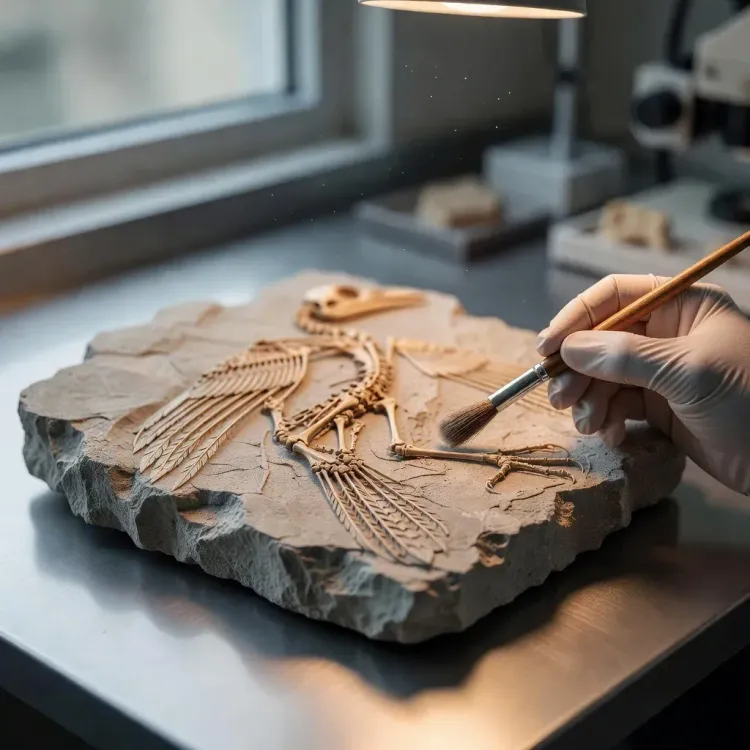
The newly described specimen, named Zhengheornis buyu, was recovered from Zhenghe County in Fujian Province and belongs to the broader Zhenghe Fauna — a fossil assemblage that has yielded several early bird specimens. Researchers from the CAS Institute of Vertebrate Palaeontology and Palaeoanthropology led the analysis, which places the find within the early divergence of avian lineages, closer in time to the iconic Archaeopteryx than to modern birds.
"The evolutionary assembly of the flight-adapted bird body plan encompasses some of the most profound morphological changes in terrestrial vertebrate history," the team stated in their paper. The fossil's tail anatomy sits at an intermediate stage between the long, segmented tails of non-avian dinosaurs and the fused pygostyle of living birds, providing direct skeletal evidence for a transitional form previously inferred only from phylogenetic modelling.
The competitive backdrop
Documenting this transition has historically been hampered by what researchers describe as the "exceeding rarity" of early-diverging birds and birdlike dinosaurs in the fossil record. The Jurassic-era deposits of Fujian Province are emerging as a globally significant window into this critical period, with the Zhenghe Fauna increasingly drawing international palaeontological attention. Lead researcher Wang Min, associated with the CAS team, was among the authors credited with the analysis, according to China Science Daily.
What's next
The findings challenge palaeontologists to revisit evolutionary timelines for avian body-plan assembly and may prompt renewed excavation efforts in Fujian Province's Jurassic-era beds. As the Zhenghe Fauna yields more specimens, scientists expect a clearer picture of how flight mechanics evolved incrementally — and why birds, alone among dinosaurs, endured one of Earth's most catastrophic extinction events.
Point of View
Expect the gradualist model of avian body-plan assembly to gain significant empirical weight — and expect more challenges to Western-led evolutionary narratives built on sparser fossil records.
NationPress
16 Oct 2026
Frequently Asked Questions
What is the Zhengheornis buyu fossil and why is it significant?
Zhengheornis buyu is an early bird fossil recovered from Zhenghe County in Fujian Province, China. It is significant because its tail anatomy sits at an intermediate stage between the long tails of non-avian dinosaurs and the fused pygostyle of modern birds, providing direct evidence that this transition was gradual rather than sudden.
What is a pygostyle and why does it matter for bird evolution?
A pygostyle is a compact skeletal structure formed by the fusion of the final few tail vertebrae, found in modern birds. According to the research team, it is 'functionally and ecologically vital to living birds' because it enables tail fanning and provides aerodynamic advantages critical to flight.
Who conducted the research and where was it published?
The study was conducted by researchers from the Chinese Academy of Sciences (CAS) and the Fujian Province Geological Science Research Institute, including author Wang Min. It was published in the peer-reviewed journal Science Advances on July 1.
How does this finding change our understanding of dinosaur-to-bird evolution?
Previously, the loss of the long dinosaur tail was thought to have occurred as a relatively abrupt evolutionary transition. The Zhengheornis buyu fossil provides skeletal evidence of a step-by-step process, suggesting the flight-adapted bird body plan assembled incrementally over time.
Why have transitional bird fossils been so rare?
Researchers attribute the scarcity to the 'exceeding rarity' of early-diverging birds and birdlike dinosaurs in the fossil record. The Zhenghe Fauna in Fujian Province's Jurassic-era deposits is emerging as one of the few sites where such transitional specimens are being found in meaningful numbers.