China's HIAF particle accelerator goes live with record ion beam intensity
Synopsis
China's newly operational HIAF accelerator in Huizhou delivers heavy-ion beam intensity eight times greater than the previous world record held by Germany, repositioning China at the forefront of global nuclear physics and rare isotope research.
Key Takeaways
HIAF in Huizhou, Guangdong began scientific operations after construction was completed on Tuesday, 22 July 2026 .
The facility cost 2.6 billion yuan (US$384.1 million) and was developed over 16 years by the Institute of Modern Physics in Lanzhou, Gansu .
HIAF can deliver up to eight times more atoms per pulse than the previous world record, held by a facility in Darmstadt, Germany .
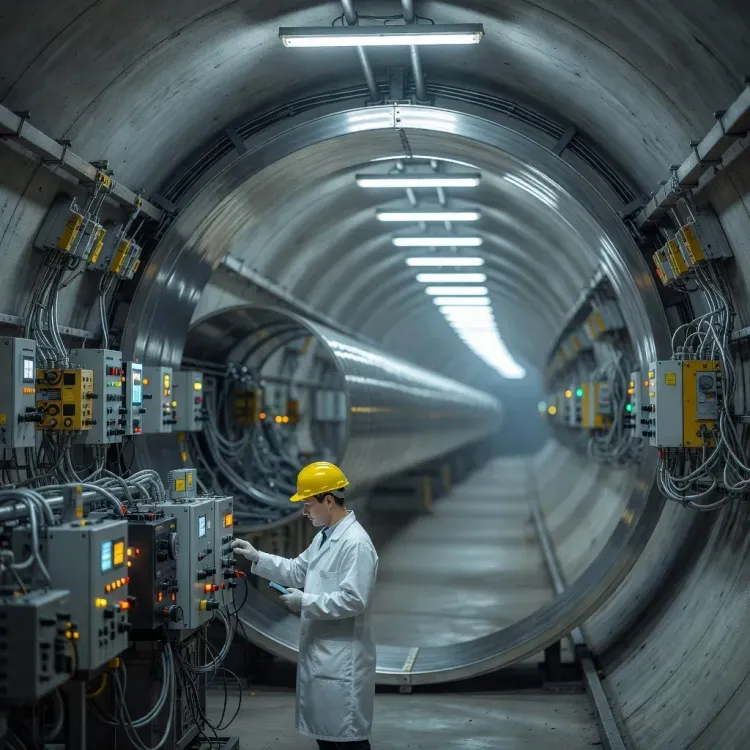
The complex uniquely combines a 100-metre linear accelerator , a 570-metre-circumference circular accelerator , and storage rings in one integrated site.
Research applications include creating unknown atomic nuclei, advancing cancer treatment via heavy-ion therapy, and developing radiation-resistant spacecraft materials .
China's National Development and Reform Commission backed the project, underscoring the state's commitment to frontier scientific infrastructure.
China has activated the High Intensity Heavy-ion Accelerator Facility (HIAF) in Huizhou, Guangdong province, a 2.6 billion yuan (US$384.1 million) machine that produces the world's most intense beams of charged atoms — opening a new frontier in nuclear physics, cancer therapy research, and advanced materials science.
A record-breaking machine
Scientific operations commenced after construction was completed on Tuesday, 22 July 2026, according to state news agency Xinhua. HIAF can pack up to eight times as many atoms into each pulse as the previous world record, which was held by a particle accelerator in Darmstadt, Germany. That benchmark shift represents a qualitative leap in beam intensity, not merely an incremental improvement.
What HIAF can do
The facility gives researchers the capability to synthesise previously unknown atomic nuclei — exotic, short-lived isotopes that exist nowhere in nature. These rare isotopes are central to understanding the fundamental forces that hold matter together. Beyond pure science, the facility is expected to advance research into cancer treatment using heavy-ion therapy and into radiation-hardened materials for spacecraft.
Design and architecture
HIAF was developed over 16 years by researchers at the Institute of Modern Physics in Lanzhou, Gansu, along with their collaborators. Unlike most comparable facilities currently in operation — including the Facility for Rare Isotope Beams (FRIB) in the United States — HIAF integrates a 100-metre-long linear accelerator, a 570-metre-circumference circular accelerator, and storage rings into a single unified complex. This integrated architecture is designed to maximise experimental flexibility and beam efficiency.
Why it matters
The commissioning of HIAF marks a significant milestone in China's long-term investment in large-scale scientific infrastructure, backed by the National Development and Reform Commission. Access to the world's most intense heavy-ion beams positions Chinese researchers at the centre of global nuclear physics for the coming decade. International collaborators are expected to apply for beam time, much as they do at comparable facilities in Europe and North America.
What's next
Early experimental programmes are expected to focus on mapping the boundaries of nuclear stability — the so-called 'nuclear drip lines' — and producing isotopes relevant to astrophysical processes. As the facility ramps up to full operational capacity, it is likely to attract partnerships with research institutions across Asia, Europe, and beyond. The degree to which HIAF remains open to international collaboration under current geopolitical conditions will be closely watched by the global physics community.
Point of View
From quantum computing to nuclear research, reducing dependence on access to foreign large-scale facilities. What mainstream coverage tends to underplay is the dual-use potential: isotope production at this intensity has direct relevance to medical radioisotope supply chains and, more quietly, to understanding materials under extreme radiation environments relevant to defence applications. The geopolitical context also shapes who gets beam time: as scientific decoupling accelerates between China and the West, HIAF could become a gravitational centre for researchers from the Global South and Belt and Road partner nations who find access to US and European facilities increasingly complicated.
NationPress
21 Oct 2026
Frequently Asked Questions
What is the HIAF particle accelerator in China?
The High Intensity Heavy-ion Accelerator Facility (HIAF) is a 2.6 billion yuan (US$384.1 million) scientific complex in Huizhou, Guangdong province , designed to produce the world's most intense beams of charged heavy atoms. It was developed over 16 years by the Institute of Modern Physics in Lanzhou and began scientific operations in July 2026 .
What world record does HIAF break?
HIAF can pack up to eight times as many atoms into each pulse as the previous world record, which was held by a particle accelerator in Darmstadt, Germany . This makes it the most intense heavy-ion beam source on Earth.
How is HIAF different from the US Facility for Rare Isotope Beams?
Unlike the Facility for Rare Isotope Beams (FRIB) in the United States and most other comparable facilities, HIAF integrates a 100-metre linear accelerator , a 570-metre-circumference circular accelerator , and storage rings into a single unified complex, offering greater experimental flexibility.
What research will HIAF enable?
HIAF will allow scientists to create previously unknown atomic nuclei and study exotic rare isotopes. Key application areas include advancing heavy-ion cancer therapy and developing radiation-hardened materials for spacecraft .
Who funded and built the HIAF accelerator?
The project was backed by China's National Development and Reform Commission and built by researchers at the Institute of Modern Physics in Lanzhou, Gansu over 16 years . Construction was completed in July 2026 , with scientific operations commencing immediately after.