China tests stellar aberration navigation for 2030 Jupiter mission
Synopsis
China's Tianhui-7 satellite has validated stellar aberration navigation — a NASA-originated concept — achieving 5 km positional accuracy in orbit. The breakthrough directly enables the Tianwen-4 Jupiter mission in 2030, where one-way radio delays exceed 50 minutes, making autonomous navigation non-negotiable.
Key Takeaways
China 's Tianhui-7 satellite tested stellar aberration navigation in January 2026 , achieving positional accuracy of approximately 5 km in low-Earth orbit.
The technique detects tiny shifts in apparent star positions to calculate a spacecraft's speed and direction autonomously, without relying on real-time ground commands.
The 5 km accuracy is reportedly comparable to NASA 's antenna-based Deep Space Network , according to researchers from the China Academy of Space Technology .
Jupiter sits up to 900 million km from Earth , with one-way radio signal delays of over 50 minutes , making autonomous navigation essential for the mission.
China 's Tianwen-4 Jupiter mission is scheduled for launch in 2030 and is the primary beneficiary of this navigation breakthrough.
The research will be published in the Journal of Deep Space Exploration , with the experiment linked to NASA 's earlier StarNAV concept.
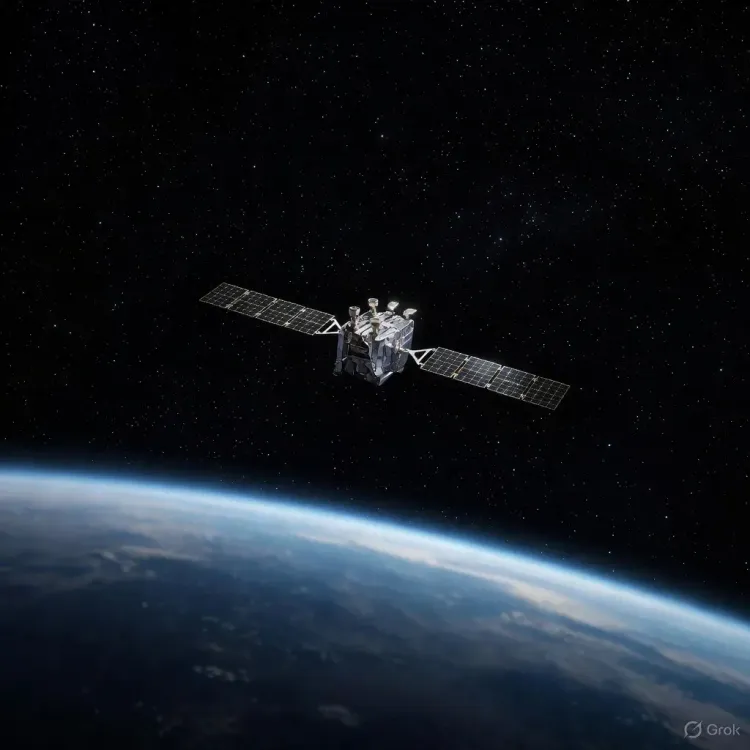
Chinese researchers have successfully validated a deep-space navigation technique using stellar aberration — a concept originally funded by NASA — bringing China's planned Jupiter mission significantly closer to technical readiness. The experiment, conducted in January 2026 aboard the Tianhui-7 satellite in low-Earth orbit, demonstrated autonomous real-time positioning without relying on continuous ground-based commands.
What is stellar aberration navigation?
Stellar aberration navigation works by detecting minute shifts in the apparent positions of stars relative to a spacecraft's motion, allowing the probe to calculate its velocity and trajectory independently. The technique enables a spacecraft to navigate autonomously in deep space — a critical capability given the vast distances involved in interplanetary travel. The approach is closely related to NASA's StarNAV concept, which the American agency had explored as a next-generation autonomous navigation framework.What the Tianhui-7 experiment showed
During the January low-Earth-orbit test, the Tianhui-7 satellite used stellar aberration to determine its position to within approximately 5 km (3.1 miles). According to researchers from the China Academy of Space Technology — China's primary spacecraft manufacturer — this accuracy is comparable to that achieved by NASA's antenna-based Deep Space Network. The findings are set to be published in the Journal of Deep Space Exploration.Why it matters for the Jupiter mission
Jupiter can be as far as 900 million km from Earth, with one-way radio signal travel times exceeding 50 minutes, the researchers noted in their paper. That communication lag makes real-time ground intervention effectively impossible, making autonomous onboard navigation not just convenient but operationally essential. China's Tianwen-4 mission, targeting Jupiter with a planned launch in 2030, stands to benefit directly from this validated technology.The competitive backdrop
The achievement positions China alongside established deep-space players including NASA and the European Space Agency, both of which have invested heavily in autonomous navigation research. By demonstrating a working implementation of a concept that NASA had largely kept at the research stage, China's China Aerospace Science and Technology Corporation and the China Academy of Space Technology signal an accelerating pace of applied space technology development. The experiment was launched from the Jiuquan Satellite Launch Centre.What's next
The successful low-Earth-orbit validation is an early but significant milestone; the technology must still prove itself across the vastly greater distances of interplanetary space before the 2030 launch window. Analysts will be watching whether China integrates stellar aberration navigation into the full Tianwen-4 mission architecture, and whether the precision demonstrated in orbit can be sustained or improved as the spacecraft moves beyond the inner solar system.Point of View
Compressing the usual research-to-flight timeline. With the 2030 Jupiter window fixed and non-negotiable, the pressure to scale this from 5 km LEO accuracy to interplanetary precision within four years will be the real test of China's deep-space engineering maturity.
NationPress
23 Sept 2026
Frequently Asked Questions
What is stellar aberration navigation and how does it work?
Stellar aberration navigation determines a spacecraft's velocity and direction by measuring tiny apparent shifts in star positions caused by the probe's own motion through space. Because these measurements are taken onboard using star sensors, the spacecraft can navigate autonomously without waiting for commands from Earth — a process that can take over 50 minutes one way at Jupiter's distance.
What did China's Tianhui-7 satellite achieve in its navigation test?
The Tianhui-7 satellite, tested in January 2026 in low-Earth orbit, used stellar aberration navigation to determine its position to within approximately 5 km (3.1 miles). According to researchers from the China Academy of Space Technology, this accuracy is comparable to NASA's Deep Space Network.
How does this relate to China's Jupiter mission?
China's Tianwen-4 mission is targeting Jupiter with a planned launch in 2030. Because Jupiter can be up to 900 million km from Earth and one-way radio delays exceed 50 minutes, real-time ground control is impossible, making the autonomous navigation capability validated by Tianhui-7 operationally essential for the mission.
What is NASA's StarNAV concept and how is China connected to it?
NASA's StarNAV is a research concept that explored using stellar aberration for autonomous spacecraft navigation. Chinese researchers have now brought a working version of this approach to a practical orbital experiment, reportedly achieving accuracy on par with NASA's existing Deep Space Network infrastructure.
Who are the key organisations behind this navigation breakthrough?
The research was led by scientists from the China Academy of Space Technology, China's primary spacecraft manufacturer, operating under China Aerospace Science and Technology Corporation. The Tianhui-7 satellite was launched from the Jiuquan Satellite Launch Centre, and the findings are to be published in the Journal of Deep Space Exploration.