China plans robot dogs to guard lunar research station
Synopsis
Scientists at China's Academy of Space Technology have proposed deploying robot dogs to patrol the International Lunar Research Station, with a three-astronaut crew directing the machines for surface exploration, resource extraction, and even psychological companionship — a striking glimpse into China's crewed lunar ambitions.
Key Takeaways
China's Academy of Space Technology published a blueprint in July 2026 for using robot dogs at the International Lunar Research Station (ILRS) .
The plan calls for a crew of three astronauts working alongside multiple autonomous robots, with one astronaut directing two robot dogs across the lunar surface.
Robots would support resource extraction tasks including harvesting water ice , mining minerals, and building habitats inside lava tubes .
The ILRS is a joint China–Russia initiative targeting the moon's south pole , a region rich in confirmed water-ice deposits.
Robots are also proposed for domestic duties and social interaction, including chatting with astronauts to reduce psychological stress during isolation.
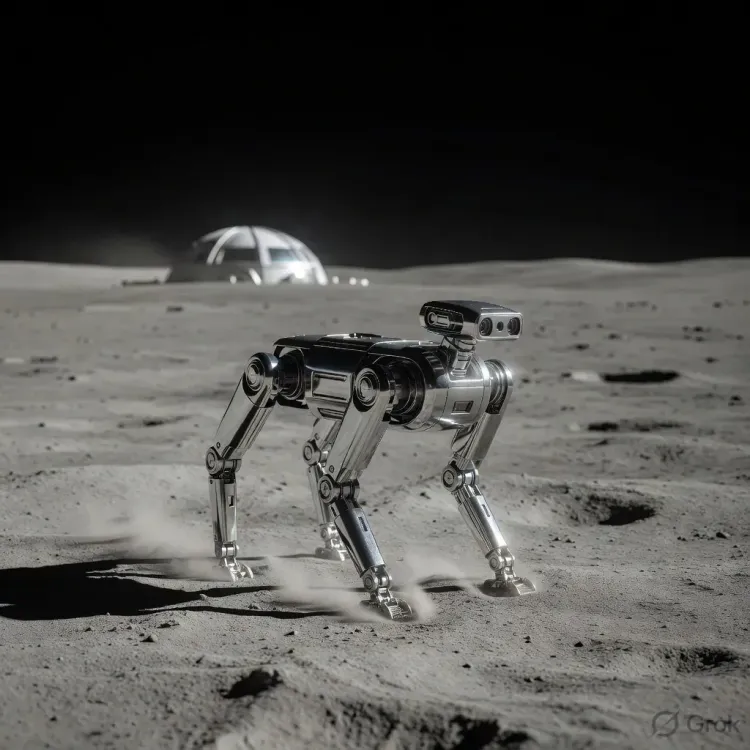
China's Academy of Space Technology has outlined a blueprint for deploying robot dogs at the International Lunar Research Station (ILRS), envisioning the four-legged machines patrolling the lunar surface, scouting hazards, and assisting astronauts in collecting scientifically valuable rocks. The concept, published in the journal Chinese Space Science and Technology in July 2026, represents one of the most detailed operational frameworks yet for how humans and autonomous machines could co-exist on the moon's surface.
The Human-Robot Team on the Moon
The blueprint envisions a crew of three astronauts working in close coordination with intelligent machines. One astronaut would direct two robot dogs across the lunar landscape, while a second handles rock sampling and detailed scientific fieldwork. A third crew member would remain inside a van-sized pressurised rover, coordinating the overall mission and taking remote control of other robots as needed, according to scientists from the China Academy of Space Technology, the nation's leading spacecraft developer.
'China is extending the frontier of human space flight from Earth orbit to the moon,' the authors wrote, adding that future lunar exploration would depend on 'astronaut-led decision-making and autonomous robots carrying out the work.'
Why It Matters: Resource Extraction and Long-Term Settlement
Robots are expected to play a central role in preparing the moon for sustained human presence. Tasks outlined in the paper range from harvesting water ice and mining minerals to converting lava tubes into habitats and constructing structures using local materials. This approach — often called in-situ resource utilisation — is widely regarded as essential for making long-duration lunar missions economically viable.
The ILRS, a joint initiative between China and Russia, is targeting the moon's south pole, a region of intense scientific and strategic interest due to confirmed water-ice deposits in permanently shadowed craters.
Beyond Exploration: Domestic and Psychological Support
The researchers also envision robots handling routine station duties — regulating air and temperature, cleaning living quarters, tending plants, and preparing meals. Strikingly, the paper suggests robots could serve a social function as well, chatting with astronauts and helping ease the psychological strain of prolonged isolation in a remote environment.
This dual role — operational workhorse and companion — reflects a growing recognition that crew mental health is as mission-critical as hardware reliability on deep-space postings.
The Competitive Backdrop
The ILRS is positioned as a direct counterpart to NASA's Artemis programme, which also targets the lunar south pole and is developing its own robotic support systems. Both programmes are racing to establish a durable human foothold on the moon, with robot autonomy emerging as a key differentiator. China's Chang'e series of lunar missions has already demonstrated progressively sophisticated robotic capabilities, providing a technical foundation for the more complex systems described in the new paper.
What's Next
The paper is a conceptual framework rather than a confirmed engineering programme, but it signals the direction of China's crewed lunar planning ahead of its targeted lunar landing in the early 2030s. How quickly robot-dog hardware can be adapted for the moon's vacuum, radiation, and extreme temperature swings will be a critical engineering challenge to watch.
Point of View
But whose human-robot system proves most robust under the moon's unforgiving conditions.
NationPress
8 Aug 2026
Frequently Asked Questions
What is China's plan for robot dogs on the moon?
Scientists at the China Academy of Space Technology have proposed deploying robot dogs at the International Lunar Research Station (ILRS) to patrol the surface, scout hazards, and assist astronauts in collecting rock samples. The blueprint, published in July 2026 , envisions one astronaut directing two robot dogs while the rest of a three-person crew handles scientific work and mission coordination.
Where is China's lunar research station being built?
The International Lunar Research Station (ILRS) is planned for the moon's south pole , a region of high scientific and strategic interest due to confirmed water-ice deposits in permanently shadowed craters. The station is a joint project between China and Russia .
What tasks would robots perform at the lunar base?
According to the research paper, robots would handle a wide range of duties — from extracting water ice and mining minerals to converting lava tubes into habitats and constructing buildings with local materials. They would also manage routine station tasks such as regulating air and temperature, cleaning, cooking, tending plants, and even providing social companionship to astronauts.
How does China's lunar robot plan compare to NASA's Artemis programme?
Both the ILRS and NASA 's Artemis programme target the lunar south pole and are developing robotic support systems for crewed operations. China's blueprint emphasises a tightly integrated human-robot teaming model, a concept that broadly parallels robotic frameworks being developed under Artemis, reflecting convergent engineering approaches despite intense geopolitical rivalry.
When could China land astronauts on the moon?
China is targeting a crewed lunar landing in the early 2030s . The robot-dog blueprint published in July 2026 is a conceptual framework that signals the operational direction of that programme, though specific hardware development timelines have not been confirmed.