Xi Jinping to keynote WAIC 2026 as China pushes AI beyond chatbots
Synopsis
President Xi Jinping will personally keynote China's World AI Conference on 18 July 2026, as Beijing uses the 1,100-company showcase to project dominance in humanoid robots and autonomous agents — not just chatbots — while deflecting US chip restrictions and 'open-source trap' accusations.
Key Takeaways
President Xi Jinping will attend and deliver the opening keynote at WAIC 2026 in Shanghai on Friday, 18 July 2026 .
The four-day conference features more than 1,100 companies , over 3,000 exhibits , and more than 300 global product debuts .
Key participants include Tencent Holdings , Huawei Technologies , Alibaba , ZTE , and Turing Award winner Andrew Yao .
China's foreign ministry spokesman Lin Jian rejected claims that Beijing's open-source AI promotion is a strategic 'trap,' saying China opposes 'ideological lines and technological blockades.' US export restrictions on advanced chips — particularly from Nvidia — remain a central constraint shaping China 's domestic AI hardware push, led by Huawei .
WAIC 2026 will spotlight humanoid robots, autonomous AI agents, and scientific AI — signalling China 's ambition to lead embodied and physical-world AI.
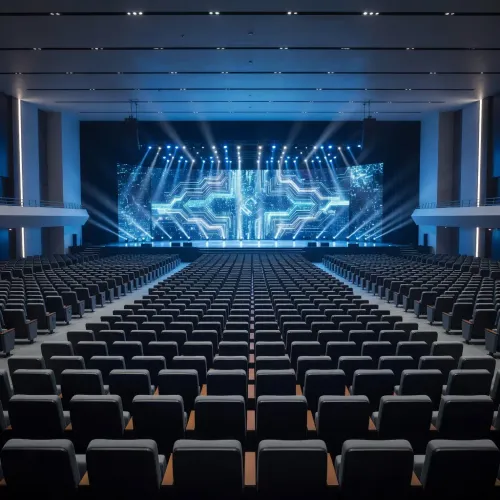
President Xi Jinping will deliver the opening keynote at the World AI Conference (WAIC) in Shanghai on Friday, 18 July 2026, lending direct political authority to China's most prominent annual AI showcase as Beijing accelerates a strategy that reaches well beyond large language models into autonomous agents, humanoid robots, scientific computing, and consumer hardware.
What WAIC 2026 represents
The four-day conference will gather more than 1,100 companies displaying over 3,000 exhibits, with more than 300 products making their global debuts, according to organisers. Key participants include Tencent Holdings, Huawei Technologies, Alibaba, and ZTE, alongside international delegations. The scale signals that China is positioning WAIC not merely as a domestic technology fair but as a platform to shape global AI governance, safety standards, and interoperability frameworks.
Industry observers note that this year's edition will be read as a stress test of how effectively China has converted model-layer breakthroughs into a broader industrial ecosystem — spanning edge devices, robotics, and enterprise software — rather than concentrating progress in benchmark-chasing foundation models alone.
The competitive backdrop
WAIC unfolds against an intensifying technology rivalry with Washington. Ongoing US export restrictions continue to limit China's access to advanced computing chips, most notably those produced by Nvidia. Beijing has responded by elevating technological self-reliance to a national-security imperative, channelling investment into domestic semiconductor alternatives and homegrown AI accelerators, with Huawei Technologies at the centre of that hardware push.
Separately, China's foreign ministry pushed back on Thursday against claims circulating in Western media that Beijing's promotion of open-source AI models overseas constitutes a strategic 'trap.' Spokesman Lin Jian said China 'opposed drawing ideological lines and imposing technological blockades,' and indicated that WAIC would be used to 'promote exchanges and consensus' while ensuring AI's benefits reach developing nations.
AI moves into the physical world
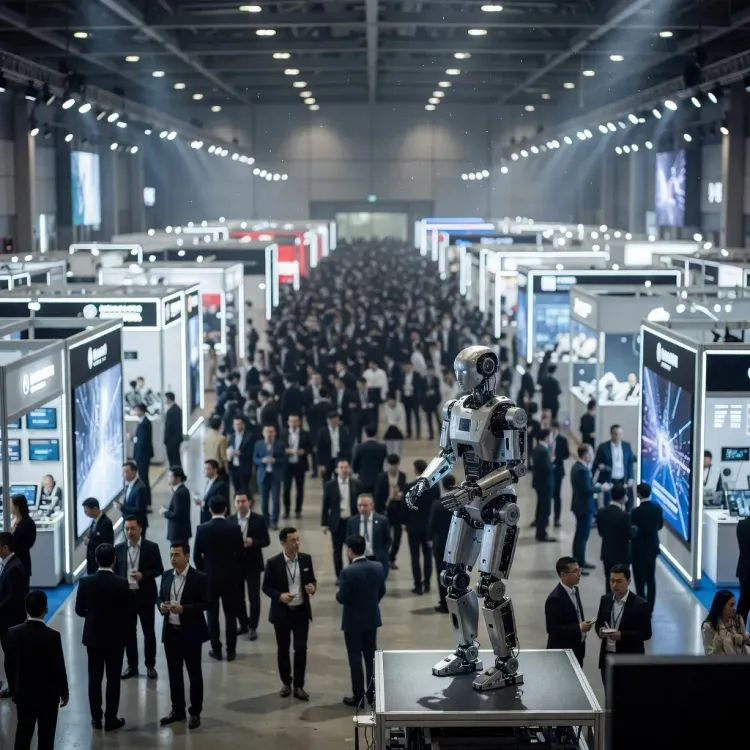
A defining theme at WAIC 2026 is the transition of AI from screen-based interactions to physical-world execution. Foundation models are becoming multimodal and agent-capable, enabling autonomous task completion across robotics, industrial automation, and scientific research workflows. Humanoid robots are expected to feature prominently on the exhibition floor, reflecting China's stated ambition to lead in embodied AI — a domain where hardware capability and software intelligence converge.
Turing Award laureate Andrew Yao is among the academic figures expected to participate, underscoring the conference's dual role as both a commercial showcase and a forum for foundational research dialogue.
Why it matters
Xi's attendance elevates WAIC beyond a corporate trade show; it signals that AI industrial policy is now operating at the highest level of state priority. The governance and standards discussions held at the conference could influence how emerging economies adopt and regulate AI, giving China soft-power leverage in markets where US technology companies face greater scrutiny.
What's next
Announcements from Huawei, Alibaba, and Tencent during the conference will be closely watched for evidence of commercial traction in agentic AI and robotics. The degree to which China's domestic chip ecosystem can credibly substitute for restricted Nvidia hardware will be a key sub-text running through every major product unveiling at WAIC this week.
Point of View
Placing it alongside chip self-sufficiency and space as a domain of state-level competition. What mainstream coverage tends to underweight is the governance dimension: WAIC's standards and safety forums are where China is quietly building the institutional architecture to influence how the Global South adopts and regulates AI, a soft-power play that chip export controls cannot neutralise. The 'open-source trap' rebuttal from the foreign ministry is also telling — it suggests Beijing is acutely aware that its model-sharing strategy is drawing Western regulatory scrutiny, and is pre-emptively framing it as anti-colonial technology access. Investors and policymakers should watch not just the product launches but the multilateral frameworks quietly signed in the conference's side rooms.
NationPress
17 Jul 2026
Frequently Asked Questions
What is WAIC 2026 and when does it take place?
The World AI Conference (WAIC) 2026 is China's largest annual artificial intelligence gathering, held in Shanghai from 18 July 2026 for four days. It brings together more than 1,100 companies showcasing over 3,000 exhibits, with more than 300 global product debuts, according to organisers.
Why is Xi Jinping attending WAIC 2026?
President Xi Jinping will deliver the opening keynote on Friday, 18 July, adding direct political weight to an event that has traditionally served as China's premier technology showcase. His attendance signals that AI leadership is now a top-tier national-security and economic priority for Beijing.
How do US chip restrictions affect China's AI ambitions at WAIC?
Ongoing US export controls limit China's access to advanced chips, particularly those made by Nvidia, constraining the computing power available for training large AI models. Beijing has responded by making technological self-reliance a national priority, with Huawei Technologies leading domestic chip development as an alternative.
What is China's 'open-source AI trap' controversy?
Some Western media and officials have characterised China's promotion of open-source AI models to developing countries as a strategic 'trap.' China's foreign ministry spokesman Lin Jian rejected this framing on Thursday, saying Beijing opposes 'drawing ideological lines and imposing technological blockades' and intends WAIC to promote global AI access.
Which companies and technologies are in focus at WAIC 2026?
Major participants include Tencent Holdings, Huawei Technologies, Alibaba, and ZTE. Key technology themes span autonomous AI agents, humanoid robots, scientific computing, and consumer AI devices — reflecting China's push to move AI from conversational interfaces into physical-world applications.