GeM crosses ₹1,55,000 crore GMV in a decade, Piyush Goyal says rules rewritten
Synopsis
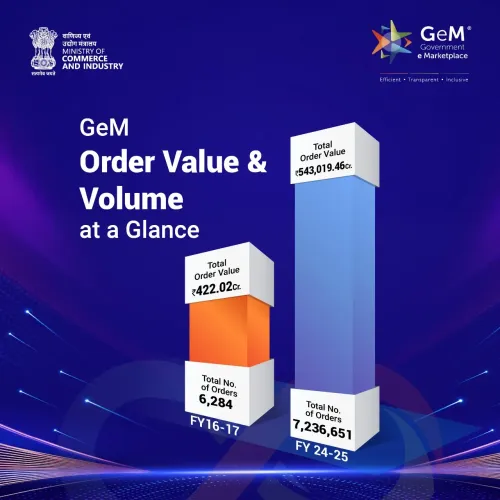
GeM has gone from ₹422 crore to ₹1,55,000 crore in GMV over a decade — a 367-fold jump. With 12.28 lakh MSEs, 2.25 lakh women-led firms, and 42,000 startups now on board, India's public procurement portal is no longer just a government buying tool; it is becoming the backbone of inclusive economic growth and digital self-reliance.
Key Takeaways
GeM's GMV has grown from ₹422 crore a decade ago to over ₹1,55,000 crore today — a nearly 367-fold rise.
The platform now links 1.37 lakh government buyer organisations with nearly 25 lakh sellers and service providers .
Over 12.28 lakh MSEs , including 2.25 lakh women-led enterprises , and 42,000 startups are registered on GeM.
GeM offers over 10,660 product categories and 350 service categories .
Artificial intelligence integration is the next phase, aimed at improving transparency and efficiency.
The portal was launched on 9 August 2016 and is now in its 11th year .
Commerce and Industry Minister Piyush Goyal on Monday, 10 August declared that the Government e-Marketplace (GeM) has fundamentally transformed public procurement in India, growing from a gross merchandise value (GMV) of just ₹422 crore a decade ago to over ₹1,55,000 crore today — a nearly 367-fold increase. The announcement came as GeM entered its 11th year since its launch on 9 August 2016.
Scale of Growth
In a post on X, Goyal highlighted that GeM now connects more than 1.37 lakh government buyer organisations with nearly 25 lakh sellers and service providers. The platform hosts over 10,660 product categories and 350 service categories, making it one of the most comprehensive digital public procurement ecosystems in the world.
Notably, the platform's reach extends well beyond large vendors. Over 12.28 lakh Micro and Small Enterprises (MSEs) — including more than 2.25 lakh women-led enterprises — and over 42,000 startups are now registered on the portal.
What the Minister Said
'Over the last 10 years, the platform has enhanced competition, improved price discovery, reduced procurement cycle times, generated significant savings for the Government, and strengthened accountability through end-to-end digital procurement,' Goyal stated. He added that GeM is 'emerging as a key driver of self-reliance that is also strengthening the foundation of a Viksit Bharat.'
Inclusion at the Core
Beyond large-scale procurement efficiency, GeM has positioned itself as a tool for economic inclusion. The platform has opened government markets to Self-Help Groups, artisans, and weavers — segments historically excluded from formal procurement channels. This aligns with the Centre's broader 'Vocal for Local' and 'Make in India' mandates, according to official statements.
What Comes Next
The focus is now shifting toward a smarter, more integrated procurement ecosystem. Artificial intelligence integration and wider stakeholder participation are being prioritised to further strengthen transparency, efficiency, and governance. According to an official factsheet, GeM's continued expansion is central to India's journey toward a digitally empowered and self-reliant economy, with the platform expected to deepen its role as a pillar of the country's Digital Procurement Ecosystem.
Point of View
But GMV alone does not capture procurement quality, price competitiveness, or whether the savings claimed have been independently audited. The inclusion of 2.25 lakh women-led MSEs is a meaningful signal, yet the share of total orders flowing to these enterprises — versus large incumbents — remains unquantified in official statements. As AI integration is announced, the harder question is whether GeM's governance framework can prevent bid manipulation at scale, a risk that grows with platform size. The real test of GeM's decade-long promise is not the GMV milestone but whether smaller sellers are winning contracts, not just registrations.
NationPress
10 Aug 2026
Frequently Asked Questions
What is the Government e-Marketplace (GeM) and what does it do?
GeM is India's official digital public procurement platform, launched on 9 August 2016, that connects government buyer organisations with sellers and service providers. It covers over 10,660 product categories and 350 service categories, enabling end-to-end digital procurement for central and state government bodies.
How much has GeM grown in the last decade?
GeM's gross merchandise value has grown from ₹422 crore a decade ago to over ₹1,55,000 crore today — a nearly 367-fold increase. The platform now links 1.37 lakh government buyer organisations with nearly 25 lakh sellers.
How many MSEs and startups are registered on GeM?
Over 12.28 lakh Micro and Small Enterprises, including more than 2.25 lakh women-led firms, and over 42,000 startups are registered on GeM, according to Commerce and Industry Minister Piyush Goyal.
What is the government's next plan for GeM?
The Centre plans to integrate artificial intelligence into GeM to further improve transparency, efficiency, and governance. Wider stakeholder participation is also being encouraged to deepen the platform's role in India's digital procurement ecosystem.
How does GeM support the 'Make in India' and 'Vocal for Local' initiatives?
GeM gives domestic MSEs, startups, Self-Help Groups, artisans, and weavers direct access to government procurement demand, reducing dependence on intermediaries. This alignment with 'Make in India' and 'Vocal for Local' is intended to channel public spending toward homegrown enterprises and local production.