India's power capacity hits 560 GW; non-fossil sources now 55% of the mix
Synopsis
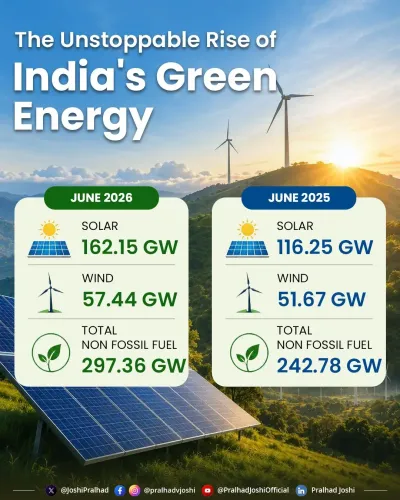
India's installed power capacity has crossed 560 GW — more than doubling in twelve years — with non-fossil sources now making up 55% of the mix. Solar alone has surged from 2.8 GW to nearly 175 GW since 2014, and India overtook the US to become the world's second-largest solar growth market in 2025. The numbers signal a structural shift, not just an incremental one.
Key Takeaways
India's total installed power capacity reached 560 GW in October 2026 , up from 249 GW in 2014.
Non-fossil fuel sources account for 55% of capacity; India ranks third globally in renewable installed capacity with 308 GW .
Solar capacity surged to nearly 175 GW by 31 October 2026 , from just 2.8 GW in 2014; India added 37 GW in 2025 alone.
The PM Surya Ghar scheme has covered 65.26 lakh households with rooftop solar; 21 lakh now receive zero electricity bills.
India recorded its highest-ever annual wind capacity addition of 6.05 GW in FY26, up 46% over FY25.
New schemes — PM-SSY (₹5,070 crore for floating solar) and Small Hydro Power scheme (₹2,584.60 crore) — are expanding the clean energy portfolio further.
India's total installed power generation capacity crossed 560 gigawatts (GW) in October 2026, more than doubling from 249 GW in 2014, with non-fossil fuel sources now accounting for 55 per cent of that total, according to an official government factsheet released on Friday, 13 November 2026. The milestone marks one of the fastest capacity expansions by any major economy in a single decade.
Renewable Energy Scale and Global Standing
India held 308 GW of non-fossil fuel capacity as of 31 July 2026, placing it third globally in renewable energy installed capacity. The country channelled $63.7 billion into its renewable energy sector between July 2024 and June 2026, reflecting the scale of private and public capital mobilised for the transition.
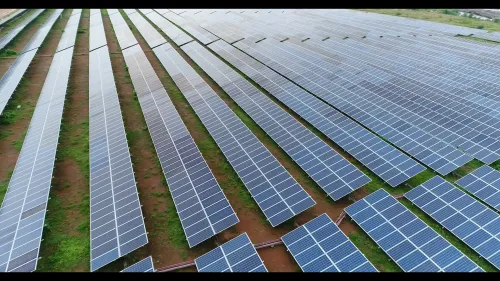
Solar power has emerged as the single largest renewable component. Installed solar capacity reached nearly 175 GW as of 31 October 2026, up from just 2.8 GW in 2014 — a more than 60-fold increase in twelve years. India added over 37 GW of solar capacity in 2025 alone, overtaking the United States (which added 34 GW) to become the world's second-largest solar growth market that year.
PM Surya Ghar Scheme: Progress on Rooftop Solar
The PM Surya Ghar scheme, launched in February 2024 with an outlay of ₹75,021 crore targeting one crore households, had delivered rooftop solar installations to 65.26 lakh households by 2 November 2026. Approximately ₹35,800 crore in subsidy has been transferred to beneficiaries under the scheme.
Notably, nearly 21 lakh households have received zero electricity bills through October 2026, while a cumulative 19.1 GW of rooftop solar capacity has been commissioned under the programme so far.
Floating Solar, Wind, Bio-power and Small Hydro
The government approved the Pradhan Mantri Surya Sarovar Yojana (PM-SSY) on 31 July 2026, with an outlay of ₹5,070 crore, targeting 5,000 MW of Floating Solar Photovoltaic projects with integrated energy storage systems — adding a new dimension to India's solar push.
On the wind front, India added 6.05 GW in FY26, its highest-ever annual wind capacity addition, and 46 per cent higher than FY25. Bio-power capacity stood at 11.75 GW as of 29 October 2026, with 839 Compressed Biogas (CBG) plants registered as of 2 November 2026.
The government also approved the Small Hydro Power (SHP) Development Scheme in March 2026, covering FY27 to FY31 with an outlay of ₹2,584.60 crore, aimed at adding approximately 1,500 MW of small hydro capacity through projects ranging from 1 MW to 25 MW, with a particular focus on hilly and North-Eastern regions.
What the Government Said
'India is building an energy system powered increasingly by clean, renewable sources. Expanding solar, wind, hydro and bio-energy capacity is being supported by domestic manufacturing, energy storage and emerging technologies such as green hydrogen and geothermal energy,' the official statement noted.
What Comes Next
With India's installed capacity now at 560 GW and renewable targets extending well into the next decade, the focus is shifting from installation milestones to grid integration, storage solutions, and domestic manufacturing of components. The trajectory on floating solar and green hydrogen will be closely watched as India pushes toward its longer-term clean energy commitments under international climate frameworks.
Point of View
But the more consequential number is 55% — for the first time, the majority of India's installed capacity comes from non-fossil sources, a structural threshold that changes how grid managers, investors, and policymakers must think. The solar surge from 2.8 GW to 175 GW in twelve years is genuinely extraordinary, and overtaking the US in annual solar additions is not a symbolic milestone. The harder challenge now is absorption: storage, grid balancing, and transmission infrastructure have not kept pace with generation capacity. Unless investment flows as aggressively into those enablers as it has into panels and turbines, the installed-capacity story could outrun the delivered-electricity reality.
NationPress
14 Nov 2026
Frequently Asked Questions
What is India's total installed power capacity as of 2026?
India's total installed power generation capacity reached approximately 560 GW in October 2026, according to an official government factsheet. This is more than double the 249 GW capacity recorded in 2014.
How much of India's power capacity comes from renewable or non-fossil sources?
Non-fossil fuel sources account for 55 per cent of India's installed capacity, equivalent to 308 GW as of 31 July 2026. This places India third globally in renewable energy installed capacity.
What is the PM Surya Ghar scheme and how many households has it reached?
The PM Surya Ghar scheme is a government initiative launched in February 2024 with a ₹75,021 crore outlay to provide rooftop solar installations to one crore households. By 2 November 2026, it had covered 65.26 lakh households, with 21 lakh of them receiving zero electricity bills.
How has India's solar power capacity grown since 2014?
India's solar installed capacity grew from 2.8 GW in 2014 to nearly 175 GW by 31 October 2026 — a more than 60-fold increase. India added over 37 GW in 2025 alone, surpassing the United States to become the world's second-largest solar growth market that year.
What new renewable energy schemes has the government approved recently?
The government approved the Pradhan Mantri Surya Sarovar Yojana (PM-SSY) on 31 July 2026, with ₹5,070 crore earmarked for 5,000 MW of floating solar projects with energy storage. It also approved the Small Hydro Power Development Scheme in March 2026 with ₹2,584.60 crore to add around 1,500 MW of small hydro capacity from FY27 to FY31.