Nvidia Claims GB300 NVL72 Delivers 20x Better Perf Per Watt
Synopsis
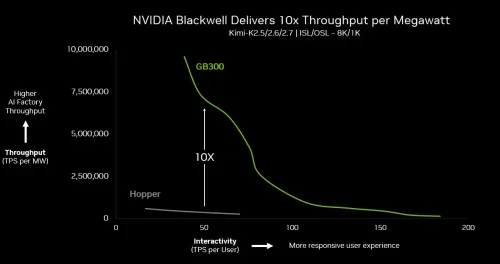
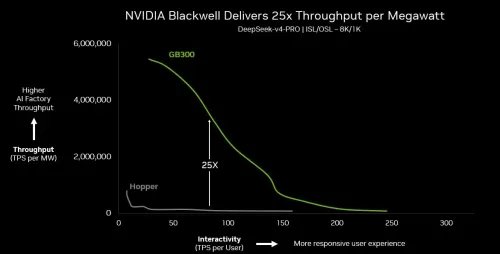
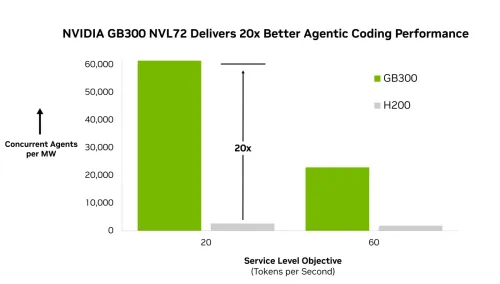
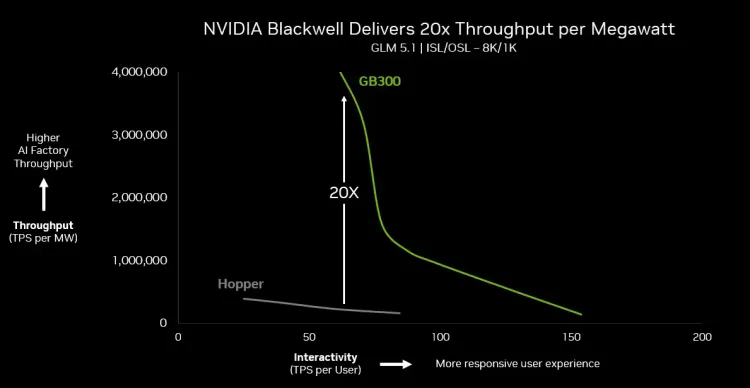
Nvidia has claimed its GB300 NVL72 systems deliver up to 20 times higher performance per watt than its Hopper architecture on the GLM 5.1 AI model, marking a major efficiency leap in its rack-scale GPU lineup and intensifying competition in the global AI infrastructure market.
Key Takeaways
Nvidia's GB300 NVL72 systems claim up to 20x higher performance per watt over the previous-generation Hopper architecture.
The benchmark cited is GLM 5.1 , an AI model workload used to measure inference and training efficiency.
The GB300 NVL72 is a rack-scale configuration housing 72 GPUs , building on Nvidia's Blackwell architecture unveiled in 2024 .
Nvidia's Hopper architecture, based on the H100 GPU , was launched in 2022 and became the dominant platform for enterprise AI workloads.
The efficiency claim is commercially significant for data centre operators and AI developers seeking to reduce power and cooling costs at scale.
Nvidia continues to compete against AMD , Intel , and hyperscaler custom silicon while navigating US export controls on advanced chips.
Chip giant Nvidia posted on X on Tuesday, 14 July 2026, claiming that its GB300 NVL72 rack-scale systems deliver up to 20 times higher performance per watt than its previous-generation Hopper architecture when running the GLM 5.1 AI model benchmark.
Context
The post, shared via Nvidia's official corporate account, states: 'On GLM 5.1, NVIDIA GB300 NVL72 systems deliver up to 20x higher performance per watt than NVIDIA Hopper.' The claim positions the GB300 NVL72 — a rack-scale, multi-GPU system — as a generational leap over the H100-based Hopper architecture that became the industry standard for AI training after its 2022 launch.
Nvidia's Blackwell GPU architecture, unveiled in 2024, was already positioned as Hopper's successor with significant efficiency gains. The GB300 NVL72 appears to represent a further evolution within the Blackwell lineage, scaled to a full 72-GPU rack-scale configuration known as NVL72.
Policy Backdrop
Nvidia's successive architecture generations — from Ampere to Hopper to Blackwell and beyond — have each emphasised performance-per-watt as a key selling point, reflecting the growing energy costs of large-scale AI infrastructure. Data centres globally are under mounting pressure to reduce power consumption even as AI workloads expand rapidly.
The company continues to navigate US export controls on advanced chips, which restrict the sale of certain high-performance GPUs to specific markets, including parts of Asia. These controls have shaped how Nvidia packages and markets products for different geographies, making efficiency benchmarks increasingly central to its global sales narrative.
Stakeholders and Impact
AI developers and data centre operators are the primary audience for this claim. A 20x improvement in performance per watt, if validated at scale, would significantly reduce the total cost of ownership for large AI deployments — cutting both electricity bills and cooling infrastructure requirements.
Nvidia faces intensifying competition from AMD, Intel, and custom silicon developed by hyperscalers such as Google, Amazon, and Microsoft. Efficiency benchmarks on widely-used AI models like GLM 5.1 serve as a key differentiator in procurement decisions by cloud providers and enterprise customers worldwide, including in India, where AI infrastructure investment is accelerating.
What's Next
Nvidia's next major GTC keynote or quarterly earnings update is expected to provide further detail on production timelines and commercial availability of the GB300 NVL72 systems. Independent third-party benchmarking of the 20x performance-per-watt claim on GLM 5.1 will be closely watched by the industry.
As Indian enterprises and government agencies scale up AI infrastructure, efficiency claims of this magnitude could directly influence procurement cycles and data centre planning across the country — making Nvidia's next product disclosures a closely tracked event for the region's technology sector.
Point of View
Not just raw performance, to defend its premium pricing against AMD and hyperscaler custom silicon. For India's rapidly expanding AI infrastructure ecosystem, such claims will shape enterprise and government procurement conversations well before independent benchmarks arrive.
NationPress
14 Jul 2026
Frequently Asked Questions
What is the Nvidia GB300 NVL72?
The Nvidia GB300 NVL72 is a rack-scale AI computing system housing 72 GPUs, built on Nvidia's Blackwell architecture. Nvidia claims it delivers up to 20 times higher performance per watt than its previous Hopper-generation systems on AI workloads like GLM 5.1.
What is Nvidia Hopper and how does it compare to GB300?
Nvidia Hopper is the GPU architecture behind the H100 chip, launched in 2022, which became the industry standard for AI training and inference. Nvidia's latest claim positions the GB300 NVL72 as delivering up to 20x better performance per watt than Hopper-based systems on the GLM 5.1 benchmark.
What is GLM 5.1 in the context of Nvidia's benchmark claim?
GLM 5.1 is an AI model used as a benchmark workload in Nvidia's comparison between the GB300 NVL72 and Hopper systems. Nvidia cited this specific model to demonstrate the efficiency gains of its newer rack-scale GPU systems.
Why does performance per watt matter for AI data centres?
Performance per watt determines how much AI computation a data centre can run for a given electricity and cooling budget. Higher efficiency directly reduces operating costs, making it a critical metric for cloud providers, enterprises, and government AI infrastructure projects.
How does this Nvidia announcement affect India's AI sector?
Indian enterprises and government agencies scaling up AI infrastructure closely track GPU efficiency claims when planning data centre procurement. A validated 20x improvement over Hopper could accelerate upgrade cycles and influence which hardware platforms underpin India's growing AI buildout.