Nvidia Powers OpenAI GPT-6 Astra Ultrafast, Claims 8x Speed Gain
Synopsis
Nvidia has publicly confirmed that OpenAI's GPT-6 Astra Ultrafast model runs on its hardware, claiming up to 8x faster inference speeds. The announcement cements Nvidia's position as the dominant silicon provider for frontier AI models and signals a new benchmark in AI serving performance.
Key Takeaways
OpenAI's GPT-6 Astra Ultrafast officially runs on Nvidia hardware, confirmed by Nvidia's corporate X account on 2 October 2026 .
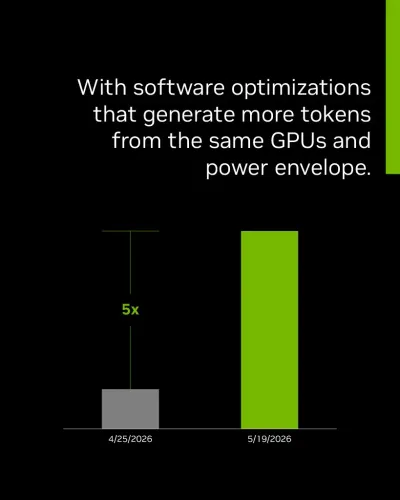
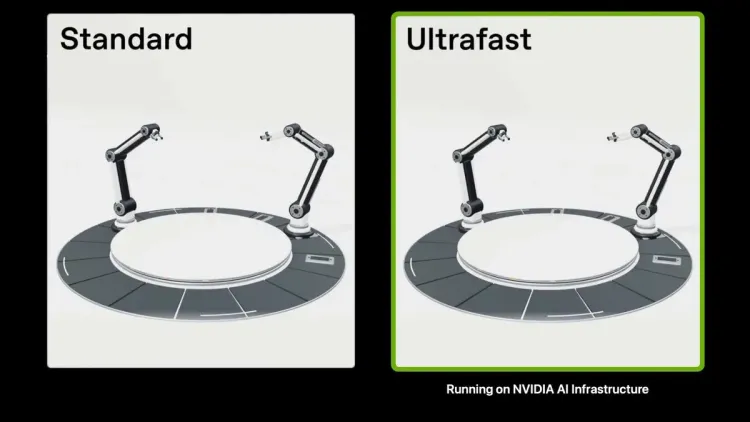
Nvidia claims the configuration delivers speeds up to 8 times faster than prior benchmarks, a figure with direct implications for inference cost and user experience.
The 'Astra Ultrafast' branding suggests a dedicated latency-optimised serving tier within the GPT-6 product line.
The partnership reinforces Nvidia's pattern of powering every major OpenAI model generation, extending its grip from training to high-speed inference.
Faster, potentially cheaper inference tiers could lower the cost of building AI-powered products for developers globally, including India's growing AI ecosystem.
Eight times faster — and now the hardware behind that leap has a name. Chip giant Nvidia confirmed on Friday, 2 October 2026 that OpenAI's GPT-6 Astra Ultrafast model runs on Nvidia silicon, publicly claiming the performance milestone for its own infrastructure stack.
The post, shared from Nvidia's official corporate account, was characteristically spare: 'Up to 8x faster, and now you know why' — with a lightning bolt, a tag to @openai, and a link to a longer read on Nvidia's own channels. The restraint is deliberate. When your chip is inside the world's most-watched AI model, you let the number do the talking.
What '8x Faster' Actually Signals
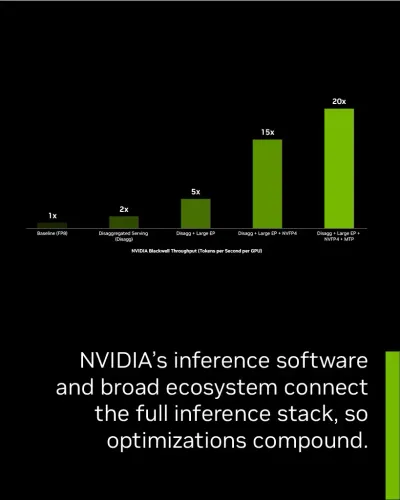
The '8x faster' figure is a significant inference-speed claim. For context, inference speed — how quickly a model generates a response after receiving a prompt — is the metric that most directly governs the cost and user experience of deploying large language models at scale. A model that runs eight times faster on the same task either slashes compute costs, enables far more concurrent users, or both. For enterprises paying per token, that multiplier translates directly into economics.
The phrasing 'Astra Ultrafast' suggests OpenAI has positioned this as a distinct serving tier of GPT-6, likely optimised for latency-sensitive applications — real-time voice, agentic workflows, or high-frequency API calls where every millisecond compounds.
Nvidia's Quiet Grip on the AI Stack
The announcement reinforces a pattern that has defined the AI era: regardless of which lab builds the frontier model, Nvidia's GPUs sit underneath it. The company's dominance in AI training infrastructure has been widely documented, but inference — serving models to end users at scale — has increasingly become the next contested layer, with rivals racing to close the gap.
By publicly linking its hardware to GPT-6 Astra Ultrafast's speed headline, Nvidia is staking a claim in that inference conversation. The message to hyperscalers, cloud providers, and enterprise buyers is explicit: the fastest version of the world's most prominent AI model chose Nvidia.
OpenAI-Nvidia: A Partnership That Keeps Compounding
The two companies have maintained a deep hardware relationship across successive GPT generations. Each new model generation has demanded exponentially more compute, and each time, Nvidia has been the primary supplier. GPT-6 Astra Ultrafast extending that relationship — and attaching an '8x' speed claim to it — signals that Nvidia's position in OpenAI's infrastructure stack has not merely held but is being actively amplified as a marketing asset by both sides.
For India's fast-growing AI developer ecosystem, which heavily depends on cloud access to OpenAI's APIs, a faster and potentially cheaper inference tier could meaningfully lower barriers to building latency-sensitive products.
The GPU wars are not slowing down. They are just getting louder.
Point of View
Nvidia is using OpenAI's marquee model as a live proof point that its GPU stack remains the performance ceiling. The '8x' figure, if it holds under independent scrutiny, could reset enterprise procurement conversations around AI serving infrastructure heading into 2027.
NationPress
2 Oct 2026
Frequently Asked Questions
What is OpenAI GPT-6 Astra Ultrafast?
GPT-6 Astra Ultrafast is a serving tier of OpenAI's GPT-6 model, positioned for high-speed inference. Nvidia confirmed on 2 October 2026 that it runs on Nvidia hardware and delivers up to 8x faster response speeds compared to previous benchmarks.
Why did Nvidia announce the GPT-6 Astra Ultrafast partnership?
Nvidia publicly confirmed the partnership to establish its hardware as the backbone of the fastest version of the world's leading AI model, reinforcing its dominance in the AI inference market as competition from rival chipmakers intensifies.
What does '8x faster' mean for AI model users?
'8x faster' refers to inference speed — how quickly the model generates a reply. For users and developers, this means lower latency in real-time applications, reduced compute costs per query, and the ability to serve far more users simultaneously.
Does Nvidia make the chips used in OpenAI models?
Yes. Nvidia's GPUs have been the primary hardware for training and serving successive generations of OpenAI models, including GPT-4 and now GPT-6 Astra Ultrafast, making Nvidia a central infrastructure partner for OpenAI.
How does the Nvidia-OpenAI GPT-6 deal affect Indian developers?
Indian developers who use OpenAI's APIs to build applications could benefit from faster and potentially more cost-effective inference, reducing latency in products such as AI assistants, voice interfaces, and agentic tools built on the GPT-6 platform.