Xi Jinping warns against 'new historical injustices' in AI era at Shanghai summit
Synopsis
In his first in-person appearance at the World AI Conference since its 2018 launch, Xi Jinping framed US-led export controls as potential ‘new historical injustices,’ positioning China as the champion of open AI access for the Global South — hours after Trump publicly accused Beijing of the ‘largest compromise of election data in history.’
Key Takeaways
Chinese President Xi Jinping addressed the 2026 World Artificial Intelligence Conference in Shanghai on July 17, 2026 — his first in-person appearance at the event since its 2018 launch.
Xi warned against creating “new historical injustices” in the AI era and called for greater support for the Global South .
He urged nations to oppose “overstretching the national security concept in the field of AI ,” in an implicit rebuke of US export controls and blacklists.
US President Donald Trump delivered a prime-time broadcast accusing China of orchestrating the “largest compromise of election data in history” in a near-simultaneous address.
Beijing is positioning itself as a leader in global AI governance, advocating an open, inclusive development model as an alternative to Washington’s restrictions-based approach.
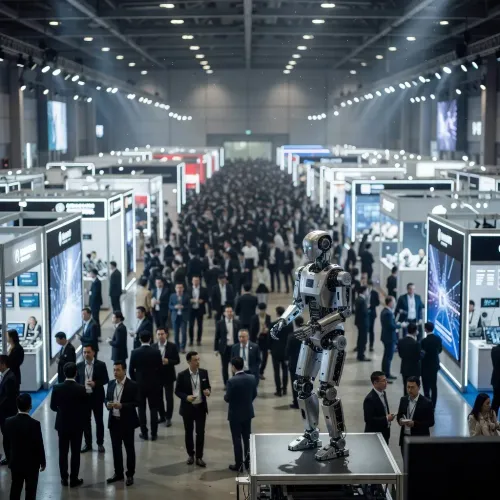
Chinese President Xi Jinping used his first in-person appearance at the World Artificial Intelligence Conference in Shanghai on Friday, July 17, 2026, to warn against creating “new historical injustices” in the AI era, calling for greater support for the Global South and a more open, inclusive approach to artificial intelligence development. The address came at the opening ceremony of China’s largest annual AI industry gathering, which has been held since 2018.
A pointed message on AI governance
Xi urged nations to strengthen risk awareness and ensure that AI remains “secure and controllable,” while simultaneously pushing back against what he described as the growing securitisation of the technology. “We should jointly oppose overstretching the national security concept in the field of AI or placing one country’s security over that of others,” he said. The remarks were widely read as a direct rebuke of Washington’s expanding export controls and corporate blacklists targeting Chinese technology firms.
The competitive backdrop
Xi’s speech arrived moments after US President Donald Trump delivered what was described as an unprecedented attack against Beijing during a prime-time national broadcast, accusing China of orchestrating the “largest compromise of election data in history.” The near-simultaneous addresses underscored the sharply divergent narratives the two superpowers are projecting as the global contest over AI leadership intensifies. Xi’s appearance at the conference — his first since the event’s launch — was seen as a signal of Beijing’s intention to position itself at the centre of global AI governance.
Why it matters
The framing of AI access as an equity and justice issue marks a notable strategic shift for Beijing, aligning its technology policy with the concerns of developing nations that have been largely excluded from the benefits of advanced AI systems. By casting export controls and blacklists as instruments of historical injustice, China is seeking to build a coalition of countries sympathetic to an alternative governance model. Access to advanced technologies is increasingly constrained by restrictions that disproportionately affect nations in the Global South, industry analysts noted.
What’s next
The 2026 World Artificial Intelligence Conference in Shanghai is expected to serve as a platform for China to advance its preferred framework for international AI standards and governance norms. With US-China tech rivalry showing no signs of easing, the competing visions articulated by Xi and Trump on the same day will likely shape multilateral discussions at upcoming forums. The degree to which Global South nations align with Beijing’s “open and inclusive” framing will be the key variable to watch in the months ahead.
Point of View
Where resentment of Western technology gatekeeping runs deep. The fact that both Xi and Trump addressed their respective audiences on the same day, with diametrically opposed narratives, signals that the AI governance battle has fully entered the geopolitical arena. Mainstream coverage tends to focus on the technical dimensions of the US-China rivalry — chips, models, data — but the more consequential contest may be over which power writes the norms that govern AI for the majority of the world’s population. The outcome of that normative battle, not raw compute capacity, could determine who leads the next decade of AI deployment across the developing world.
NationPress
16 Oct 2026
Frequently Asked Questions
What did Xi Jinping say at the 2026 World Artificial Intelligence Conference?
Xi Jinping warned against creating “new historical injustices” in the AI era and called for an open, inclusive approach to AI development with greater support for the Global South . He also urged countries to ensure AI is “secure and controllable” and opposed “overstretching the national security concept” in the field.
Why did Xi Jinping attend the World AI Conference in person in 2026?
Xi’s in-person attendance at the 2026 World Artificial Intelligence Conference in Shanghai was his first since the event launched in 2018 . The appearance was widely interpreted as a signal of Beijing’s intention to lead global AI governance amid intensifying US-China tech rivalry.
What did Donald Trump say about China on July 17, 2026?
US President Donald Trump delivered a prime-time national broadcast accusing China of orchestrating the “largest compromise of election data in history.” The broadcast aired moments before or around the same time as Xi Jinping’s address in Shanghai .
How does China’s AI governance stance differ from the US approach?
China , as articulated by Xi Jinping , advocates an open and inclusive model of AI development that prioritises access for the Global South and opposes securitising the technology. The United States , by contrast, has pursued export controls and corporate blacklists that restrict access to advanced AI hardware and software for Chinese entities.
Who is most affected by the US-China AI rivalry?
Developing nations in the Global South are increasingly caught between the two competing governance models, as access to advanced AI technologies is constrained by US export controls. Chinese technology firms subject to corporate blacklists are also directly affected, as are international partners seeking to build AI infrastructure without geopolitical entanglement.