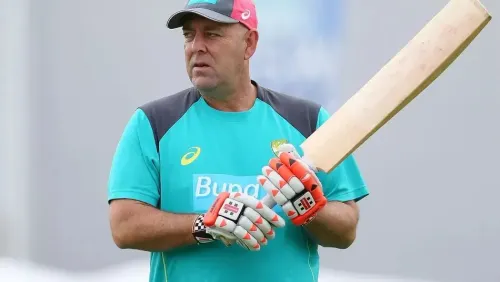
Darren Lehmann denies Sandpapergate knowledge, calls 2018 scandal a 'dark place'
Synopsis
Seven years on, Sandpapergate refuses to stay buried. Cameron Bancroft's 4,000-word account placed Darren Lehmann in the dressing-room conversation; Lehmann says he cannot remember being there. With Usman Khawaja's 'all of us knew' claim also in the mix, the scandal's true circle of knowledge remains as contested as ever — and no official inquiry is in sight.
Key Takeaways
Darren Lehmann reaffirmed he had no knowledge of the sandpaper plan during the 2018 South Africa tour , speaking to ABC Radio ahead of the Australia vs England T20I.
Cameron Bancroft 's 4,000-word account alleged that Lehmann and bowling coach David Saker were present when the sandpaper idea was discussed in the dressing room.
David Warner reportedly raised the possibility of using sandpaper to roughen the ball, according to Bancroft's account.
Lehmann said the scandal took him to a 'dark place' and that it took him three to four years to return to normality.
Usman Khawaja 's claim that 'all of us' knew has widened scrutiny beyond the three players originally banned by Cricket Australia .
Cricket Australia has not indicated any plans to reopen its investigation into the Cape Town ball-tampering incident.
Former Australia head coach Darren Lehmann has firmly reiterated that he had no prior knowledge of the sandpaper plot hatched during the 2018 South Africa tour, describing the fallout from the infamous Sandpapergate scandal as one of the darkest periods of his life. Lehmann's remarks come after the controversy resurfaced in recent weeks, reignited by fresh claims from players directly involved in the incident.
What Lehmann Said
Speaking to ABC Radio ahead of the first T20 International between Australia and England on Saturday, Lehmann was unequivocal about his position. 'I haven't changed my views from what happened in 2018,' he said. 'It was a dark time, and we got a lot of things wrong, but my version still stays the same. It was just a bad time. We all made mistakes.'
Lehmann acknowledged broader culpability as coach while stopping short of admitting direct involvement in the plan. 'In 2018, it went too far, and I'm (responsible) for that as the coach,' he said. 'People said I didn't lose anything. I actually lost the best job in the world, and I'm sorry for that, and I'm sorry for what happened.'
The Bancroft Claims That Reopened the Debate
The scandal was thrust back into the spotlight after Cameron Bancroft — the player caught on camera using sandpaper on the ball during the Cape Town Test — published a detailed 4,000-word account of the events. In it, Bancroft alleged that a conversation about using sandpaper to generate reverse swing took place in the dressing room, and that both bowling coach David Saker and Lehmann were present. 'Coach Darren Lehmann was also present,' Bancroft wrote.
Bancroft also alleged that David Warner 'raised the possibility of using sandpaper to roughen one side of the ball' during those discussions. Lehmann, however, said he could not recall being part of any such exchange. 'I can't remember being present in that conversation,' he said. 'But again, it is eight and a half years ago; you'll have to ask those people. That's the issue, I have my version, and that's where I stand.'
The Human Cost Lehmann Describes
Beyond the cricketing and reputational fallout, Lehmann opened up about the severe personal toll the scandal took on him. 'I went to a really dark place. I went to as dark a place as you can think about. It took me probably three to four years to actually get back to some sort of normality,' he said.
He expressed empathy for all those caught up in the controversy, including Bancroft and the wider playing and support staff. 'I feel for everyone and their families,' Lehmann said, adding that some media coverage had been 'outright hurtful to a lot of people.' He also declined to revisit the episode in further detail. 'I'm not going back to that dark place. I'm trying to move forward,' he said.
The Khawaja Claim That Kept the Controversy Alive
The renewed scrutiny of Sandpapergate was also partly triggered by batter Usman Khawaja, who had claimed that 'all of us' in the Australian dressing room were aware of what was happening. That assertion widened the circle of alleged knowledge well beyond the three players — Steve Smith, David Warner, and Cameron Bancroft — who were banned by Cricket Australia in the immediate aftermath of the scandal.
Lehmann, who resigned as head coach shortly after the Cape Town episode, acknowledged the complexity of dressing-room dynamics. 'There are a lot of different conversations going on and some people are privy to them, and some people are not. I'm not privy to every conversation or meeting,' he said.
What Happens Next
With multiple accounts now in the public domain — and key figures offering conflicting recollections — the full picture of what transpired in Cape Town in March 2018 remains contested. Cricket Australia has not indicated any plans to reopen its investigation. For Lehmann, the priority is personal recovery rather than relitigating the past, though the renewed wave of claims suggests the cricket world has not yet closed the chapter on one of the sport's most damaging controversies.
Point of View
But the accumulation of contrary accounts — from Bancroft placing him in the room to Khawaja's sweeping 'all of us' claim — means his version is now an outlier, not a consensus. The real accountability gap is Cricket Australia's: having closed its investigation years ago, the board has no mechanism to adjudicate between irreconcilable recollections. What this episode exposes is that the original inquiry prioritised swift punishment over a complete factual record — and the sport is still paying that price.
NationPress
21 Nov 2026
Frequently Asked Questions
What did Darren Lehmann say about Sandpapergate in his latest statement?
Lehmann told ABC Radio that his position has not changed since 2018 — he maintains he had no prior knowledge of the plan to use sandpaper on the ball during the Cape Town Test. He accepted broader responsibility as head coach but said he could not recall being part of any dressing-room conversation about using the object.
What did Cameron Bancroft claim about Lehmann's involvement?
In a detailed 4,000-word account, Bancroft alleged that Lehmann and bowling coach David Saker were present during dressing-room conversations about getting the ball to reverse swing using sandpaper. Lehmann has said he cannot remember being part of that conversation.
Why has the Sandpapergate scandal resurfaced now?
The controversy was reignited by two developments: Cameron Bancroft's extensive written account naming Lehmann and Saker, and batter Usman Khawaja's claim that 'all of us' in the Australian dressing room were aware of what was happening — widening the alleged circle of knowledge beyond the three players originally banned.
Who was punished after the 2018 Cape Town ball-tampering incident?
Cricket Australia banned Steve Smith, David Warner, and Cameron Bancroft following the incident. Lehmann resigned as head coach shortly afterwards but was not formally sanctioned. No new investigation has been announced despite the fresh claims.
What personal impact did Sandpapergate have on Lehmann?
Lehmann said the scandal sent him to a 'really dark place' and that it took him approximately three to four years to return to normality. He expressed empathy for all those affected, including Bancroft and their families, and said he has no intention of revisiting that period.