Will the 2026 Elections See Foes Become Allies?
Synopsis
As the 2026 elections approach, a complex political landscape unfolds in India. Opposition parties across states are forming alliances despite existing rivalries. This uneasy coalition raises questions about their effectiveness and credibility as they navigate voter perceptions and regional identities. Will these alliances hold strong, or will past conflicts resurface?
Key Takeaways
Opposition alliances are forming across states for the 2026 elections.
Historical rivalries complicate coalition dynamics.
Voter trust may be affected by perceived inconsistencies.
Regional identity plays a significant role in political strategy.
Past election experiences highlight the importance of strong coalition management.
New Delhi, Dec 24 (NationPress) In the lead-up to the 2026 State Assembly elections, a coalition is emerging among Opposition factions spread across a vast 2,000-km expanse, facing fierce competition against one another. This scenario presents a challenging campaign as they struggle to persuade voters amidst perceptions of inconsistency.
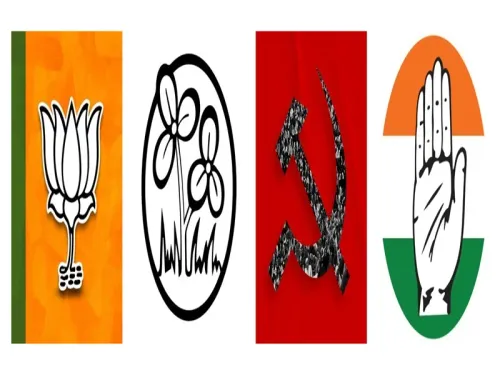
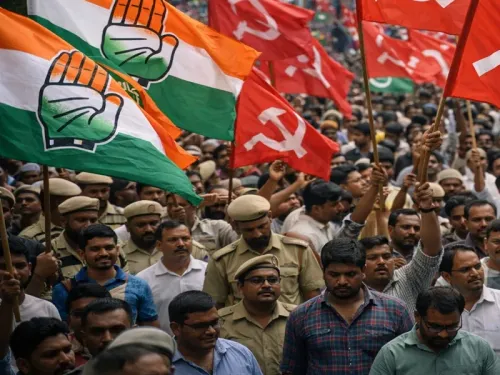
The phrase “a foe in one shadow, an ally in another light” will resonate between Kerala and West Bengal, as the Left, Congress, and Trinamool Congress form a strategic alliance based on regional dynamics.
In Kerala, the ruling Left Democratic Front (LDF), spearheaded by the Communist Party of India (Marxist), has historically been in opposition to the Congress-led United Democratic Front (UDF).
With just three months remaining before the Assembly elections, the UDF has recently decided to broaden its coalition by inviting three additional political parties, including the Trinamool Congress.
Meanwhile, in West Bengal, the CPI(M)-led Left Front is collaborating with the Congress to challenge the ruling Trinamool Congress. However, these alliances have not yet been formally announced for the upcoming elections.
The Trinamool Congress had previously dismantled West Bengal’s leftist stronghold in 2011 in partnership with Congress, but since then, under Mamata Banerjee’s leadership, it has opted to navigate the political landscape independently, resulting in a three-way contest involving the Trinamool, Bharatiya Janata Party (BJP), and the Left-Congress alliance, which has notably seen a decline in its voter base.
In Kerala, the political landscape remains largely divided between the LDF and UDF, with the BJP gaining ground recently. The apparent inconsistency in electoral strategies is likely to undermine voter trust, as visible confrontations in one region may raise doubts about their ability to collaborate effectively in another.
Public exchanges of accusations among parties signify weak coalition cohesion and diminishes confidence in the opposition’s potential to present a viable alternative in different states.
In West Bengal, regional identity has consistently overshadowed national alliances. Despite being a founding member of the Opposition’s INDIA Bloc, Mamata Banerjee has kept national allies like the Left and Congress at arm's length.
Conversely, the enduring ideological conflict between the Left and Congress in Kerala makes their tactical cooperation feel more like a transaction than a principled stance. With the Trinamool’s involvement, voters might begin to question the legitimacy of these alliances and their sustainability.
Previous elections in Bihar revealed significant rifts among Opposition Mahagathbandhan partners over seat allocation and campaign messaging. The All India Majlis-e-Ittehadul Muslimeen (AIMIM) struggled to find a place on the platform despite numerous attempts, while the Jharkhand Mukti Morcha (JMM), which governs the neighboring state alongside other coalition partners, faced similar setbacks.
It was forced to withdraw from the electoral race, leaving Bihar in disarray. This situation raises concerns about the future of the Jharkhand government, with JMM leaders suggesting a potential split from the Rashtriya Janata Dal (RJD) and Congress at the local level.
Additionally, Congress leader Rahul Gandhi’s “vote chori” slogan against the Election Commission’s Special Intensive Revision (SIR) of electoral rolls failed to gain traction among coalition partners, notably the RJD. After the elections, allies reportedly engaged in blame-shifting as well. In this politically charged environment, a regional alliance formed out of convenience may not bode well for partners entrenched in rivalries elsewhere.
Point of View
The evolving political alliances ahead of the 2026 elections reflect the complexity of India's democratic landscape. While such coalitions may appear strategic, their effectiveness will ultimately depend on the parties' ability to address voter concerns and maintain credibility in their governance.
NationPress
2 Oct 2026
Frequently Asked Questions
What are the main political parties involved in the 2026 elections?
The major parties include the Left Democratic Front (LDF), United Democratic Front (UDF), Trinamool Congress, and Bharatiya Janata Party (BJP), among others.
How does regional identity influence these alliances?
In regions like West Bengal, local identities often take precedence over national alliances, affecting how parties cooperate and present themselves to voters.
What challenges do these alliances face?
These coalitions face challenges such as historical rivalries, public trust issues, and the need for cohesive messaging among diverse partners.
Is voter perception important in these elections?
Yes, voter perception is crucial, as inconsistencies in party behavior can erode public trust and undermine coalition effectiveness.
What lessons can be learned from past elections?
Previous elections have shown that rifts over seat distribution and coalition dynamics can significantly impact electoral outcomes.