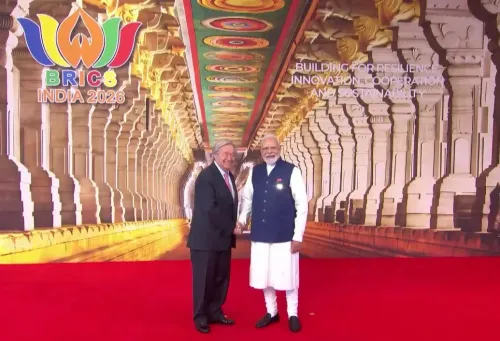
BRICS 2026 New Delhi Summit: What India's consensus moment tells a fractured world
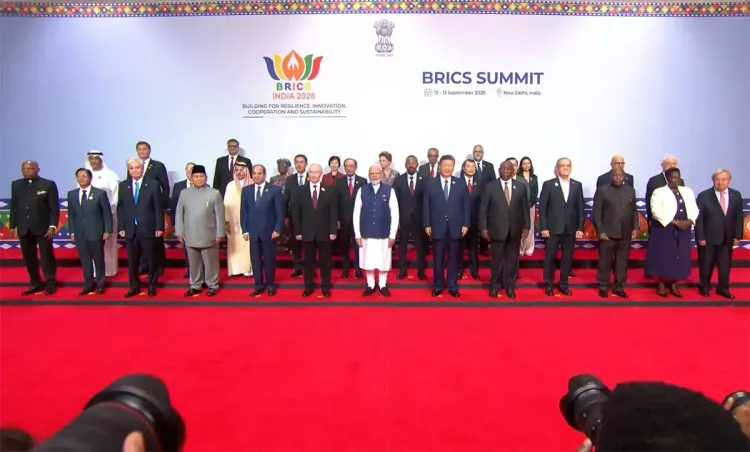
Synopsis
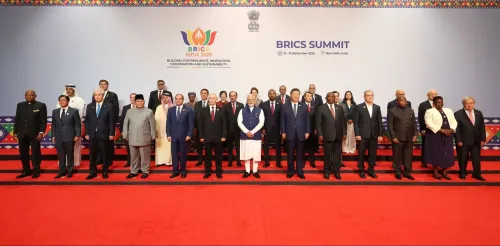
Despite wars in West Asia, a stalemated Russia-Ukraine conflict, and Trump's tariff threats, BRICS 2026 in New Delhi produced both a consensus declaration and an unexpected Iran-UAE diplomatic handshake. Modi's 'pyramid of privilege' address framed the summit as a direct challenge to the existing global order — and India as the convener capable of holding that conversation.
Key Takeaways
The New Delhi Declaration was adopted at the BRICS 2026 Summit , achieving consensus despite deep internal and global divisions.
Prime Minister Narendra Modi described the current global governance structure as a 'pyramid of privilege' and called for a 'platform of partnership' in its place.
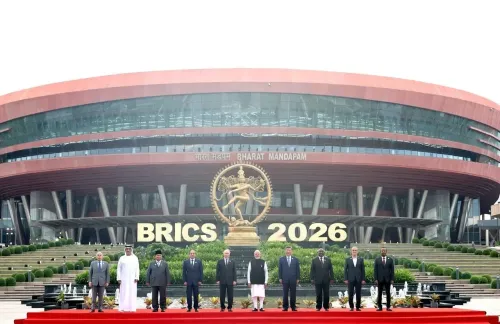
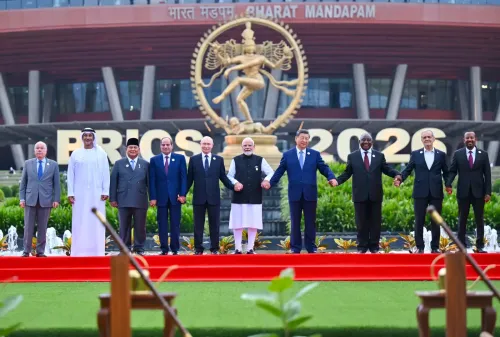
UAE Crown Prince Sheikh Khaled bin Mohamed bin Zayed Al Nahyan and Iranian President Masoud Pezeshkian met at Bharat Mandapam on 11 September — a notable diplomatic exchange amid the West Asia conflict.
Russian President Vladimir Putin used the BRICS platform on 11 September to assert Russia posed no threat to Europe, while also warning that European troop deployment to Ukraine would be 'a war against Russia.' The summit reaffirmed multilateralism , multipolarity , and respect for international law — a rebuff to characterisations of the grouping as irrelevant.
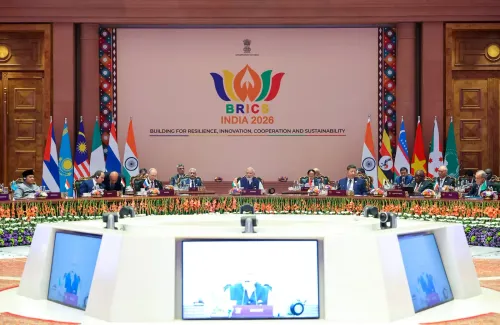
The adoption of the New Delhi Declaration at the BRICS 2026 Summit in New Delhi has emerged as a defining diplomatic moment — not because consensus was guaranteed, but because many observers doubted it was possible at all. Against a backdrop of unresolved conflicts, shifting trade rules, and deep geopolitical fault lines, the grouping managed to present a unified front, however imperfect.
A summit held against steep odds
The global context could hardly have been more turbulent. Conflicts continue to rage across West Asia, the Russia-Ukraine war has entered its fourth year, and Washington has repeatedly altered tariff frameworks while taking an increasingly adversarial posture toward multiple nations. Several BRICS members themselves carry significant bilateral differences, making any consensus a genuine diplomatic accomplishment rather than a formality.
Growing anxiety over peace, trade stability, and the future of global supply chains has placed the Global South under mounting pressure. The New Delhi Summit, according to participants, at least gestured toward an alternative path — one built on cooperation rather than confrontation.
Modi's 'pyramid of privilege' challenge
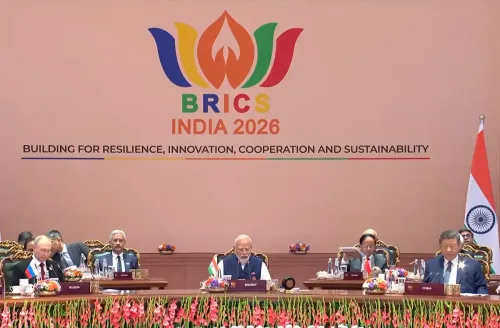
Prime Minister Narendra Modi, in his opening address, offered perhaps the sharpest framing of the summit's intent. Describing the existing global decision-making architecture as a 'pyramid of privilege', he called for a fundamental reset. 'The Global South is in the front row of global crises, but in the back row of decision-making,' he said, urging that this structure be replaced by a 'platform of partnership' where every country commands a voice, every member holds a stake, and human development sits at the centre of global effort.
The criticism was pointed: decisions affecting developing and least-developed nations are routinely taken without adequate representation from those most affected. Modi's framing positioned India as both a convener and an advocate for structural reform of multilateral institutions, including the United Nations and the UN Security Council, whose effectiveness has come under growing scrutiny.
The Iran-UAE handshake: Diplomacy in action
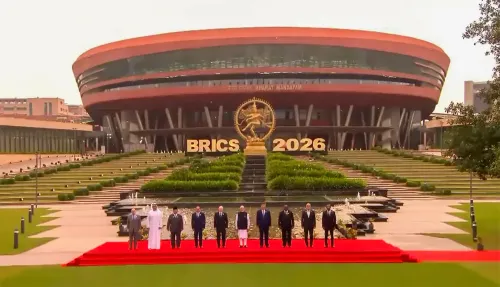
If the declaration was the formal achievement of the summit, an informal moment may have carried equal weight. On 11 September, at Bharat Mandapam, UAE Crown Prince Sheikh Khaled bin Mohamed bin Zayed Al Nahyan met Iranian President Masoud Pezeshkian alongside their respective delegations. The two leaders reportedly exchanged a warm handshake — a quietly significant gesture between two nations separated by deep regional divisions.
The meeting did not resolve the West Asia conflict, nor was it intended to. But the fact that two countries with sharply divergent positions were able to sit together, talk, and engage — on a platform created by India — is itself a demonstration of what structured diplomacy can achieve. It also underscores a consistent thread in New Delhi's foreign policy: keeping dialogue open, even when differences appear unbridgeable.
Putin's dual message from New Delhi
Russian President Vladimir Putin, speaking from the summit venue, used the BRICS platform to send a signal to Europe — that Russia did not pose a threat to European nations. In the same breath, on 11 September, he reportedly warned that any deployment of European troops to Ukraine would constitute 'a war against Russia.' The juxtaposition was noted by observers: the BRICS stage offered Putin a global audience at a moment when Russia's diplomatic options in Western forums remain severely constrained.
What the New Delhi Summit signals
US President Donald Trump had previously dismissed BRICS as 'dead' and had repeatedly threatened higher tariffs on member states. The New Delhi outcome offered a contrary signal: the grouping reaffirmed multilateralism, multipolarity, and respect for international law, even as it acknowledged internal contradictions. India's role as host demonstrated a diplomatic bandwidth that few nations currently possess — the ability to convene adversaries, managed disagreements, and still produce a collective statement.
BRICS, the summit suggested, is no longer merely a forum for annual meetings among emerging economies. It is evolving into a platform through which the Global South is asserting its right to shape the rules of the international order — a development with implications that extend well beyond the declaration itself.
Point of View
However hard-won, are not policy outcomes. Modi's 'pyramid of privilege' rhetoric is compelling and politically resonant, yet the same critique has been voiced at multilateral forums for decades without producing structural reform of the UN Security Council or the Bretton Woods institutions. The Iran-UAE moment at Bharat Mandapam is the summit's most concrete deliverable — a rare instance of adversaries using an Indian-convened platform to engage — and it is telling that the most meaningful outcome was informal, not declaratory. India's growing diplomatic bandwidth is real; translating it into durable architecture for Global South influence is the harder and still-unfinished task.
NationPress
13 Sept 2026
Frequently Asked Questions
What was agreed at the BRICS 2026 New Delhi Summit?
The BRICS 2026 Summit, hosted by India in New Delhi, produced the New Delhi Declaration, a consensus document reaffirming multilateralism, multipolarity, and respect for international law. The declaration was notable given sharp differences among member states on several global conflicts.
What did PM Modi say in his BRICS 2026 opening address?
Prime Minister Narendra Modi described the current global governance structure as a 'pyramid of privilege' and called for it to be replaced by a 'platform of partnership.' He argued that the Global South is 'in the front row of global crises, but in the back row of decision-making.'
What was the significance of the Iran-UAE meeting at BRICS 2026?
UAE Crown Prince Sheikh Khaled bin Mohamed bin Zayed Al Nahyan and Iranian President Masoud Pezeshkian met at Bharat Mandapam on 11 September, on the sidelines of the summit. The meeting was significant because it brought together two nations with deeply divergent positions on the West Asia conflict, demonstrating that the BRICS platform can create space for dialogue even without resolving underlying disputes.
What did Putin say at the BRICS 2026 Summit?
Russian President Vladimir Putin used the BRICS Summit to assert that Russia did not pose a threat to European nations. On 11 September, he also warned that any deployment of European troops to Ukraine would constitute 'a war against Russia,' using the global platform to restate Moscow's position on the conflict.
Why does the BRICS 2026 Summit matter for the Global South?
The summit reinforced BRICS as a platform for Global South nations to advocate for a reformed international order. India, as host, positioned the grouping as an alternative multilateral voice at a time when Western-led institutions face credibility questions, and when developing nations feel excluded from key global decision-making processes.