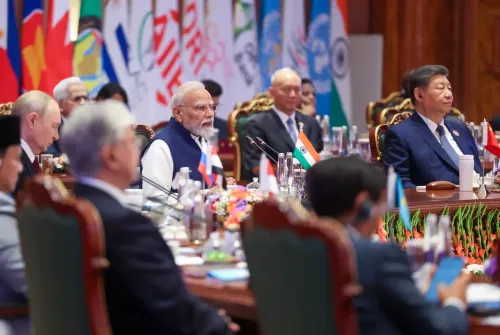
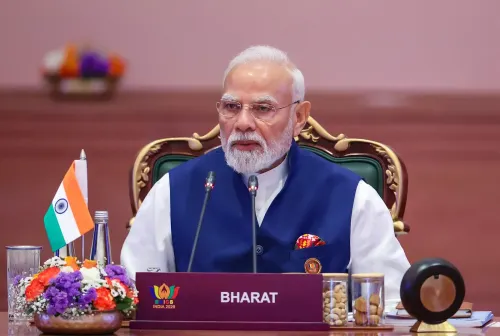
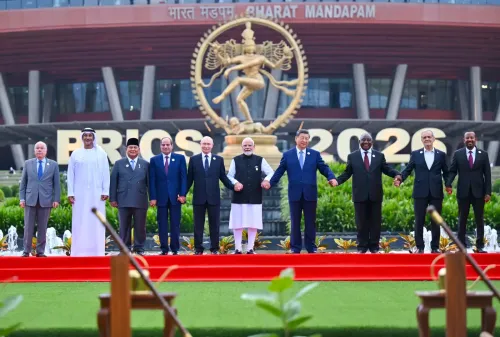
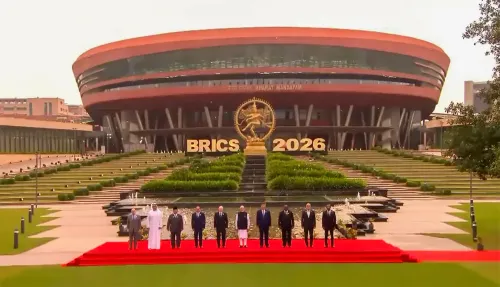
BRICS Summit 2026: India's presidency puts New Delhi on global diplomatic stage
Synopsis
India's BRICS presidency didn't just keep a fractious 11-member bloc together — it steered it away from an anti-West posture, secured rare consensus on the 2025 Pahalgam terror attack, and won acknowledgement from a G7 chair keen to engage. The Delhi Declaration is a diplomatic high-water mark, but the harder task — turning paper consensus into implemented reform — now lies ahead.
Key Takeaways
India hosted the 18th BRICS Summit in New Delhi under its chairmanship, securing consensus on the Delhi Declaration .
The summit reached a notable agreement on the 2025 Pahalgam attack , with BRICS adopting a call for zero tolerance for terrorism .
PM Narendra Modi challenged the 11-member bloc to develop 10 global governance reform proposals for a unified BRICS Reform Roadmap .
India broadened the BRICS agenda to include AI, critical minerals, women's empowerment, climate and trade resilience — moving beyond de-dollarisation.
China proposed a BRICS open-source AI community ; several members reportedly expressed scepticism.
Analysts cautioned that summit outcomes are inherently long-term and may take time to produce tangible results ahead of the next summit in China .
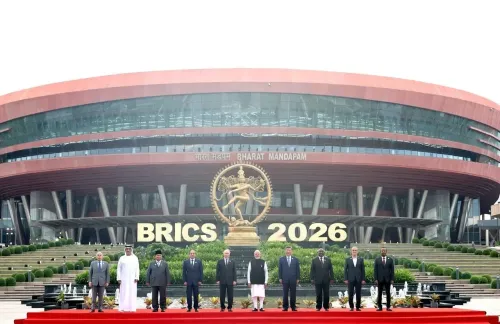
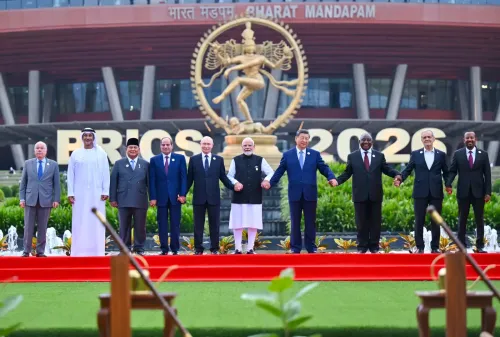
India's chairmanship of the 18th BRICS Summit in New Delhi has been widely praised by top analysts and seasoned diplomats as a landmark exercise in multilateral diplomacy, demonstrating the country's ability to forge consensus across an increasingly diverse grouping despite a fraught geopolitical and geoeconomic environment. Experts gathered on Wednesday, 16 September 2026 — three days after the summit's conclusion — assessed the outcomes as a significant affirmation of New Delhi's convening power on the world stage.
Roundtable Takes Stock of Summit Outcomes
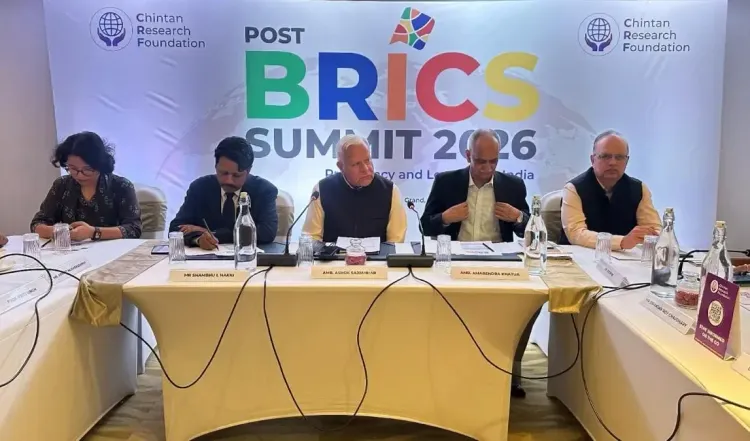
Distinguished diplomats, policy analysts, academics and strategic community representatives convened at a roundtable organised by the Chintan Research Foundation (CRF) in New Delhi, titled 'Post BRICS Summit 2026: Presidency and Lessons for India'. Participants broadly agreed that India's presidency had elevated BRICS's relevance as a platform for Global South cooperation rather than a narrowly geopolitical or anti-West bloc.
A particularly significant outcome, participants noted, was the consensus secured on the 2025 Pahalgam attack, paired with a call for zero tolerance for terrorism and the disruption of terror financing. The summit also broadened BRICS's agenda well beyond de-dollarisation to encompass trade resilience, institutional reform, health, food and energy security, climate, technology, artificial intelligence, critical minerals, women's empowerment, and people-to-people connect.
What the Delhi Declaration Signals
Delivering the keynote address, Shambhu L Hakki, Joint Secretary (Multilateral Economic Relations and G20) in the Ministry of External Affairs (MEA) and India's G20 and BRICS Sous-Sherpa, explained that the Delhi Declaration adopted at the summit signalled practical cooperation between developing countries. He highlighted the presence of the African Union, ASEAN, CELAC, GCC and BIMSTEC as broadening representation across the Global South.
Hakki noted that heads of National Standardisation Bodies (NSBs) convened to discuss harmonising standards and reducing trade barriers. He also underscored the Troika Agreement's importance in ensuring institutional continuity across annual presidency rotations. Prime Minister Narendra Modi challenged the 11-member bloc to collaborate on 10 global governance reform proposals in the coming months to build a unified BRICS Reform Roadmap ahead of the next summit in China.
Geopolitical Dynamics and Shifting Perceptions
Seasoned diplomat Ambassador Ashok Sajjanhar described the Delhi Declaration as being more about practical cooperation than posturing, stressing that all consensus points must be implemented and not remain on paper. He observed that India steered BRICS toward a collaborative rather than confrontational identity, and noted that the G7 under France's presidency had shown interest in engaging with BRICS on connectivity, global supply chains and finance — a signal that the Global South's weight is being acknowledged even by developed economies.
The roundtable also flagged the participation of the presidents of Russia, China and Iran, as well as a bilateral meeting between the Iranian President and a UAE high-level representative. Notably, some participants voiced the view that the United States had moved, in global perception, from being seen as a liberator to a disruptor and, in one characterisation, a 'rent-seeking landlord' in South Asia — a formulation attributed to roundtable contributors, not official government positions.
De-Dollarisation, AI and BRICS Expansion
Discussions also addressed persistent challenges surrounding de-dollarisation and the absence of a common BRICS currency, with experts stressing the urgency of strengthening cross-border payment mechanisms and the New Development Bank (NDB). China proposed establishing a BRICS open-source artificial intelligence (AI) community, though several members reportedly expressed scepticism about the proposal.
On expansion, participants underlined the need to pay greater attention to interest from South Asian countries. Pakistan's possible inclusion was discussed in terms of the complications it could create for the grouping, while Malaysia was cited for the weight it could add. Sustained economic engagement with partner countries such as Cuba and Bolivia was also called for.
Recommendations and the Road Ahead
The roundtable concluded with concrete recommendations: early implementation of cross-border payment mechanisms, a BRICS grain exchange, and remote-sensing satellite constellations, alongside further strengthening of the NDB. Wealth creation from waste was flagged as another practical cooperation area. Experts cautioned, however, that as with any multilateral process, many of the summit's outcomes are inherently long-term and may take time to materialise. With the next summit set to be held in China, the pressure now shifts to converting Delhi's consensus into verifiable action.
Point of View
But the more consequential question is whether the consensus it captures — on terrorism, trade, and institutional reform — translates into anything measurable before China takes the chair. India's ability to nudge BRICS away from an explicitly anti-West posture is strategically significant, yet the grouping's internal fault lines — between Russia and China's revisionist instincts and India's preference for a multipolar but not adversarial order — have been managed, not resolved. The G7's reported interest in engaging with BRICS on supply chains signals that New Delhi's centrist positioning is being noticed in capitals that matter. The risk is that a well-convened summit becomes another multilateral document on the shelf unless the Troika framework forces follow-through.
NationPress
16 Sept 2026
Frequently Asked Questions
What were the key outcomes of the 18th BRICS Summit in New Delhi?
The 18th BRICS Summit, held in New Delhi under India's chairmanship, produced the Delhi Declaration — a consensus document covering practical cooperation on trade, institutional reform, security, climate, AI, and critical minerals. A significant outcome was collective agreement on the 2025 Pahalgam terror attack and a call for zero tolerance for terrorism and disruption of terror financing.
What is the Delhi Declaration and why does it matter?
The Delhi Declaration is the consensus document adopted at the 18th BRICS Summit in New Delhi. According to analysts at the post-summit roundtable, it marks a shift from geopolitical posturing to practical cooperation between developing countries, and reflects India's effort to position BRICS as a constructive Global South platform rather than an anti-West bloc.
What did PM Modi propose at the BRICS Summit 2026?
Prime Minister Narendra Modi challenged the 11-member BRICS bloc to collaborate on 10 global governance reform proposals over the coming months to build a unified BRICS Reform Roadmap ahead of the next summit in China. He also steered the grouping's agenda toward broader issues including AI, critical minerals, and women's empowerment.
How did India handle the challenge of BRICS expansion?
Analysts at the CRF roundtable noted that India sought to make the expanded grouping more representative and centrist rather than confrontational. Discussions touched on potential inclusion of South Asian countries, with Pakistan's possible entry flagged as potentially complicating for the group, and Malaysia cited as a candidate that could add strategic weight.
What happens next after India's BRICS presidency?
India's BRICS presidency concludes with the Delhi Declaration and a handover ahead of the next summit, to be hosted by China. Analysts recommend early implementation of cross-border payment mechanisms, the BRICS grain exchange, and satellite constellations. Many outcomes are described as inherently long-term, with follow-through dependent on the Troika Agreement's institutional continuity framework.