Congress and Left Face Uphill Battle in Upcoming Assembly Elections
Synopsis
As elections approach in Tamil Nadu and West Bengal, the Congress and Left parties are struggling for relevance. With historical losses and internal challenges, can they reclaim their political standing?
Key Takeaways
Congress and Left parties are struggling in Tamil Nadu and West Bengal.
Both parties are contesting as junior partners in alliances.
Kerala remains a key battleground for the Left.
Congress aims to reverse recent losses in Assam.
May 4 results could redefine political dynamics.
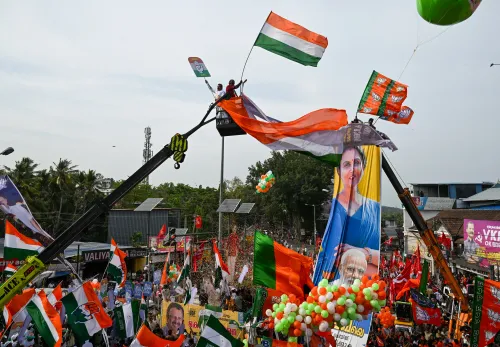
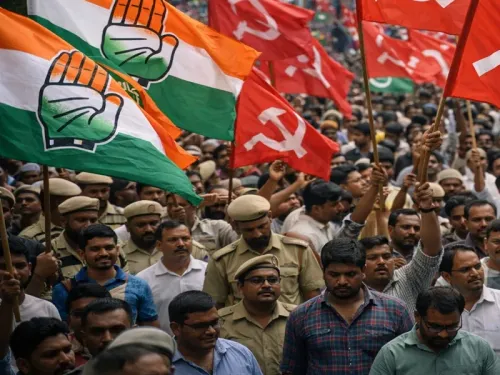
New Delhi, April 6 (NationPress) As four states and a Union Territory prepare for elections this month, the outcomes in two of them—spanning nearly 2,500 kilometers—are crucial for the resurgence of two once-prominent political entities in India.
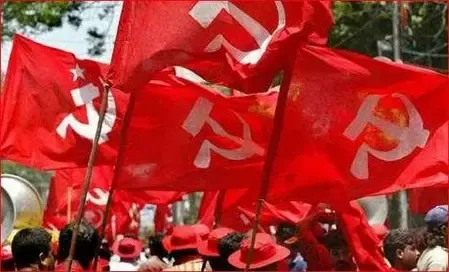
Current media insights and political analysts indicate that neither the historic Congress party nor the influential Left parties appear likely to secure significant power in Tamil Nadu or West Bengal.
In Tamil Nadu, both parties are contesting the April 23 Assembly elections as minor partners alongside the ruling Dravida Munnetra Kazhagam (DMK). Conversely, in West Bengal, neither seems poised to take the lead in the state Assembly.
Kerala presents the only potential opportunity for either party, with Assam providing a slim chance for Congress.
Interestingly, both states will hold elections on Thursday. In Kerala, the two leading coalitions have alternated in power for the past four decades, a trend disrupted by the Left Democratic Front (LDF) in 2021.
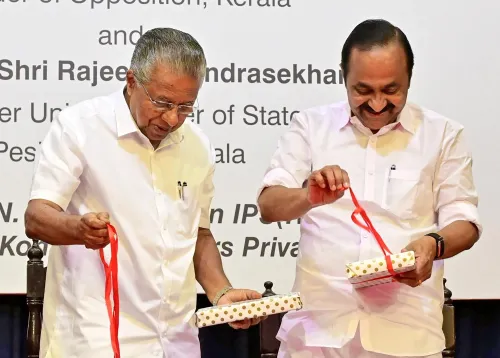
The LDF, led by the Communist Party of India (Marxist), has a record of winning state elections in 1980, 1987, 1996, 2006, 2016, and again in 2021.
This marked the first instance in 40 years where an incumbent administration was re-elected consecutively.
Overall, the LDF has claimed victory in 6 out of 10 elections since the alliance's inception in 1980.
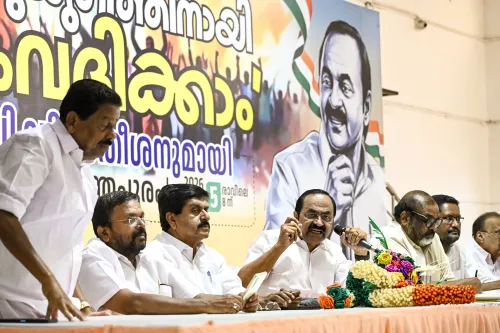
In 1980, former state Congress leader K. Karunakaran established the United Democratic Front (UDF) and took power in 1981, returning in 1982 after a brief period of President's Rule.
The UDF has since won elections in 1982, 1991, 2001, and 2011. With no third formidable contender for power, this election cycle will again favor one of the two alliances, offering a critical boost to either Congress or the CPI(M)—both of which have experienced significant declines in their political influence over recent years.
The results on May 4 will reveal whether the UDF can prevent the LDF from achieving the unprecedented feat of winning state elections three times consecutively.
The Grand Old Party of India has been facing challenges, struggling to maintain rule in states like Chhattisgarh and Rajasthan, and suffering losses in Haryana and Maharashtra.
Even in Delhi, Congress failed to leverage discontent towards the Aam Aadmi Party, finishing in a distant third.
An additional defeat would deliver a considerable blow to the Gandhi family, with Rahul Gandhi being the prominent figure leading Congress' revival efforts and Priyanka Gandhi making a significant political entry from the Wayanad Lok Sabha constituency. Thus, a victory is essential for the party, especially with mounting anti-incumbency sentiments against the LDF after two consecutive terms in governance and the state facing fiscal difficulties.
For the Left, Kerala remains their last stronghold following losses in West Bengal and Tripura.
Meanwhile, in Assam, the competition primarily involves two factions—the BJP and Congress—where the latter is fervently striving to regain its footing, fighting to remain relevant in key areas.
Pre-election analyses paint a bleak picture for Congress, but they are banking on a revival led by Gaurav Gogoi after two consecutive defeats in the state.
Reports indicate that notable departures have diminished the party's organizational strength. Additionally, the split in minority votes following the exit from the perfume mogul Badruddin Ajmal-led All India United Democratic Front (AIUDF) may not bode well for either party.
Frequently Asked Questions
What is the significance of the upcoming elections for Congress and the Left?
The elections represent a critical moment for both Congress and the Left to potentially revive their political fortunes after facing significant losses in recent years.
Which states are going to polls this month?
The elections are taking place in Tamil Nadu, West Bengal, Kerala, and Assam.
How have the Left parties performed in Kerala elections historically?
The Left Democratic Front has won 6 out of 10 elections since its formation in 1980, showcasing a strong historical performance.
What challenges does Congress face in the upcoming elections?
Congress is dealing with declining political influence, recent electoral defeats, and the need to appeal to voters amidst anti-incumbency sentiments.
What is the outlook for the Left in Kerala?
The Left is trying to maintain its last stronghold in Kerala after losing power in other states, making this election crucial for their survival.