Jana Sena MP demands 2 new AIIMS for Andhra Pradesh, writes to Nadda
Synopsis
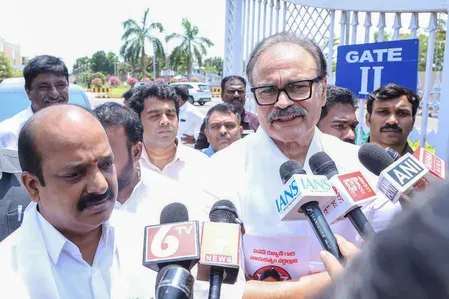
Jana Sena's Rajya Sabha MP Lingamaneni Ramesh has written to Union Health Minister J.P. Nadda demanding two new AIIMS-level hospitals for Andhra Pradesh's most underserved regions — Rayalaseema and North Coastal Andhra — and citing Bihar and J&K as states that already have multiple AIIMS. With a near-five crore population and a single central-belt AIIMS, Andhra Pradesh's healthcare gap is both a political and a public health flashpoint.
Key Takeaways
Jana Sena Rajya Sabha MP Lingamaneni Ramesh has written to Union Health Minister J.P.
Nadda seeking two new AIIMS-level institutions for Andhra Pradesh .
The demand covers one institution each in Rayalaseema and North Coastal Andhra (Uttarandhra) .
Ramesh also sought expansion of AIIMS Mangalagiri — approved in 2015 under PMSSY — with additional super-specialty departments and research centres.
Andhra Pradesh has a population of nearly five crore across three distinct regions, but only one AIIMS, which primarily serves the central coastal belt.
Precedents cited: Jammu & Kashmir has two AIIMS; Bihar has two AIIMS.
Jana Sena Rajya Sabha MP Lingamaneni Ramesh has formally urged the Centre to sanction two new AIIMS-level institutions for Andhra Pradesh, citing acute regional healthcare disparities and the state's near-five crore population spread across three geographically distinct zones. In a letter to Union Health Minister J.P. Nadda, Ramesh called for one institution each in Rayalaseema and North Coastal Andhra (Uttarandhra), alongside a significant expansion of the existing AIIMS Mangalagiri.
What the MP has demanded
Ramesh's letter to Nadda outlines a three-part ask: a new AIIMS-level institution in Rayalaseema, a second in North Coastal Andhra, and the strengthening of AIIMS Mangalagiri through additional super-specialty departments, advanced research centres, and increased institutional capacity. The MP framed the demand around equitable access to world-class medical care for a reorganised state that he argued has been underserved since bifurcation.
The case for regional coverage
AIIMS Mangalagiri, approved in 2015 under the Pradhan Mantri Swasthya Suraksha Yojana (PMSSY), primarily serves the central coastal belt. Patients from Rayalaseema districts must travel several hundred kilometres for advanced treatment, while residents of North Coastal Andhra largely depend on Visakhapatnam or seek care outside the region entirely. Ramesh highlighted that this travel burden has direct consequences in time-critical conditions — cardiac emergencies, stroke, trauma, organ transplantation, oncology, neurosciences, paediatric super-specialty care, and advanced critical care.
The precedent argument
The Rajya Sabha MP pointed to existing multi-AIIMS precedents within single states and union territories. Jammu & Kashmir has both AIIMS Vijaypur (Jammu) and AIIMS Awantipora (Kashmir); Bihar operates AIIMS Patna and AIIMS Darbhanga. Ramesh argued that Andhra Pradesh's comparable geographical spread, population distribution, and post-bifurcation circumstances make a strong case for similar treatment from the Centre.
The bifurcation context
The reorganised state of Andhra Pradesh lost significant institutional infrastructure following the 2014 bifurcation that created Telangana. The Government of India recognised these special circumstances by sanctioning AIIMS Mangalagiri as part of its commitments to the reorganised state. Ramesh's letter argues that healthcare demand has grown manifold over the past decade and that a single premier institution is no longer adequate for a state of this scale and complexity.
What happens next
The letter is a formal representation and does not guarantee a policy decision. Any new AIIMS sanction would require clearance under the PMSSY framework and budgetary allocation from the Centre. With Andhra Pradesh currently under a Telugu Desam Party (TDP)-led coalition that includes Jana Sena, the political momentum behind this demand is likely to intensify ahead of future budget cycles.
Point of View
Not a manufactured grievance. The precedent argument citing Bihar and J&K is hard for the Centre to dismiss without appearing inconsistent. What the letter does not address is the execution record of existing AIIMS expansions, many of which have lagged on faculty recruitment and super-specialty rollout. Sanction is one thing; operationalisation is another — and that distinction will matter most to the patients in Rayalaseema and Uttarandhra who are travelling hundreds of kilometres today.
NationPress
20 Sept 2026
Frequently Asked Questions
What has Jana Sena MP Lingamaneni Ramesh demanded for Andhra Pradesh?
Ramesh has urged Union Health Minister J.P. Nadda to sanction two new AIIMS-level institutions for Andhra Pradesh — one in Rayalaseema and one in North Coastal Andhra — along with the expansion of the existing AIIMS Mangalagiri. He made the request citing regional healthcare disparities and the state's near-five crore population.
Why is one AIIMS considered insufficient for Andhra Pradesh?
AIIMS Mangalagiri, the state's only AIIMS, primarily serves the central coastal region. Patients from Rayalaseema must travel several hundred kilometres for advanced care, while North Coastal Andhra residents rely on Visakhapatnam or travel outside the region. This travel burden is particularly dangerous in emergencies involving cardiac events, stroke, and trauma.
Which states already have more than one AIIMS?
Jammu & Kashmir has AIIMS Vijaypur in Jammu and AIIMS Awantipora in Kashmir. Bihar has AIIMS Patna and AIIMS Darbhanga. Ramesh cited these as precedents supporting Andhra Pradesh's case for multiple AIIMS based on geography and population needs.
What is AIIMS Mangalagiri and when was it established?
AIIMS Mangalagiri is a premier tertiary healthcare and medical education institution in Andhra Pradesh, approved in 2015 under the Pradhan Mantri Swasthya Suraksha Yojana (PMSSY). It was sanctioned as part of the Centre's commitments to the reorganised state following the 2014 bifurcation that created Telangana.
What is the Pradhan Mantri Swasthya Suraksha Yojana (PMSSY)?
PMSSY is a central government scheme aimed at correcting regional imbalances in tertiary healthcare and expanding medical education by establishing new AIIMS and upgrading existing government medical colleges. AIIMS Mangalagiri was sanctioned under this scheme in 2015.