Arunachal CM Calls Women’s Reservation Bill a Milestone for Leadership in Governance
Synopsis
On April 15, Arunachal Pradesh's Chief Minister Pema Khandu praised the Women’s Reservation Bill as a transformative measure for governance. He urged increased female leadership and highlighted various initiatives aimed at empowering women in politics and society.
Key Takeaways
Pema Khandu advocates for women's leadership in governance.
The Nari Shakti Vandan Adhiniyam mandates 33% reservation for women.
Women's representation in Arunachal Pradesh's Assembly is currently very low.
Various schemes support women's empowerment and education.
The Chief Minister envisions a future with a woman Chief Minister.
Itanagar, April 15 (NationPress) Arunachal Pradesh's Chief Minister Pema Khandu emphasized that the involvement of women in policymaking serves as a vital measure of societal progress. He pointed out that many developed countries boast a 40-50 percent representation of women in governance.
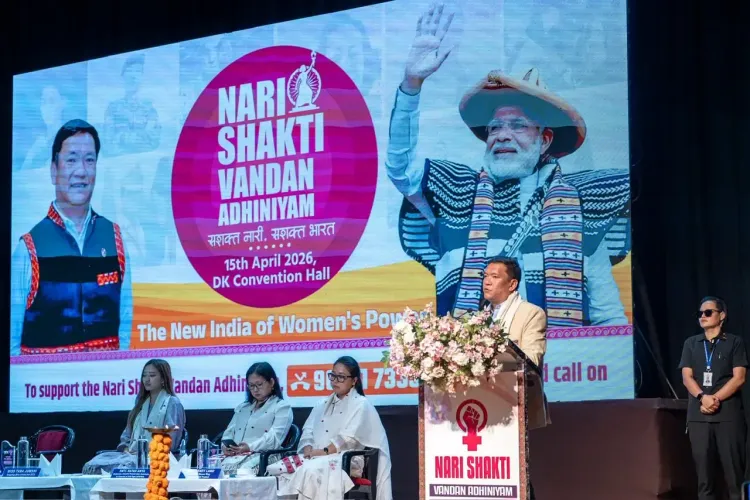
During a special event entitled “Celebrating Strength, Equality and Leadership,” organized to honor women's empowerment and promote awareness about the Nari Shakti Vandan Adhiniyam, Khandu highlighted that India currently sees approximately 13.6 percent female representation in the Lok Sabha and around 9 percent in state Assemblies.
In Arunachal Pradesh, only four women hold positions in the 60-member Assembly, underscoring the pressing necessity to boost women's political involvement. Speaking to an audience of women leaders, students, and dignitaries, he characterized the Nari Shakti Vandan Adhiniyam as a landmark reform that is set to reshape India's political and governance framework.
He noted that the legislation, enacted in 2023 under Prime Minister Narendra Modi's leadership, secures 33 percent reservation for women in both Parliament and state Assemblies. Khandu recalled that the push for women's reservation dates back to 1996, with numerous attempts made before the Bill was successfully passed in 2023 with widespread political backing.
Khandu informed attendees of a special session of Parliament from April 16 to 18, aimed at finalizing the rules and implementation strategies, with the intention of activating the reservation by the 2029 elections. He encouraged women to aspire beyond the 33 percent quota, advocating for active roles in leadership and decision-making.
He highlighted various initiatives for women’s empowerment, including the Dulari Kanya Scheme, which offers Rs 50,000 support for the higher education of girl students, benefiting over 13,800 individuals so far. Additionally, he mentioned the HPV Vaccination Campaign, which provides free vaccines to 14-year-old girls, with 19,000 beneficiaries identified in its initial phase.
Furthermore, Khandu indicated that the Pradhan Mantri Matru Vandana Yojana has assisted over 37,000 beneficiaries, while the PM Poshan Scheme has reached approximately 35,000 individuals. He also noted the success of the Self-Help Group (SHG) movement in the state, where since 2016, more than 1.5 lakh women have actively participated. The government is now looking to bolster cooperative efforts to expand women-led businesses.
Encouraging female entrepreneurship, he pointed out the opportunities available under MSME initiatives, urging women to register and take advantage of financial aid, loans, and skill development programs. He asserted that empowering women at the household level is essential for achieving broader socio-economic transformation.
The Chief Minister commended several outstanding women from Arunachal Pradesh across various fields, including celebrated author Mamang Dai, Indian Army officer Ponung Doming, entrepreneur Tage Rita Takhe, the state’s first woman IPS officer Tenzin Yanki, Padma Shri awardee and mountaineer Anshu Jamsenpa, traditional medicine practitioner and Padma Shri awardee Yanu Jamoh Lego, and academician Jamuna Bini.
He also praised women athletes for their significant contributions to Arunachal Pradesh’s enhanced performance in national sports competitions, noting the state's improved standings. Calling for electoral reforms, Khandu urged political parties to nominate capable women candidates instead of relying on proxy representation.
He emphasized the necessity of enabling women to lead independently and efficiently. Expressing hope for the future, the Chief Minister stated that he envisions a day when Arunachal Pradesh will have a woman Chief Minister, encouraging women to engage actively in public life.
Labeling the Nari Shakti Vandan Adhiniyam as a “game-changer,” Khandu called on women throughout the state to join discussions, overcome obstacles, and assume leadership positions in governance and development.
Lastly, he acknowledged the contributions of the Prime Minister, Members of Parliament, and other stakeholders in passing the legislation, affirming that it will significantly bolster women’s empowerment and accelerate India’s journey towards Viksit Bharat 2047 and Viksit Arunachal 2047.
Point of View
The Chief Minister's remarks reflect a significant shift towards inclusivity in governance, emphasizing the need for women to occupy leadership roles to drive societal progress. The passage of the Women’s Reservation Bill is a crucial step in addressing the gender gap in politics, offering a structured approach to elevate women's voices in decision-making processes.
NationPress
19 Sept 2026
Frequently Asked Questions
What is the Nari Shakti Vandan Adhiniyam?
The Nari Shakti Vandan Adhiniyam is a legislative measure that mandates a 33% reservation for women in Parliament and state Assemblies, aimed at increasing female representation in governance.
Why is women's representation in governance important?
Women's representation is a crucial indicator of development, as it ensures diverse perspectives in policymaking and fosters equitable governance.
What initiatives has the Arunachal Pradesh government implemented for women's empowerment?
The government has launched various initiatives, including the Dulari Kanya Scheme for higher education support, the HPV Vaccination Campaign, and the Pradhan Mantri Matru Vandana Yojana.
How many women currently serve in Arunachal Pradesh's Assembly?
Currently, only four women serve in the 60-member Arunachal Pradesh Assembly, highlighting the need for greater female political participation.
What are the expected outcomes of the Women's Reservation Bill?
The bill aims to operationalize women's reservation by the 2029 elections, promoting greater female leadership and participation in governance.