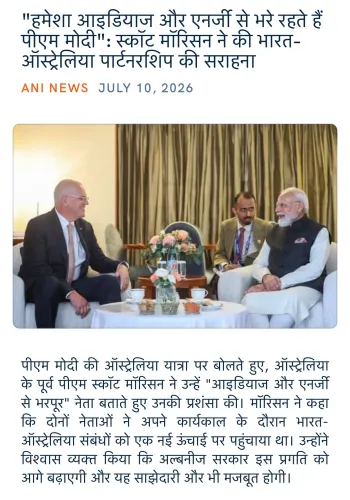
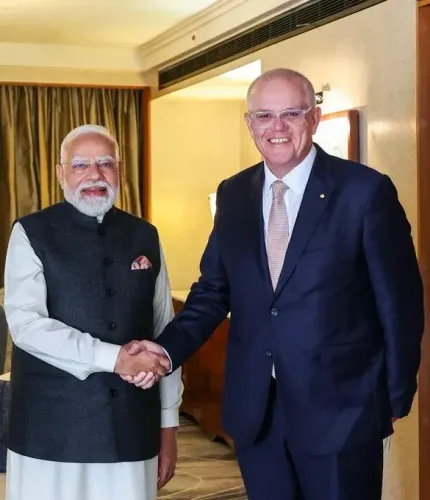
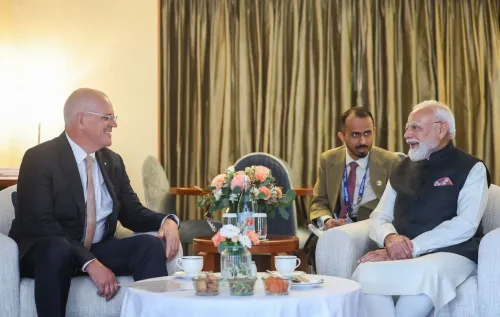
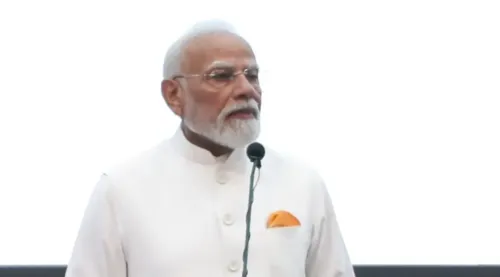
Scott Morrison praises Modi's national-interest foreign policy, backs India's Quad role
Synopsis
Former Australian PM Scott Morrison has offered one of the most direct foreign endorsements of Modi's diplomatic doctrine — calling it unapologetically national-interest-driven and crediting Jaishankar as its chief executor. His insistence that India's Quad engagement is 'critical to its success' signals how central New Delhi has become to Indo-Pacific security architecture, even as a leaders' summit remains elusive.
Key Takeaways
Former Australian PM Scott Morrison praised PM Modi for bringing a 'very strong national-interest focus' to India's foreign policy.
Jaishankar was described as an 'able lieutenant' and 'incredibly industrious' in executing Modi's foreign policy vision.
Morrison called India's continued engagement with the Quad 'critical to its success' and unlike any other regional grouping.
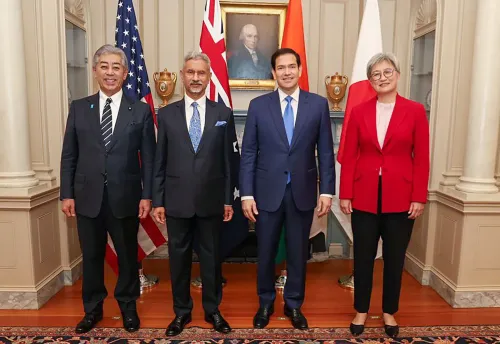
US Secretary of State Marco Rubio reinforced the Quad's security mandate the day after the new US administration was sworn in, according to Morrison.
Morrison predicted India will become a space powerhouse over the next 20 to 30 years as its space economy matures.
He positioned India and Australia as key gateways for European companies seeking to understand the Indo-Pacific .
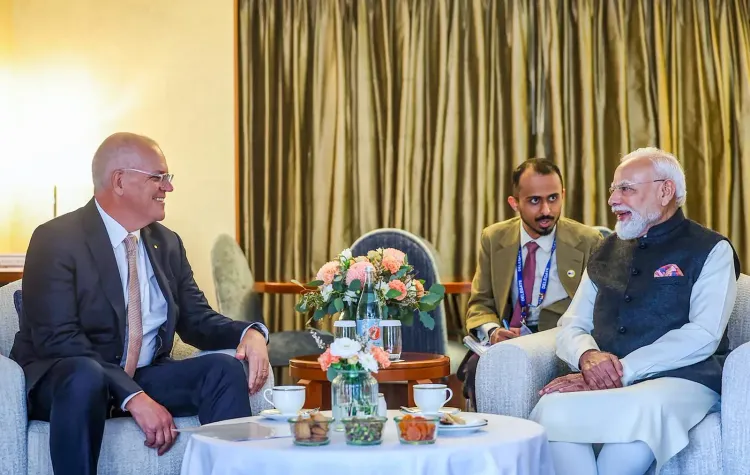
Former Australian Prime Minister Scott Morrison has praised Prime Minister Narendra Modi for bringing a strong national-interest focus and a pragmatic approach to India's foreign policy, adding that External Affairs Minister S. Jaishankar has played an indispensable role in executing that vision. Morrison made the remarks during an interview with Italian-Indian entrepreneur and analyst Vas Shenoy at the Indo-Mediterranean Dialogues, as New Delhi prepares to mark the 80th Independence Day on 15 August.
Morrison on Modi's foreign policy approach
The former Australian leader described India's foreign policy posture as principled but unsentimental — driven by national interest rather than ideological alignment. He credited Modi with a willingness to engage any country or leader when it serves India's strategic goals.
'India continues to honour its independence and its independent settings, but not slavishly, not for its own sake. Its interests drive it into closer engagement with the United States, Australia, Japan, Korea and many other countries. But that is not done to the exclusion of its other relationships. I've found Prime Minister Modi quite unapologetic about the fact that he'll pick up the phone and talk to whoever he wants to,' Morrison said.
He further noted: 'Prime Minister Modi has brought a very strong national-interest focus and a very practical focus to India's foreign policy. Dr Jaishankar has been an able lieutenant in that process and incredibly industrious in following through on that leadership.'
India's role in the Quad
Morrison described India's continued engagement with the Quad as the grouping's defining feature, calling it 'critical to its success.' He stressed that New Delhi's participation is what distinguishes the Quad from other regional security arrangements.
He also welcomed the recent visits of the Indian and Japanese Prime Ministers to Australia, and recalled a personal conversation with Modi during that visit focused on Indo-Pacific developments. 'He remains very alive to those issues,' Morrison said.
Notably, Morrison acknowledged that a Quad leaders' summit has yet to take place, even as foreign ministers have continued to make progress.
Maritime security and the 'Indo' in Indo-Pacific
Morrison called for greater emphasis on the 'Indo' dimension of the Indo-Pacific within the Quad's agenda, arguing that maritime security across the broader region deserves more attention. He pointed to US Secretary of State Marco Rubio and his deputy as strong advocates for the Quad's maritime security role, noting that the security element of the grouping was reinforced 'literally the day after the administration was sworn in.'
'Secretary of State Rubio and his Deputy Secretary are very aware of the significant role of the Quad. They've taken a strong view about it when it comes to maritime security, and not just in the Pacific but the Indo-Pacific,' he said.
India and Australia as gateways for Europe
Emphasising that the Indo-Pacific has become the geopolitical centre of the world, Morrison urged European companies to develop expertise in the region's security and economic dynamics. He positioned India and Australia as natural entry points for European engagement with the Indo-Pacific, alongside Japan and Korea.
'Australia and India are great platforms for Europe to gain that understanding of this part of the world,' he said, adding that the two countries — though 'very different' — together with regional partners offer 'important points of engagement.'
Morrison, who served as Australian Prime Minister from 2018 to 2022, also highlighted India's long-term potential in space, predicting it would become 'a space powerhouse over the next 20 or 30 years as its space economy matures.' As India's 80th Independence Day approaches, his remarks underscore the growing international recognition of New Delhi's strategic weight — and the expectation that it will only grow.
Point of View
Not just a leader. By framing Modi's willingness to engage any country as a strength rather than a liability, he implicitly validates India's much-debated multi-alignment strategy. Yet the absence of a Quad leaders' summit, which Morrison himself acknowledged, points to a structural gap between the grouping's rhetorical momentum and its institutional depth. If India's Quad engagement is truly 'critical to its success,' the question is why the highest-level convening mechanism has stalled — and what that signals about the limits of the partnership.
NationPress
27 Sept 2026
Frequently Asked Questions
What did Scott Morrison say about PM Modi's foreign policy?
Morrison said Modi has brought a 'very strong national-interest focus and a very practical focus' to India's foreign policy, describing him as unapologetic about engaging any country to advance India's interests. He made the remarks at the Indo-Mediterranean Dialogues ahead of India's 80th Independence Day.
What role did Morrison attribute to EAM S. Jaishankar?
Morrison described Jaishankar as an 'able lieutenant' to Modi and praised him as 'incredibly industrious' in following through on the Prime Minister's foreign policy vision. He credited Jaishankar with a key role across areas including economy, technology, and space.
Why does Morrison consider India's Quad engagement so important?
Morrison said India's participation is what makes the Quad 'unique' and called it 'critical to its success,' arguing no other country can replicate New Delhi's strategic weight in the Indo-Pacific. He also advocated for greater emphasis on maritime security across the broader 'Indo' dimension of the Indo-Pacific.
What did Morrison say about the US and the Quad under the current administration?
Morrison noted that US Secretary of State Marco Rubio reinforced the Quad's security mandate literally the day after the new US administration was sworn in. He said Rubio and his deputy are 'very aware' of the Quad's significance, particularly on maritime security.
What is India's predicted role in space, according to Morrison?
Morrison predicted India will become 'a space powerhouse over the next 20 or 30 years' as its space economy matures. He listed space alongside the economy and technology as areas of enormous opportunity for India.