Rajasthan Governor invokes Ambedkar at Jaipur law university convocation
Synopsis
At Bhimrao Ambedkar Law University’s third convocation in Jaipur, Rajasthan Governor Haribhau Bagde invoked Ambedkar’s 1938 declaration that Indians must be ‘Indian first, Indian last’ — framing it as the founding principle for legal education. Over 25,000 degrees were activated via DigiLocker, while Union Minister Meghwal pitched a new lecture series on Ambedkar’s multidimensional legacy.
Key Takeaways
Rajasthan Governor Haribhau Bagde addressed the third convocation of Bhimrao Ambedkar Law University, Jaipur on 27 May 2025 .
He quoted Ambedkar’s 1938 Bombay Legislative Assembly declaration: ‘I want all people to be Indian first, Indian last, and nothing but Indian.’ Union Law Minister Arjun Ram Meghwal described Ambedkar as economist, author, psychologist, and visionary, and proposed a university lecture series on his legacy.
Meghwal contrasted colonial penal laws with the new Bharatiya Nyaya Sanhita , calling it a shift to justice-centric governance.
Governor Bagde digitally activated degrees for more than 25,000 students through DigiLocker .
Deputy CM Prem Chand Bairwa linked legal reform to the Viksit Bharat vision.
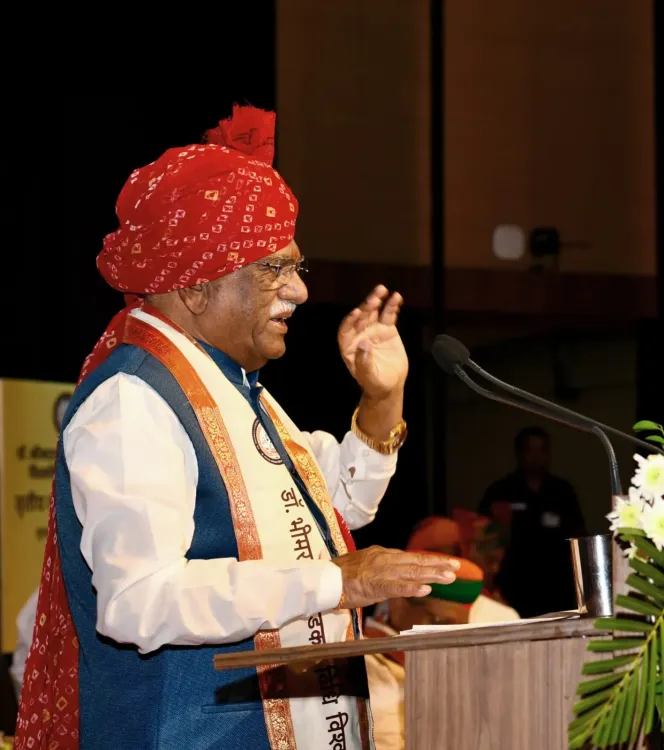
Rajasthan Governor Haribhau Bagde on Wednesday, 27 May called for legal education to transcend caste, class, and community divisions, invoking B.R. Ambedkar's landmark declaration from the 1938 Bombay Legislative Assembly: “I want all people to be Indian first, Indian last, and nothing but Indian.” Speaking at the third convocation ceremony of Bhimrao Ambedkar Law University in Jaipur, the Governor urged the institution to anchor its mission in constitutional values and national unity.
Key Addresses at the Ceremony
Union Minister for Law and Justice Arjun Ram Meghwal and Rajasthan Deputy Chief Minister Prem Chand Bairwa were among the dignitaries present as medals and degrees were conferred upon graduating students. Vice-Chancellor Nishtha Jaswal presented the university’s achievements and formally welcomed the guests.
Governor Bagde drew on the Taittiriya Upanishad to frame the convocation as more than a ceremonial milestone, describing it as a moment where the ancient tradition of a teacher’s final counsel to students finds modern expression. He emphasised truth, righteousness, and intellectual humility as enduring values for legal practitioners.
Ambedkar’s Legacy at the Centre
Recalling Dr. B.R. Ambedkar’s role as Independent India’s first Law Minister, Governor Bagde highlighted his foundational contribution to legislation aimed at social equality and justice for marginalised communities. The Governor also paid tribute to jurist Bachhraj Vyas of Didwana, praising his constitutional scholarship and commitment to justice.
Union Minister Meghwal described Ambedkar as a figure whose intellectual range extended well beyond law — encompassing economics, authorship, psychology, and visionary thought. He proposed that the university establish a dedicated lecture series to explore Ambedkar’s multidimensional legacy for the benefit of younger generations.
New Criminal Laws and Viksit Bharat
Minister Meghwal argued that colonial-era penal statutes were designed primarily to punish Indian citizens, and contrasted them with the new Bharatiya Nyaya Sanhita, which he said pursues justice-centric governance under Prime Minister Narendra Modi’s leadership.
Deputy Chief Minister Bairwa linked legal education and judicial reform to the broader goal of a ‘Viksit Bharat’ (Developed India), calling on graduates to contribute to India’s emergence as a leading global power. He noted that Rajasthan is actively working to deliver globally competitive education.
Digital Degrees and Institutional Milestone
In a notable administrative step, Governor Bagde digitally activated degrees for more than 25,000 graduating students through DigiLocker during the ceremony. The move reflects a wider push to integrate technology into academic credentialing across Indian universities.
With Rajasthan’s legal education community gathered under Ambedkar’s name and legacy, the convocation underscored the continuing relevance of his vision for a unified, justice-driven India — and placed fresh expectations on the next generation of lawyers to carry it forward.
Point of View
But the substantive question is whether the institution’s curriculum and culture actually reflect his vision of social justice — not just his name on the letterhead. The pivot to the Bharatiya Nyaya Sanhita as proof of justice-centric reform is a political framing that deserves scrutiny: critics of the new criminal codes argue that several provisions replicate colonial-era overreach under a different name. The DigiLocker activation of 25,000 degrees is a genuine administrative step forward. What is missing from the ceremony’s discourse is any reckoning with the barriers — economic, social, geographic — that still keep first-generation students from marginalised communities out of legal education altogether.
NationPress
11 Oct 2026
Frequently Asked Questions
What was the occasion for Rajasthan Governor Haribhau Bagde’s speech on Ambedkar?
Governor Bagde spoke at the third convocation ceremony of Bhimrao Ambedkar Law University in Jaipur on 27 May 2025, where medals and degrees were conferred upon graduating students. He invoked Ambedkar’s 1938 declaration to frame the purpose of legal education.
What did Ambedkar say that the Governor quoted?
The Governor quoted Ambedkar’s statement made in the Bombay Legislative Assembly in 1938: ‘I want all people to be Indian first, Indian last, and nothing but Indian.’ He used it to argue that legal education must rise above caste, class, and community divisions.
What did Union Law Minister Arjun Ram Meghwal propose at the convocation?
Minister Meghwal proposed that Bhimrao Ambedkar Law University organise a lecture series exploring Ambedkar’s multidimensional contributions — as economist, author, psychologist, and visionary — so younger generations can understand his broader legacy beyond his role as a legal architect.
How were degrees distributed at the convocation?
Governor Bagde digitally activated the degrees of more than 25,000 graduating students through DigiLocker during the ceremony, reflecting a broader push to integrate technology into academic credentialing in Indian universities.
What did Deputy Chief Minister Prem Chand Bairwa say about legal education?
Deputy CM Bairwa said legal education and judicial reforms are essential for realising the vision of a Viksit Bharat (Developed India). He called on students to help make India a leading global power and noted that Rajasthan is working towards providing globally competitive education.