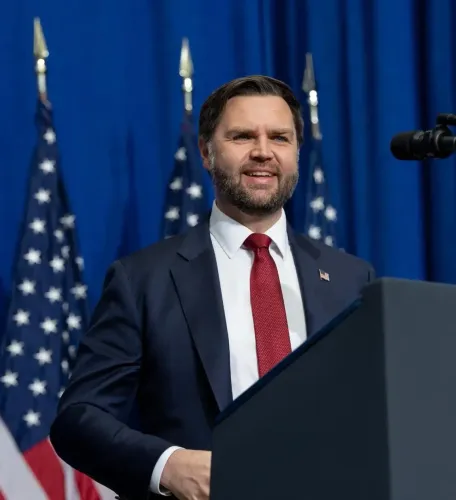
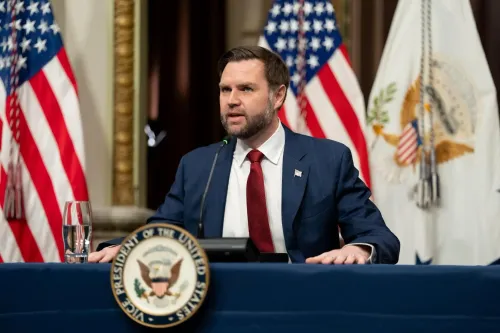
Vice President J D Vance to Lead Iran Negotiations in Islamabad
Synopsis
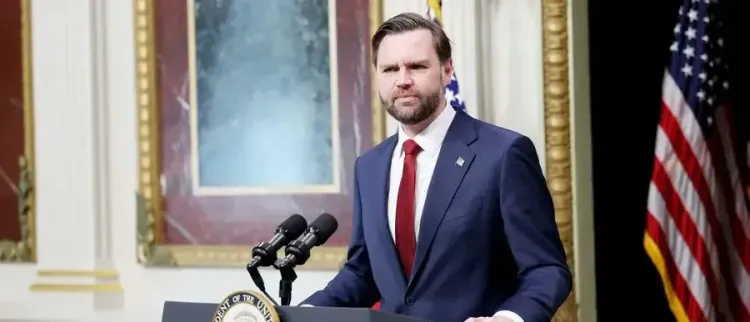
US Vice President J D Vance is set to lead a high-level American team to Islamabad for critical talks with Iran, aiming to establish a fragile ceasefire after recent military escalations. With a focus on Iran's nuclear program, this diplomatic mission could reshape regional dynamics.
Key Takeaways
Vice President J D Vance is leading negotiations in Islamabad this weekend.
The talks aim to solidify a fragile ceasefire with Iran.
Iran's nuclear program will be a central topic of discussion.
Compliance with ceasefire terms is crucial for regional stability.
The US holds significant leverage in these negotiations.
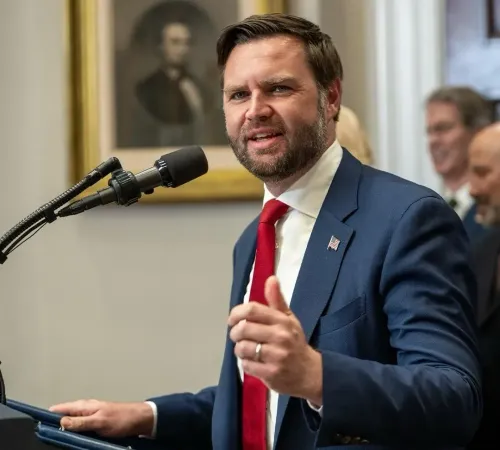
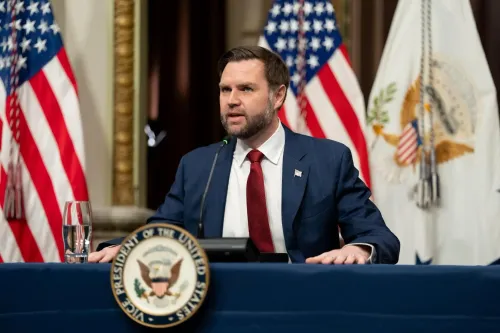
Washington, April 9 (NationPress) - US Vice President J D Vance is returning to the United States from Hungary before heading to Islamabad to spearhead a significant American delegation for discussions with Iran this weekend. This diplomatic mission aims to solidify a delicate ceasefire after weeks of military tensions.
The White House announced on Wednesday that the delegation will also include Special Envoy Steve Witkoff and Jared Kushner, highlighting the administration's intention to follow a structured diplomatic path following what they term a pivotal military phase.
“I am pleased to share that the President is sending his negotiation team, headed by Vice President J D Vance, alongside Special Envoy Witkoff and Mr. Kushner to Islamabad for talks this weekend,” stated White House Press Secretary Karoline Leavitt during a press briefing.
“The initial round of discussions is set for Saturday morning, local time, and we eagerly anticipate these face-to-face meetings,” she added.
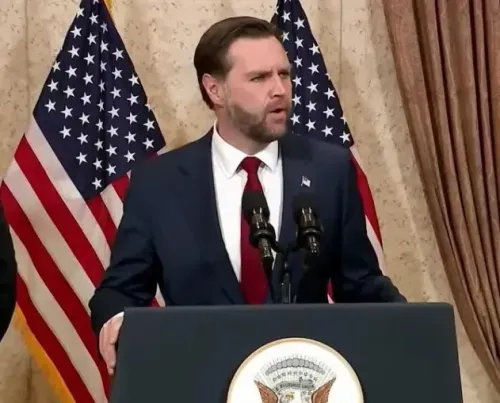
Before departing Hungary, Vance emphasized that the negotiations are already influenced by concurrent diplomatic dialogues involving Pakistan and Iran. “We have a negotiation expected to commence this weekend, and that is a positive first step,” he remarked.
These talks are a follow-up to a two-week ceasefire period announced by President Donald Trump after the military operation dubbed “Operation Epic Fury,” which the administration claims significantly weakened Iran’s military strength.
“This represents a triumph for the United States, achieved through the efforts of the President and our remarkable military,” Leavitt noted.
The White House indicated that military actions compelled Tehran to pursue a ceasefire and agree to reopen the Strait of Hormuz, a vital global oil passage.
“The President’s rigorous pressure and the leverage gained from the successful Operation Epic Fury prompted the Iranian regime to request and ultimately accept a ceasefire proposal,” she explained.
Vance pointed out early indications of compliance, stating, “We genuinely believe we are observing signs that the straits are beginning to reopen.”
He also specified that the ceasefire terms are conditional. “The agreement involves a ceasefire and negotiations. Our commitment is to maintain the ceasefire, while their commitment is to reopen the straits,” he added, cautioning that noncompliance would lead to consequences.
Despite the diplomatic efforts, the administration has warned that the truce remains precarious.
“This is an unstable truce. Ceasefires inherently possess fragility,” Leavitt noted.
On the primary agenda for the Islamabad meetings, Vance asserted that Iran’s nuclear ambitions will be a focal point. “We aim for Iran to abandon nuclear weapon capabilities... we require Iran to relinquish nuclear fuel,” he articulated.
“The President’s firm stance regarding the cessation of Iranian enrichment within Iran has not wavered,” Leavitt reiterated.
Vance also countered media narratives surrounding Iranian proposals, asserting, “There are three distinct ten-point proposals… the first one was immediately dismissed and rejected.”
He emphasized that Washington believes Tehran is now engaging with greater sincerity. “What’s unfolding in Iran indicates that the government’s position is to negotiate with the United States,” he stated.
Simultaneously, he cautioned that the US holds significant leverage. “The President possesses all the necessary leverage here,” Vance concluded.
Point of View
Its fragility raises questions about long-term stability in the region. The focus on Iran's nuclear program remains critical, indicating the complexities involved in these negotiations.
NationPress
12 Oct 2026
Frequently Asked Questions
What is the purpose of J D Vance's visit to Islamabad?
Vice President J D Vance is leading a high-level American delegation to negotiate with Iran and aim to establish a fragile ceasefire following military escalations.
Who else is part of the American delegation?
The delegation includes Special Envoy Steve Witkoff and Jared Kushner, signifying a structured diplomatic approach.
What are the key topics for discussion?
A central focus will be Iran's nuclear program, along with the terms of the ceasefire and reopening of the Strait of Hormuz.
What is the current status of the ceasefire?
The ceasefire is considered fragile, with the administration warning that compliance is essential to maintain stability.
How is the US administration viewing the negotiations?
The US administration believes that Tehran is engaging more seriously in these negotiations, driven by recent military operations.