Trump Appoints VP Vance to Head Iran Negotiations in Pakistan

Synopsis
In a significant diplomatic move, President Trump is sending Vice President J.D. Vance to Pakistan to lead high-stakes negotiations with Iran, following a fragile ceasefire. This could redefine U.S.-Iran relations amid heightened military tensions.
Key Takeaways
Vance is leading U.S. negotiations with Iran in Islamabad.
The talks follow a fragile ceasefire after intense military actions.
The outcome may reshape U.S.-Iran relations .
Key issues include Iran's nuclear program and the Strait of Hormuz.
The U.S. has set clear red lines regarding uranium enrichment.
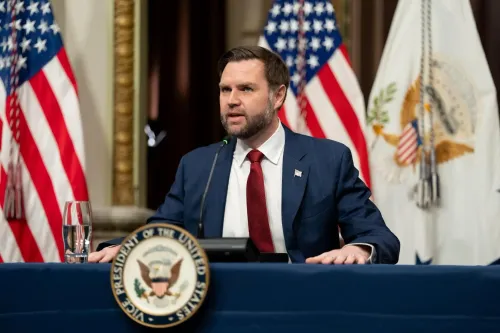
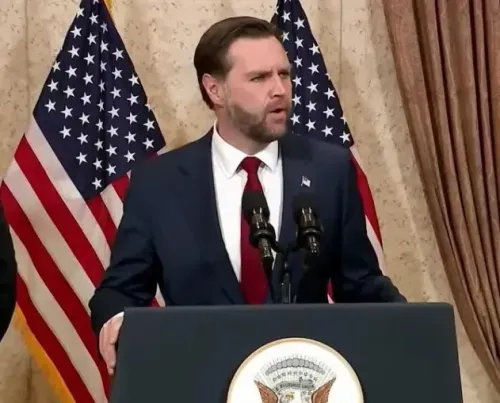
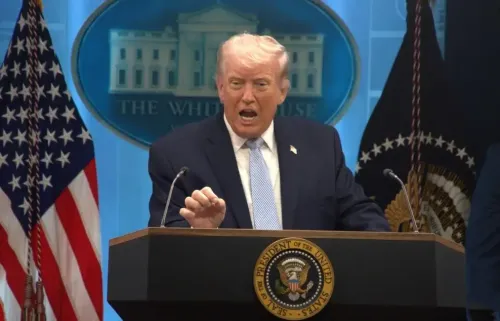
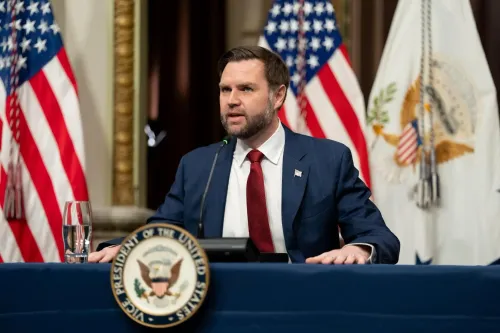
Washington, April 8 (NationPress) President Donald Trump is dispatching Vice President J.D. Vance to Pakistan to spearhead crucial negotiations with Iran, ushering in a new chapter in diplomacy following a tenuous ceasefire achieved after weeks of intense military engagement.
The announcement was made as the White House confirmed that it is sending its premier negotiation team to Islamabad, with the aim of securing a lasting resolution with Tehran.
“I am pleased to announce that the President is sending his negotiation team, led by Vice President J.D. Vance, along with Special Envoy Witkoff and Mr. Kushner, to Islamabad for discussions this weekend,” said White House Press Secretary Karoline Leavitt during a press briefing.
“The initial round of talks is scheduled for Saturday morning, local time, and we anticipate productive in-person discussions,” Leavitt noted in response to queries.
These negotiations come after a two-week ceasefire was declared by President Trump following what the administration characterized as a pivotal military operation against Iran.
Leavitt stated that the talks are a result of the United States achieving its primary objectives during “Operation Epic Fury,” which she termed a swift and decisive military success.
“This represents a significant victory for the United States, made possible by the President and our exceptional military forces,” she declared.
According to the White House, the military operations weakened Iran's defense systems, missile capabilities, and naval assets, thereby creating a favorable environment for diplomatic efforts. The administration indicated that this pressure compelled Tehran to pursue a ceasefire and agree to reopen the critical Strait of Hormuz — a vital route for global oil transit.
“The President’s strategy of maximum pressure, alongside the leverage gained from Operation Epic Fury, prompted the Iranian regime to request and ultimately accept a ceasefire proposal with the United States,” Leavitt emphasized.
However, the ceasefire is conditional. Washington has made it clear that the “safe, free, and immediate reopening” of the Strait of Hormuz is a fundamental requirement, with the administration closely monitoring real-time developments.
Leavitt also warned that the truce remains inherently unstable. “This is a fragile ceasefire. Ceasefires are inherently delicate,” she mentioned, referencing disruptions within Iran's command and control structures following sustained military strikes.
The discussions in Islamabad are anticipated to tackle critical issues, including Iran's nuclear program. The White House reiterated that halting uranium enrichment within Iran is a non-negotiable condition.
“The President’s red lines, specifically the cessation of Iranian enrichment, remain unchanged,” Leavitt affirmed.
She added that Tehran has demonstrated some willingness to engage on sensitive topics, including highly enriched uranium, which raises cautious optimism ahead of the negotiations.
This diplomatic initiative also indicates broader geopolitical collaboration, as the White House confirmed that “conversations have occurred between senior officials of our government and China’s government,” suggesting parallel engagement among major global powers.
Point of View
It's imperative to recognize the gravity of the situation. The U.S. is at a critical juncture in its foreign policy towards Iran, with the potential for significant geopolitical shifts. The approach taken by President Trump and his administration could either pave the way for lasting peace or lead to further conflict.
NationPress
12 Oct 2026
Frequently Asked Questions
What is the purpose of Vice President Vance's visit to Pakistan?
Vice President Vance is leading negotiations with Iran, aiming to secure a long-term diplomatic resolution following a fragile ceasefire.
What was Operation Epic Fury?
Operation Epic Fury was a military campaign launched by the U.S. that aimed to degrade Iran's military capabilities and secure a favorable position for negotiations.
What are the main issues on the agenda for the Islamabad talks?
Key issues include Iran's nuclear program and the reopening of the Strait of Hormuz, which is vital for global oil transit.
Is the ceasefire between the U.S. and Iran stable?
The ceasefire is considered fragile and conditional, with the U.S. closely monitoring developments.
What are the red lines for the U.S. in these negotiations?
The U.S. has made it clear that halting uranium enrichment in Iran is a non-negotiable red line.