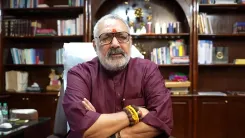
Yogi Adityanath invokes 'Office-Office' serial, vows UP governance overhaul
Synopsis
UP CM Yogi Adityanath didn't just quote a beloved satire — he used 'Office-Office' as a mirror held up to his own administration. At a Mission Karmayogi workshop, he announced that officials' promotions will be tied to citizen outcomes, not just paperwork, and pledged to transform UPAAM into an AI governance hub. The question is whether the accountability framework will outlast the speech.
Key Takeaways
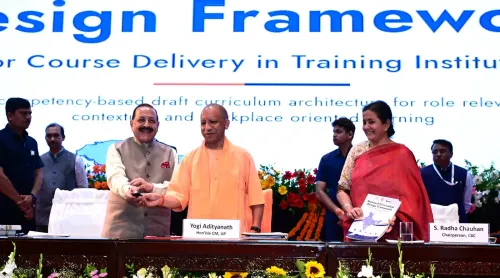
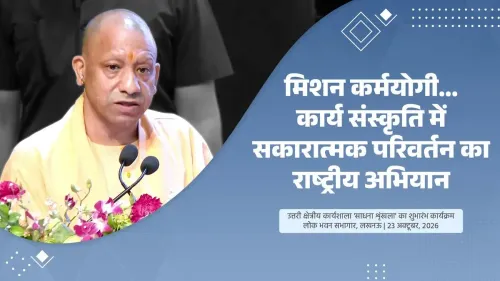
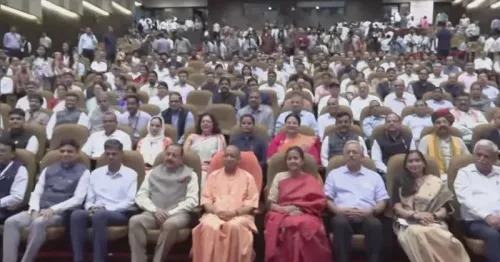
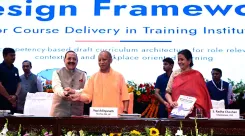
UP CM Yogi Adityanath addressed the Northern Regional Workshop of the Sadhana Series under Mission Karmayogi in Lucknow on 23 October 2026 .
He invoked TV serial 'Office-Office' to highlight how citizens are forced to shuttle between government offices for routine work.
UPAAM will be developed as an AI Centre of Excellence with support from the Capacity Building Commission .
Officials' performance and achievements will be linked to Annual Confidential Reports (ACRs) and promotions .
Capacity-building for panchayat and urban local body personnel and a 'Right Person for the Right Role' framework are the other two key initiatives.
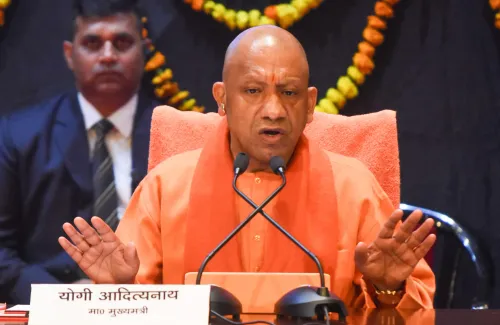
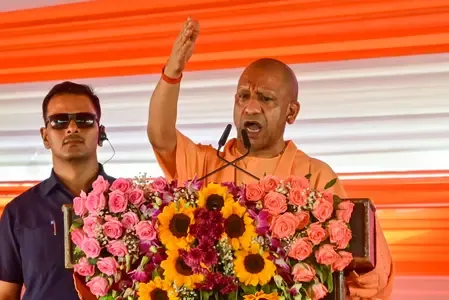
Uttar Pradesh Chief Minister Yogi Adityanath on Friday, 23 October 2026, invoked the iconic television serial 'Office-Office' to condemn the practice of forcing citizens to run from one government department to another, declaring that citizen satisfaction — not certificates or promotions — is the true measure of a public servant's worth. He was speaking at the Northern Regional Workshop of the 'Sadhana Series' under Mission Karmayogi in Lucknow.
Three Major Initiatives Announced
Chief Minister Adityanath unveiled three key initiatives at the workshop. First, the Dr. Ram Manohar Lohia Uttar Pradesh Academy of Administration and Management (UPAAM) will be developed as an AI Centre of Excellence. Second, the capacity of personnel working in panchayats and urban local bodies will be significantly enhanced. Third, the principle of 'Right Person for the Right Role' will be implemented across the state's administrative machinery to ensure competence-based postings.
What Adityanath Said on Governance Failures
Drawing on the popular satirical TV show that lampoons bureaucratic red tape, the Chief Minister said: 'Citizens being forced to run from one office to another for routine work reflects poorly on the entire governance system.' He pointed out that even today, many elderly citizens are compelled to make repeated visits to government offices simply to collect their pensions — a failure, he said, that cannot be justified.
Adityanath was blunt about systemic negligence: 'An incompetent person occupying a responsible position is dangerous, and so is a negligent person continuing in such a role... While employees are often conscious of their rights and promotions, they may not always show the same seriousness toward their responsibilities,' he said.
Performance Linked to ACRs and Promotions
In a structural shift aimed at accountability, the Chief Minister announced that efforts will be made to link officials' and employees' performance, achievements, and success stories with their Annual Confidential Reports (ACRs) and promotions. He urged the Capacity Building Commission to work with UPAAM on building this framework so that responsibilities are assigned according to demonstrated competence.
He underscored that the purpose of training is not to gather certificates but to deliver timely resolution of citizens' problems, simplified procedures, and improved public services. 'If an elderly person, youth, woman, farmer, or anyone in need has to return disappointed without timely resolution, the purpose of public service is defeated,' he added.
AI and Technology in Governance
Adityanath acknowledged that artificial intelligence, data analytics, and digital technologies are rapidly transforming governance, and that public servants must be equipped to adapt. However, he drew a clear distinction: 'Technology can accelerate governance, simplify procedures, and improve decision-making, but only a spirit of service can make administration truly sensitive to citizens' needs.'
He also stressed that gram panchayats, nagar panchayats, municipal councils, and municipal corporations must become stronger, more accountable, and citizen-centric if the goals of a developed and self-reliant India are to be met. With the workshop setting a reform agenda, the focus now shifts to whether these commitments translate into measurable changes on the ground.
Point of View
But the challenge is institutional. Linking ACRs and promotions to citizen satisfaction sounds transformative — yet similar accountability frameworks announced in other states have struggled with measurement integrity and union resistance. The announcement of an AI Centre of Excellence at UPAAM is noteworthy but vague; without a clear roadmap, it risks becoming another aspirational label. The deeper contradiction is this: the very bureaucratic culture Adityanath is critiquing will be responsible for implementing the reforms he is proposing.
NationPress
23 Oct 2026
Frequently Asked Questions
What did UP CM Yogi Adityanath say about the 'Office-Office' TV serial?
CM Adityanath used the popular satirical serial as a metaphor for bureaucratic inefficiency, saying that citizens being forced to run from one office to another for routine work reflects poorly on the entire governance system. He made the remarks at the Mission Karmayogi workshop in Lucknow on 23 October 2026.
What is Mission Karmayogi and why was the workshop held?
Mission Karmayogi is a national capacity-building programme for civil servants aimed at shifting from rule-based to role-based governance. The Northern Regional Workshop of its 'Sadhana Series' was held in Lucknow to review and advance training initiatives across Uttar Pradesh.
What are the three initiatives announced by CM Adityanath at the workshop?
The three initiatives are: developing UPAAM as an AI Centre of Excellence, enhancing capacity of panchayat and urban local body personnel, and implementing the 'Right Person for the Right Role' principle with performance linked to ACRs and promotions.
How will officials' promotions change under the new framework?
CM Adityanath announced that efforts will be made to link officials' and employees' performance, achievements, and success stories directly to their Annual Confidential Reports (ACRs) and promotions, ensuring that accountability to citizens — not just administrative compliance — is rewarded.
What role will AI play in Uttar Pradesh's governance reforms?
UPAAM is to be developed as an AI Centre of Excellence, with the Capacity Building Commission's support, to equip public servants with skills in artificial intelligence, data analytics, and digital technologies. Adityanath cautioned, however, that technology alone cannot substitute a genuine spirit of public service.