Hormuz reopening: 80 mn barrels on 40 VLCCs ready to flow as US-Iran deal holds
Synopsis
Around 80 million barrels of crude — loaded on 40 VLCCs and backed by Iranian and smaller tankers — are sitting in the Persian Gulf waiting for the Hormuz corridor to fully reopen. The US-Iran deal has already knocked crude to $75 a barrel, but Iran's new 48-hour permit regime and lingering security concerns mean the flow is not yet frictionless.
Key Takeaways
Nearly 80 million barrels of crude on approximately 40 VLCCs are stationed in the Persian Gulf , awaiting Hormuz transit, according to Vortexa data.
Before the US-Iran conflict, around 15 million barrels per day of Gulf crude transited the Strait to Asian buyers.
Roughly 21 VLCCs are signalling Asian destinations, including five bound for China and five heading to Malaysia-Singapore transfer hubs .
Three Saudi supertankers reappeared in the Gulf of Oman this week, signalling early resumption of traffic.
Iran has introduced a mandatory 48-hour advance registration and permit requirement for all vessels transiting the Strait.
Crude prices have fallen to around $75 a barrel following the tentative US-Iran peace deal .
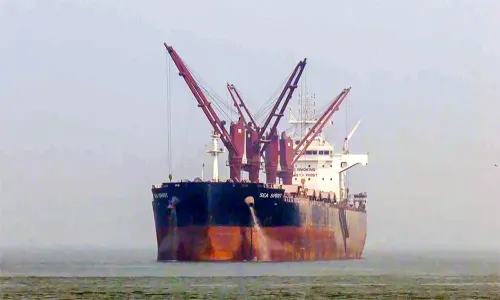
Nearly 80 million barrels of crude oil are poised to transit the Strait of Hormuz as a tentative US-Iran peace agreement raises hopes of a sustained reopening of the world's most critical energy shipping corridor. According to data compiled by Vortexa and cited in multiple reports, approximately 40 very large crude carriers (VLCCs) loaded with non-sanctioned Gulf crude are currently stationed inside the Persian Gulf, with Iranian oil and smaller tankers adding further volume to the supply queue.
Scale of Waiting Supply
The 40 VLCCs represent only part of the picture. Iranian crude and smaller tankers also positioned within the Gulf mean the true volume of supply awaiting transit is considerably higher than the headline 80 million barrels, according to Vortexa data. Prior to disruptions triggered by the US-Iran conflict, approximately 15 million barrels per day of Gulf crude routinely transited the Strait to Asian buyers — underlining the scale of what has been held back.
Ships Already Moving Toward Asia
Roughly 21 VLCCs are reportedly signalling destinations toward Asia. Of these, five are bound for China, five are heading toward ship-to-ship transfer hubs near Malaysia and Singapore, and at least three vessels were observed approaching the Strait at normal speeds, according to the same data. Separately, three Saudi supertankers reappeared in the Gulf of Oman earlier this week, widely read as a signal that traffic is resuming. Shipping groups, however, have cautioned that security risks along the route remain a concern.
Iran's New Transit Rules
Even as the waterway reopens, Iran has introduced revised regulations governing vessels transiting the Strait of Hormuz. Under the new procedures, ship owners and operators must submit transit requests at least 48 hours before arriving at the Strait. Vessels are required to register in advance and obtain permits and insurance before entering the corridor. Iran has stipulated that all required information must be provided ahead of time to avoid delays at entry and exit points — adding a layer of administrative friction to what was previously an open passage.
Market and Inflation Impact
The tentative peace deal has already moved markets. Crude prices fell sharply to around $75 a barrel following the agreement, according to reports. Analysts expect the renewed flow of Gulf crude to ease global supply tightness and put downward pressure on inflation in the months ahead. This comes amid broader global concern over energy price-driven inflation, making the Hormuz reopening a development with consequences well beyond the Gulf region.
What Happens Next
The durability of the US-Iran agreement will be the decisive variable. Shipping industry groups have stopped short of declaring the corridor fully safe, and Iran's new permit regime introduces uncertainty for operators accustomed to freer passage. If the deal holds and transit normalises, Asian refiners — particularly in China, India, and South Korea — stand to benefit from a surge in available Gulf crude. Any breakdown, however, could rapidly reverse the price decline and reignite supply anxiety.
Point of View
But Iran's new permit regime deserves scrutiny: a 48-hour advance registration requirement on one of the world's busiest chokepoints is not a neutral administrative step. It hands Tehran a lever to slow or selectively approve traffic without formally closing the Strait. Markets have priced in the deal; they may not yet have priced in the friction.
NationPress
19 Sept 2026
Frequently Asked Questions
How much crude oil is waiting to transit the Strait of Hormuz?
Nearly 80 million barrels of crude, loaded on approximately 40 very large crude carriers (VLCCs), are currently stationed in the Persian Gulf awaiting transit through the Strait of Hormuz. Iranian oil and smaller tankers add further volume beyond this figure, according to Vortexa data.
What is the US-Iran deal and how does it affect the Strait of Hormuz?
The US and Iran have signed a peace agreement that has led to a tentative reopening of the Strait of Hormuz, the world's most critical energy shipping corridor. The deal has already pushed crude prices down to around $75 a barrel, with analysts expecting further relief on global inflation if the agreement holds.
What are Iran's new rules for ships transiting the Strait of Hormuz?
Iran now requires vessels to submit transit requests at least 48 hours before arriving at the Strait, obtain permits and insurance in advance, and provide all required information to avoid delays. These regulations apply despite the recent reopening of the waterway under the US-Iran agreement.
Which countries will benefit most from Hormuz reopening?
Asian importers — particularly China, India, and South Korea — stand to benefit most, as Gulf crude primarily flows to Asian refiners. Five VLCCs are already signalling China as their destination, with others heading to ship-to-ship transfer hubs near Malaysia and Singapore.
Are there still security risks at the Strait of Hormuz?
Yes. Shipping groups have cautioned that security risks remain even after the tentative US-Iran peace deal. The durability of the agreement is uncertain, and Iran's new permit and registration requirements add administrative complexity for operators transiting the corridor.