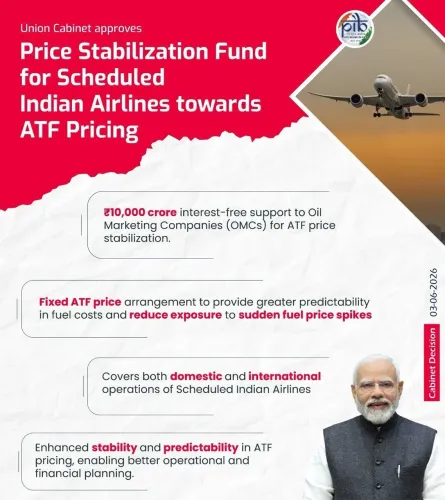
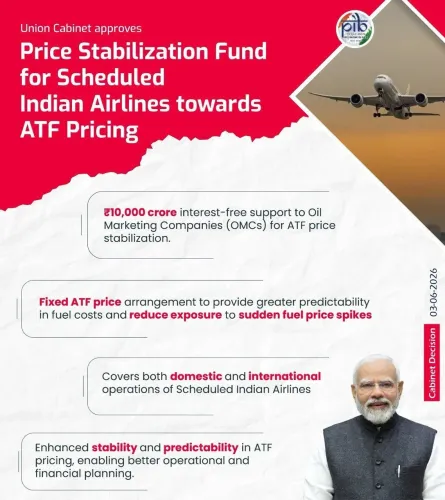
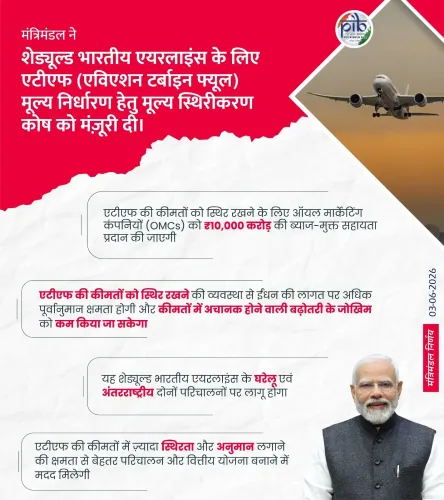
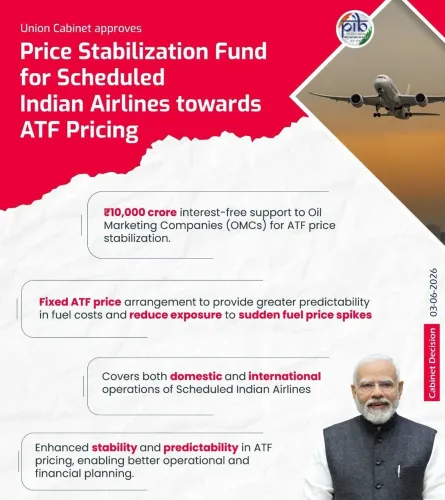
ATF price crisis: Aviation Minister in talks with airlines, OMCs over West Asia impact

Synopsis
With IndiGo already raising its fuel surcharge, Aviation Minister Ram Mohan Naidu has confirmed that the Centre is in active talks with airlines and state-run oil firms over surging ATF prices driven by the West Asia crisis. The outcome could determine whether Indian air travellers face higher fares — and how fast India accelerates its sustainable aviation fuel mandate.
Key Takeaways
Aviation Minister Ram Mohan Naidu confirmed on 6 October 2026 that the government is in discussions with airlines and OMCs over rising ATF prices .
The West Asia crisis has been cited as a key driver of the fuel cost surge, prompting IndiGo to raise its fuel surcharge.
The Civil Aviation Ministry will hold a formal stakeholder meeting before announcing any decision.
India has mandated 1% SAF on international flights by 2027 , scaling to 5% by 2030 ; talks are underway with IOCL , BPCL , and HPCL on production.
ATF accounts for an estimated 35–40% of airline operating costs in India, making any sustained price spike a direct threat to airfare stability.
Union Civil Aviation Minister Ram Mohan Naidu on Tuesday, 6 October 2026, confirmed that the government is in active discussions with airlines and oil marketing companies (OMCs) to address the surge in aviation turbine fuel (ATF) prices, a spike partly driven by the ongoing West Asia crisis. The development follows IndiGo's decision to raise its fuel surcharge, signalling growing financial strain across the sector.
What the Minister Said
'One of the most important things is the West Asia crisis and how it's putting a big burden on ATF prices. But we are still in discussion both with the airlines and also the OMCs. Let us see how the discussion unfolds,' Naidu told reporters on the sidelines of the IFQM Symposium 2026 conference in New Delhi.
The minister added that the Civil Aviation Ministry would consult all stakeholders before arriving at a formal position. 'The ministry is going to have a meeting with the stakeholders. And once we understand the point of view from all the stakeholders, then we will take a decision,' he said.
OMC Talks and Sustainable Aviation Fuel Push
The government is also engaged with state-run refiners — Indian Oil Corporation Ltd (IOCL), Bharat Petroleum Corporation Ltd (BPCL), and Hindustan Petroleum Corp (HPCL) — on producing sustainable aviation fuel (SAF) in line with global standards. India has mandated that 1 per cent of fuel used on international flights must come from SAF by 2027, rising to 2 per cent by 2028 and 5 per cent by 2030.
India's Long-Term Aviation Ambitions
Speaking at the conference, Naidu outlined a broader vision for the sector, centred on developing multiple airport hubs and a hub-and-spoke model that would connect passengers from smaller cities to long-haul international routes through domestic gateways. The plan is part of India's stated goal of becoming a global aviation hub.
On aircraft manufacturing, the minister said India views engine production as a critical capability and is pursuing a phased approach — beginning with maintenance, repair and overhaul (MRO) activities and component manufacturing. He noted progress in indigenous helicopter engine development and indicated that know-how from the defence sector could eventually support civil aviation manufacturing goals.
Why ATF Prices Matter
ATF typically accounts for 35–40 per cent of an airline's operating costs in India, making it the single largest cost driver. Any sustained spike — compounded by a geopolitical shock such as the West Asia crisis — rapidly narrows airline margins and can translate into higher ticket prices for passengers. IndiGo's fuel surcharge hike is an early signal that carriers are already passing on a portion of the burden.
What Happens Next
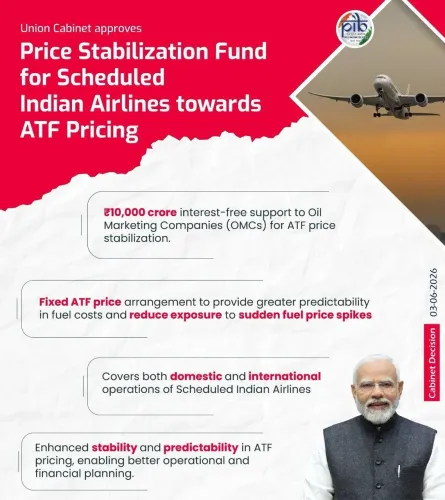
A formal stakeholder meeting is expected to be convened by the Civil Aviation Ministry, after which a policy response will be announced. Industry observers will watch closely whether the government opts for a temporary ATF duty reduction, a price-smoothing mechanism with OMCs, or a combination of both. The outcome will have direct implications for airfare trends in the coming months.
Point of View
Threatening the passenger growth story that underpins India's airport expansion ambitions. The real test is whether the Centre will intervene structurally — through an excise cut on ATF or a price-buffer arrangement with OMCs — or settle for a stakeholder meeting that produces no binding outcome. Given that ATF is not yet under GST, state-level taxes compound the problem and any Union-level measure alone may be insufficient. The timing is notable: India is simultaneously pushing a sustainable aviation fuel mandate, which by design costs more than conventional ATF. Squaring the short-term affordability crisis with the long-term green-fuel push will require more than consultations.
NationPress
6 Oct 2026
Frequently Asked Questions
Why are ATF prices rising in India?
Aviation turbine fuel prices have surged partly due to the ongoing West Asia crisis, which has disrupted global crude supply and pushed up oil prices. Since ATF is derived from crude, any geopolitical shock in major oil-producing regions rapidly transmits to jet fuel costs in India.
What has IndiGo done in response to higher ATF costs?
IndiGo has increased its fuel surcharge, effectively passing a portion of the higher ATF costs on to passengers. This move prompted the government to enter talks with airlines and oil marketing companies to find a broader solution.
What action is the government considering on ATF prices?
Civil Aviation Minister Ram Mohan Naidu has said the ministry will convene a formal stakeholder meeting — including airlines and OMCs — before announcing any decision. Potential measures under discussion could include pricing arrangements with state-run refiners or fiscal relief on ATF duties.
Which OMCs is the government talking to, and about what?
The government is in talks with Indian Oil Corporation Ltd (IOCL), Bharat Petroleum Corporation Ltd (BPCL), and Hindustan Petroleum Corp (HPCL) — both on managing current ATF costs and on producing sustainable aviation fuel (SAF) to meet India's green fuel mandates.
What is India's sustainable aviation fuel mandate?
India has mandated that 1 per cent of fuel on international flights must come from SAF by 2027, rising to 2 per cent by 2028 and 5 per cent by 2030. State-run refiners are being engaged to develop domestic SAF production capacity in line with global standards.